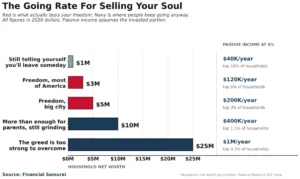
The concept of Financial Independence, Retire Early (FIRE) has transitioned from a fringe movement into a significant economic consideration for high-earning professionals. While conventional wisdom suggests that wealth accumulation makes retirement progressively easier, recent analysis of career trajectories and economic data indicates that the "golden handcuffs" of corporate life often tighten with age, making the transition to independence more difficult at 50 than at 35.
The Dynamics of Early Departure
In 2012, a significant shift in career management occurred when individuals began strategically engineering layoffs to facilitate early retirement. The phenomenon is rooted in the "runway" theory: at 35, a professional typically possesses fewer financial liabilities, such as tuition for dependents or complex eldercare costs. By the age of 35, an individual has spent approximately 13 to 17 years in the workforce, creating a window where savings rates of 50% or higher are more feasible due to a lower cost of living and a lack of generational obligations.
Data from the Bureau of Labor Statistics and various career transition studies suggest that the professional recovery period for a 35-year-old is significantly shorter than for a 50-year-old. At 35, the job market often views a candidate as having high growth potential and relevant, current skill sets. By 50, however, the landscape changes. Ageism in hiring, the compression of middle-management roles due to artificial intelligence, and a narrowing of specialized high-salary positions create a "one-way door" scenario. For the 50-year-old, the decision to retire is often permanent, whereas at 35, the decision remains reversible.
The Escalation of Golden Handcuffs
The primary barrier to retiring at 50 is the exponential growth of compensation packages. A Managing Director in investment banking, for example, might command a base salary of $500,000 with discretionary bonuses reaching $2 million. Walking away from such compensation requires a psychological and financial detachment that most individuals cannot achieve.
Lifestyle inflation acts as a secondary, yet equally potent, constraint. As income increases, the standard of living often expands to include private school tuition, residential real estate upgrades, and personal services. These recurring expenses create a high "burn rate" that necessitates continued employment. Consequently, the individual is no longer working for growth, but for the maintenance of a high-cost lifestyle. This phenomenon effectively traps the high-earner in their role, as the perceived risk of losing that lifestyle becomes greater than the desire for personal time.
Comparative Risk Assessment: 35 vs. 50
Financial planning experts note that the risk profile of retirement changes drastically over a 15-year span. At 35, the primary risk is "opportunity cost"—the potential loss of future earnings. At 50, the risk shifts to "sustainability"—the inability to return to the workforce if investment portfolios underperform or if unforeseen liabilities, such as medical emergencies for aging parents, emerge.
| Metric | FIRE at 35 | FIRE at 50 |
|---|---|---|
| Average Compensation | $150,000 | $350,000+ |
| Typical Dependents | None to Minimal | Children, Spouse, Parents |
| Re-employment Probability | High (within 12 months) | Low (often at reduced pay) |
| Lifestyle Overhead | Low/Adjustable | High/Fixed |
| Economic Vulnerability | Short-term | Long-term/Structural |
The Impact of Macroeconomic Factors
The current macroeconomic environment, characterized by higher inflation and the rapid integration of artificial intelligence (AI) into the workplace, has altered the risk-reward ratio for older workers. AI is currently disrupting sectors that were previously considered "safe" havens for experienced knowledge workers. As firms automate tasks previously handled by senior analysts or middle managers, the demand for high-cost, older talent is diminishing.

For those at 50, this means that if an attempt at early retirement fails, returning to a previous salary level is statistically unlikely. This creates a "burn the boats" reality: once the career is terminated, the individual must rely entirely on capital gains, dividends, and interest. The margin for error is significantly thinner than it is for a 35-year-old, who can leverage their remaining decades to pivot into new industries or regain their prior earnings trajectory.
The Role of Severance Negotiation
A key strategy utilized by those navigating the exit from high-stress, high-pay environments is the negotiation of a severance package. Rather than resigning, which forfeits unemployment benefits and potential severance pay, professionals are increasingly utilizing the "engineered layoff" approach. This involves documenting performance, identifying organizational redundancies, and presenting a case for a mutual separation.
Legal and HR experts observe that companies are often willing to offer substantial severance packages to long-tenured employees in exchange for a release of claims and a smooth transition. This capital serves as a critical buffer, providing the "runway" necessary to bridge the gap between active employment and the activation of retirement accounts or investment income.
Generational Wealth and Societal Implications
A point of contention among financial planners is the impact of early retirement on multi-generational wealth. Critics argue that retiring at 35 or 40 to prioritize individual freedom may come at the expense of providing financial security for the next generation, particularly given the rising costs of higher education.
Conversely, proponents of the movement suggest that the time saved by retiring early allows for more active involvement in child-rearing and family life, which they define as a form of non-monetary "generational wealth." The conflict between the traditional directive to "grind" until age 65 to ensure maximum inheritance and the desire for autonomy remains a central debate within the FIRE community.
Conclusion and Strategic Outlook
The consensus among analysts is that the "optimal" time to pursue financial independence is when the fear of leaving is present but manageable. Waiting for a state of absolute financial certainty often results in the "golden handcuffs" becoming permanent.
For the professional at 35, the path to FIRE is a matter of calculated risk and aggressive savings. For the professional at 50, the path requires a rigid assessment of fixed liabilities and a realistic view of the current labor market. Ultimately, the decision to exit the workforce is not merely a financial calculation; it is a fundamental choice between the pursuit of maximal capital accumulation and the preservation of time—the one asset that, unlike income, cannot be replenished. As market conditions evolve, those considering an early departure must prioritize the creation of a flexible, resilient financial structure that accounts for the diminished re-entry prospects inherent in the modern, automated economy.