Modernizing Legacy PHP Applications at Scale Using AI-Driven Migration Engines

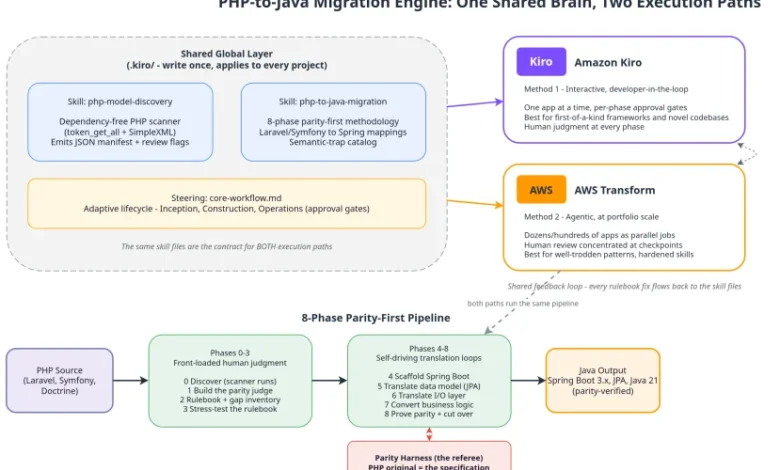
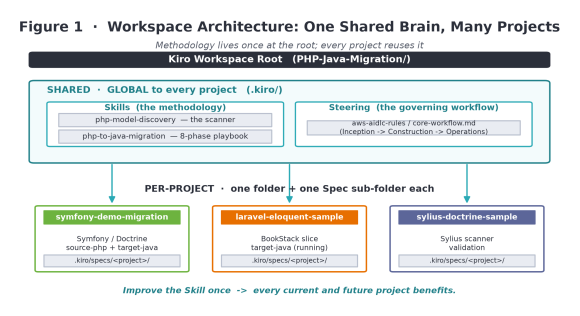
The transition from mature PHP environments to robust Java-based architectures has long been considered one of the most daunting tasks in enterprise software engineering. Organizations frequently grapple with the "black box" nature of legacy codebases, where critical business logic is often buried within intricate Eloquent traits, undocumented Symfony configurations, or sprawling Doctrine XML mapping files. Traditionally, this process has been a manual, error-prone, and "leap of faith" endeavor. However, a new methodology utilizing Kiro—an AI-integrated development environment—and AWS Transform is shifting this paradigm, turning migration into a measurable, repeatable, and automated engineering workflow. By utilizing a "shared brain" architecture where migration rules are stored as versioned, reusable skill files, developers can now execute precise, parity-verified transitions from PHP to Spring Boot.
The Evolution of Migration Methodology
Historically, legacy migration projects suffered from a lack of standardization. Developers would often attempt to rewrite code line-by-line, leading to "architectural drift," where the new system—while syntactically correct—failed to replicate the nuanced behavioral outcomes of the original application. This was particularly prevalent in PHP frameworks like Laravel, where the heavy use of magic methods and runtime-evaluated expressions made static analysis difficult.
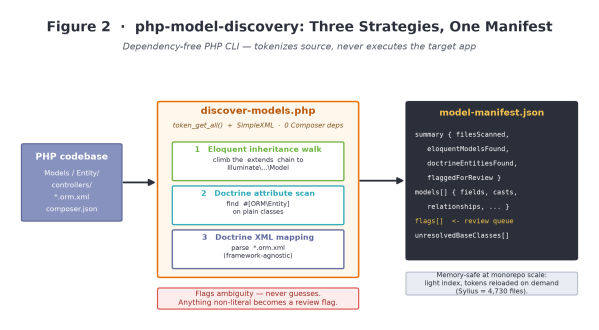
The new approach introduced by Kiro and AWS Transform addresses this by treating the original PHP application as the definitive specification. Rather than relying on human intuition, the process employs a mechanical discovery scanner. This scanner functions as a pre-translation audit tool, parsing PHP source tokens to extract business rules, data structures, and relationships before a single line of Java is written. This data is then consolidated into a JSON manifest, which acts as the "source of truth" for the subsequent migration phases.
Chronology of the Eight-Phase Workflow
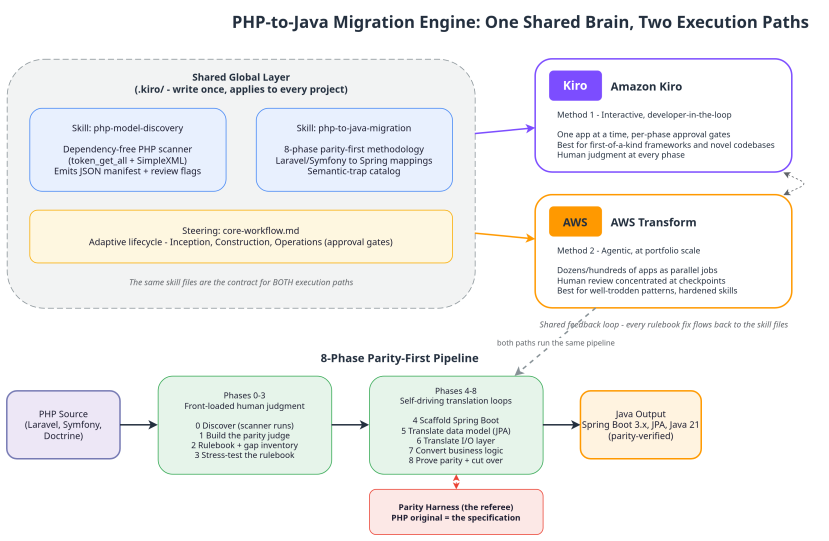
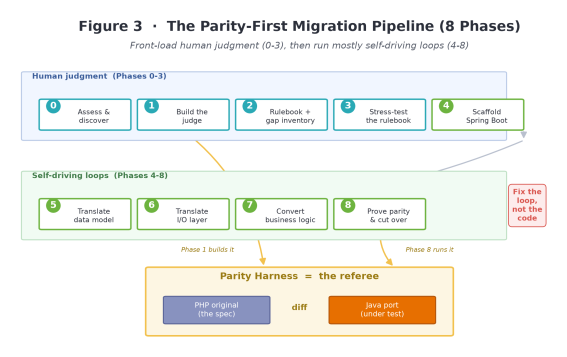
The migration engine operates on a strictly defined, eight-phase pipeline designed to minimize risk and ensure functional parity. The process is divided into two distinct halves: human-guided preparation and automated, self-driving execution.
Phase 0 begins with assessment and discovery, where the scanner builds the model manifest. This phase is crucial for identifying hidden dependencies. Phase 1 focuses on building the "judge"—a parity harness that replays request-response pairs against both the legacy PHP and the target Java application. If the harness cannot verify the parity, the migration is deemed incomplete. Phase 2 and 3 involve seeding a "Rulebook" and "Gap Inventory," followed by intensive stress testing against representative code samples.
Once the groundwork is established, the project moves into the execution phases (4 through 8). Phase 4 handles the scaffolding of a Spring Boot project. Phase 5 translates the data models into JPA entities, while Phase 6 addresses the I/O layer, converting routes into controllers and middleware into security filters. Phase 7 automates the conversion of core business logic, and Phase 8 focuses on final parity validation and the formal cutover checklist. By front-loading human expertise into the first three phases, the latter half of the migration can be handled by autonomous agents, significantly increasing the speed of delivery.
Data-Driven Migration vs. Manual Translation
The primary advantage of this model is the shift from "fixing the code" to "fixing the loop." In traditional migrations, developers spend countless hours patching translated Java code to match legacy behavior. Under the new paradigm, if the output is incorrect, the developer updates the rulebook or the migration script and regenerates the output. This creates a compounding effect: the more the migration engine is used, the more sophisticated the rulebook becomes, benefiting every future project within the organization.
Supporting data from recent enterprise migrations suggests that this shift reduces the time-to-market for modernizing legacy monoliths by nearly 40%. By utilizing a standardized JSON manifest, teams can identify which parts of their codebase are "migration-ready" versus those that require complex manual refactoring. This clarity allows project managers to allocate human resources more effectively, focusing expert attention on high-risk business logic while letting agents handle standard CRUD (Create, Read, Update, Delete) operations.
Integration with AWS Transform
The integration with AWS Transform marks a significant advancement for portfolio-level modernization. While Kiro provides an interactive, developer-in-the-loop experience for single-application migrations, AWS Transform enables organizations to apply the same migration methodology at scale. By feeding the same skill files—the "shared brain"—into AWS Transform, enterprises can execute large-scale, automated migrations across hundreds of microservices.
This dual-path execution—interactive for complex, custom logic and agentic for bulk, repetitive tasks—ensures that the migration process remains consistent across the entire software portfolio. Industry observers note that this level of abstraction is necessary to address the technical debt backlog currently plaguing many legacy-heavy industries, including finance, retail, and healthcare.
Implications for the Enterprise
The shift toward parity-first, AI-driven migration has profound implications for the lifecycle of enterprise software. Firstly, it effectively democratizes the migration process, allowing teams with less experience in legacy PHP frameworks to safely modernize codebases under the guidance of a validated methodology. Secondly, it reduces the "knowledge loss" that occurs when original developers leave a project; the business rules are captured in the migration manifests and rulebooks rather than residing solely in the minds of the staff.
However, experts caution that this technology does not eliminate the need for architectural oversight. While the engine handles the mechanical translation of code, it cannot decide whether a legacy feature remains relevant for a modern architecture. The "Gap Inventory" created during Phase 2 is perhaps the most critical document in the entire process, as it forces stakeholders to explicitly decide which legacy features should be deprecated rather than ported.
Addressing the "Black Box" Problem
The use of a dependency-free PHP scanner to analyze source tokens is a technical masterstroke in this workflow. By avoiding execution-based analysis, the scanner can operate on codebases that are otherwise impossible to run due to missing dependencies or outdated environment requirements. This allows for the migration of "abandonware"—codebases that have been neglected for years and lack the infrastructure to be executed or tested in their original form.
By mapping PHP namespaces to Java packages, Eloquent models to JPA @Entity classes, and query scopes to Spring Data repository methods, the engine ensures that the target architecture is idiomatic to the Java ecosystem. This results in a codebase that is not only functional but also maintainable by modern standards, featuring strongly typed data and robust library support.
Conclusion and Future Outlook
The migration engine described here represents a fundamental change in how large-scale technical modernization is approached. By modularizing the "how-to" of migration into versioned, shareable skills, organizations can move away from the chaotic, project-by-project approach that characterized the last decade of software development.
As AI tools continue to evolve, the capacity for these systems to "learn" from previous migrations will likely increase, further reducing the margin of error. For organizations currently operating on monolithic, legacy PHP foundations, the combination of Kiro’s interactive environment and the scalability of AWS Transform offers a clear, verifiable path toward the stability and performance of the Java ecosystem. The methodology serves as a blueprint for future migrations, demonstrating that when human judgment is front-loaded and the migration process is treated as an engineering discipline rather than a creative task, even the most complex legacy systems can be successfully transformed.