Large language models (LLMs) are fundamentally designed to predict the next token in a sequence based on statistical probabilities derived from vast training datasets. While this architecture powers their ability to generate fluent, human-like prose, it creates a structural bottleneck for complex reasoning. Without specialized intervention, models often leap from a prompt to a conclusion, bypassing the deliberate, multi-step logic required for high-stakes problem-solving. As AI agents move from experimental chatbots to autonomous systems capable of executing business logic and technical workflows, the need for robust, reliable reasoning frameworks has become a primary focus of AI research. Two methodologies—Chain of Thought (CoT) and Tree of Thoughts (ToT)—have emerged as the leading solutions for improving how AI navigates complexity.
The Evolution of Machine Reasoning
The historical trajectory of LLM development shows a clear shift from simple pattern matching to sophisticated cognitive frameworks. In the early stages of generative AI, models were evaluated primarily on their ability to complete text. However, as developers began applying these tools to mathematics, coding, and strategic planning, the "hallucination" of logic—where a model presents an incorrect answer with extreme confidence—became a critical failure point.
The concept of Chain of Thought was popularized in 2022 by researchers at Google, who demonstrated that models could be "coaxed" into higher performance by encouraging them to break down problems into intermediate steps. By simply appending phrases like "let’s think step by step," the accuracy of models on benchmarks like GSM8K (grade school math) improved significantly. Following this, the Tree of Thoughts framework was introduced in 2023 by researchers from Princeton and Google DeepMind, aiming to address the inherent linear limitations of the original CoT approach by introducing branching exploration and evaluation.
Chain of Thought: The Linear Foundation
Chain of Thought remains the most widely deployed reasoning framework in production environments. Its operation is analogous to a student showing their work on a long-form math problem. By forcing the model to externalize its intermediate reasoning, the system can self-correct minor errors and maintain context across multiple dependencies.
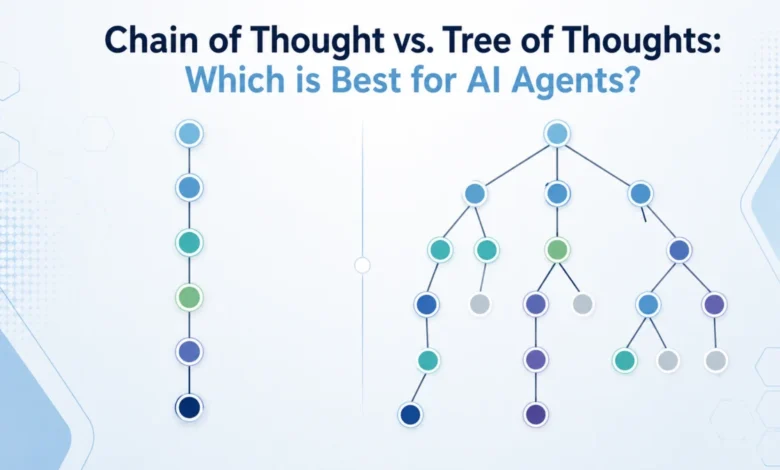
From a technical perspective, CoT operates within a single generation pass. When a user provides a prompt, the model generates a sequence of tokens that represents a linear path of logic. This approach is highly efficient in terms of latency and computational cost. Because it does not require iterative calls to the model, it is the standard for real-time AI agents tasked with document retrieval, intent classification, and routine data extraction.
However, the rigidity of CoT is its primary weakness. In a linear sequence, the model cannot backtrack. If an LLM misinterprets an early piece of data, the subsequent steps are built upon a foundation of error, leading to a "cascading failure." In complex coding tasks or multi-stage project management, a single wrong turn early in the process is often fatal to the final output.
Tree of Thoughts: The Branching Strategy
Tree of Thoughts represents a transition from "stream of consciousness" to "deliberate search." In this framework, an AI agent treats a problem as a search space rather than a sequence. At each stage of the reasoning process, the model generates multiple potential "next steps" or branches. These branches are then evaluated by the system—either through a self-scoring mechanism or by querying a second, independent model—to determine which path has the highest probability of success.
This methodology mirrors the search algorithms used in traditional artificial intelligence, such as those that allowed DeepBlue to defeat chess grandmasters. By maintaining a tree structure, the agent can:
- Backtrack: If a chosen branch leads to a logical contradiction or an impossible state, the agent can prune that branch and return to a previous node.
- Compare: The agent can hold multiple hypotheses simultaneously, allowing it to weigh competing strategies against one another.
- Optimize: By selecting the most promising branch at each step, the model focuses its computational resources on the most likely solutions.
Comparative Analysis: Efficiency vs. Accuracy
The trade-off between these two frameworks is a matter of resource allocation versus reliability. Data from recent industry benchmarks suggest that for tasks with a clear, predefined path—such as simple arithmetic or standard API lookups—CoT is significantly more efficient. The computational cost of ToT is often 10 to 50 times higher, as it necessitates multiple model calls to generate and evaluate each branch of the tree.
| Metric | Chain of Thought (CoT) | Tree of Thoughts (ToT) |
|---|---|---|
| Reasoning Style | Linear | Branching/Iterative |
| Computational Cost | Low | High |
| Error Recovery | Limited | High |
| Ideal Use Case | Routine tasks, summarization | Strategic planning, complex coding |
| Latency | Low (Single-pass) | High (Multi-pass) |
Implications for AI Agents
The choice between these frameworks has profound implications for the design of autonomous agents. Modern AI agents are now being architected as "multi-agent systems" where the reasoning layer is dynamically selected based on the input.
In a customer service agent, for example, simple inquiries are routed through a CoT process to ensure rapid, cost-effective responses. If the agent detects that the user’s request involves a multi-layered issue—such as a complex refund request involving multiple product returns and store policies—the system may escalate to a ToT-based reasoning module. This hybrid approach ensures that the organization manages its API costs effectively while providing high-quality support for complex issues.
The Future of Strategic Reasoning
As LLMs become more integrated into critical infrastructure, the limitations of simple linear reasoning will continue to drive innovation. We are already seeing the emergence of "System 2" thinking in AI, where models are trained to spend more time "thinking" before they "speak." This shift toward deliberate, iterative, and verifiable reasoning is essential for moving AI beyond the realm of generative content and into the realm of reliable executive function.
Industry analysts suggest that the next wave of agentic development will focus on the automation of the "evaluation" phase of ToT. Currently, most developers must manually define the criteria by which an agent evaluates its own branches. Future systems are expected to utilize autonomous "critics" that can assess reasoning quality without human intervention, effectively creating self-optimizing loops that improve accuracy with every iteration.
Ultimately, the selection between Chain of Thought and Tree of Thoughts is not a binary choice but a spectrum of complexity. As businesses continue to deploy AI agents at scale, the ability to discern which problems require a quick, linear response and which demand a deep, branching exploration will become a core competency for developers and systems engineers alike. By aligning the reasoning framework with the specific demands of the task, organizations can achieve a balance between operational efficiency and the high-fidelity results required for critical decision-making.