Bridging Experience and Autonomous Systems: How Industrial Intelligence and Physical AI are Redefining Modern Manufacturing

The modern manufacturing landscape has long existed at the intersection of rigid procedural documentation and the fluid, hard-won expertise of its workforce. While digital dashboards and automated production lines track every measurable output, the true lifeblood of industrial operations often resides in the tacit knowledge of veteran operators. These seasoned workers understand the subtle hum of a healthy motor, the capricious nature of a specific raw material during seasonal humidity shifts, and the precise moment a minor variance demands immediate intervention rather than routine monitoring. For decades, bridging the gap between this individual human intuition and enterprise-wide data systems remained an elusive goal for industrial architects.
Today, however, a profound technological convergence is underway. By marrying accumulated enterprise know-how with the real-time perceptual and responsive capabilities of Physical AI, global manufacturers are transforming static data records into dynamic engines of profitable, sustainable growth. This evolution moves beyond mere automation; it represents a fundamental shift in how industrial intelligence is captured, scaled, and deployed to empower human workers on the shop floor.
The Evolution of Industrial Intelligence: From Isolated Expertise to Enterprise Advantage
Historically, manufacturing expertise has been plagued by the limits of geography and individual tenure. When an experienced engineer retires, or when a master technician at a plant in Ohio develops an innovative workaround for a recurring line blockage, that knowledge rarely travels to a sister facility in Stuttgart or Singapore. It remains siloed within one person, inside one system, or trapped within the physical walls of a single plant.
Corporate leadership teams are now recognizing that unlocking this institutional knowledge is the key to scaling innovation. However, extracting expertise without stripping away the vital context that makes it useful remains a formidable challenge. A raw production log might indicate that a machine was taken offline for forty minutes, but it rarely captures the nuanced trade-offs an operator made regarding equipment configuration, material thermal thresholds, and localized quality standards.
To overcome these barriers, leading industrial organizations are investing heavily in knowledge-capture frameworks. By linking historical production records with rich contextual narratives—such as shift handoff notes, maintenance logs, and engineering change orders—companies are creating centralized repositories of industrial intelligence. When this intelligence is democratized across maintenance workshops, planning offices, and engineering teams, the entire organization gains the ability to innovate faster and respond to operational anomalies with unprecedented precision.
The Advent of Physical AI: When Intelligence Meets the Factory Floor
While data accessibility and digital knowledge management represent critical foundational steps, manufacturing remains an inherently physical domain governed by the laws of physics, material science, and mechanical wear. This realization has catalyzed the rapid adoption of Physical AI—a class of intelligent systems capable of perceiving environmental conditions, reasoning through complex variables, and executing precise physical actions in real time.
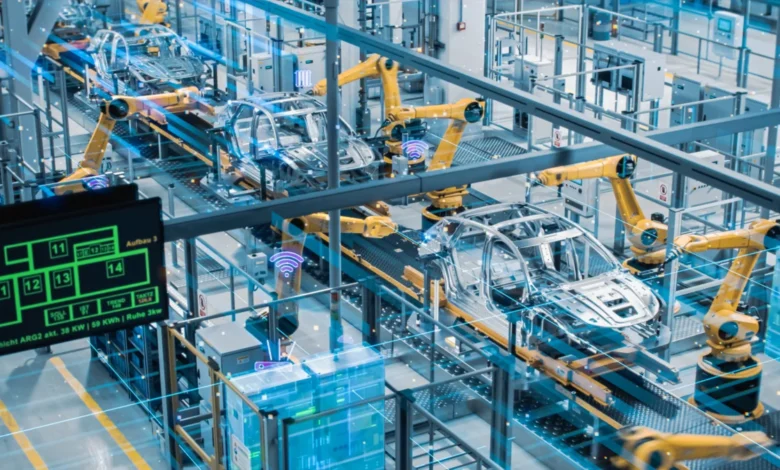
Unlike traditional automation, which relies on rigid, pre-programmed sequences of movements, Physical AI systems ingest multimodal data streams from computer vision, IoT sensors, and historical performance models. When a robotic parts-handling station encounters a misaligned component arriving on a conveyor, a vision system assesses the spatial variance, an AI model calculates the optimal corrective trajectory based on material payload characteristics, and connected servo-controls execute the adjustment within tightly validated safety parameters. The value proposition lies not merely in the system’s ability to detect an anomaly, but in its capacity to autonomously execute a corrective response before product quality is compromised.
This capability is rapidly scaling across complex industrial processes, including precision painting, chemical mixing, and high-tolerance machining. By embedding cognitive reasoning directly into physical machinery, manufacturers can maintain rigorous quality standards while dramatically reducing waste and unplanned downtime.
Real-World Deployments and Quantifiable Impact
The theoretical advantages of combining industrial intelligence with Physical AI are increasingly supported by verifiable empirical data from early industrial adopters.
At Toyota Industries Corporation, engineers faced chronic challenges in diagnosing paint shop defects due to fragmented, multi-source operational data. By deploying advanced data integration platforms to unify paint line telemetry with environmental and operational variables, the company provided its engineering and floor teams with a comprehensive contextual view of defect drivers. Internal performance metrics revealed that the initiative reduced analysis cycles from five days to under four hours. Furthermore, the initial pilot program successfully decreased relevant paint defects by approximately 25 percent, demonstrating that contextualized intelligence enables preemptive intervention rather than reactive troubleshooting.
A similarly transformative impact has been documented at Rockwell Automation’s manufacturing facility in Singapore. Facing the challenge of onboarding a new generation of technical personnel amidst a widening manufacturing skills gap, the facility integrated a specialized maintenance copilot. By feeding historical machine manuals, equipment telemetry, and the captured troubleshooting knowledge of veteran workers into an interactive AI assistant, the facility achieved remarkable efficiency gains. The onboarding timeframe required for new technicians to independently troubleshoot hundreds of complex machines plummeted from nine months down to just three months.
These implementations underscore a vital economic reality: the integration of industrial intelligence does not merely optimize machine performance; it dramatically compresses human learning curves, allowing junior staff to operate with the confidence and capability of seasoned experts.
Simulation, Operational Discipline, and the Safety Imperative
Introducing intelligent, autonomous agents into high-throughput physical environments requires rigorous operational discipline and robust safety frameworks. Unlike software environments where an algorithmic error results in a momentary system crash, industrial AI errors can cause catastrophic equipment damage, production halts, or severe workplace injuries.
To mitigate these risks, industry leaders are adopting sophisticated digital twin and simulation environments. Before any autonomous process adjustment or machine learning model update is deployed to physical equipment, it is rigorously tested within a virtual replica of the factory floor. This digital sandbox allows engineers to analyze how a proposed process modification interacts with dynamic variables, latency constraints, and material limitations without risking physical capital or line productivity.
Furthermore, responsible deployment mandates strict operational guardrails:
- Definitive Authority Bounds: Clear governance protocols dictate precisely which system parameters an AI agent may modify autonomously and which require mandatory human authorization.
- Reliable Physical Fail-Safes: Hardware-level emergency stops and deterministic control layers operate independently of software logic to ensure equipment can be brought to a safe state instantly.
- Comprehensive Audit Trails: Every automated decision, sensor reading, and manual override is chronologically logged to ensure complete traceability and regulatory compliance.
Industry analysts emphasize that trust in industrial AI cannot rely on algorithmic confidence scores alone. It must be anchored in transparent operational boundaries, rigorous physical validation, and the unwavering preservation of human authority.
Empowering the Workforce: More Capable Machines, More Capable People
A recurring apprehension surrounding the integration of artificial intelligence and advanced robotics in manufacturing is the displacement of human labor. However, executive leadership across the industrial sector increasingly frames these technologies as force multipliers for human capability rather than replacements.
Modern manufacturing environments are characterized by acute labor shortages, an aging demographic of skilled tradespeople, and exponentially rising product customization demands. In this context, intelligent equipment absorbs the most physically taxing, repetitive, and monotonous tasks, shielding workers from ergonomic strain and fatigue. Concurrently, agent-assisted systems act as cognitive partners, helping operators navigate complex, information-intensive decision-making processes under tight operational deadlines.
When an engineer is freed from tedious manual data collation, they can dedicate more time to exploring innovative process alternatives. When an operator is empowered to refine an automated system’s exception-handling protocols rather than manually managing the same recurring fault dozens of times per shift, job satisfaction and institutional ownership increase.
This symbiotic relationship requires deliberate corporate investment not only in hardware and software infrastructure, but in human capital. Comprehensive training programs, dedicated time for continuous learning, and active worker participation in designing human-machine interfaces are critical prerequisites for long-term operational success.
Strategic Implications for Sustainable Growth
As the global manufacturing sector looks toward the remainder of the decade, the primary competitive differentiator will not be the mere volume of data collected, nor the sheer number of automated assets deployed on a production line. Instead, it will be an organization’s systemic ability to translate operational experience into compounding, scalable capability.
Industrial intelligence serves as the connective tissue linking human ingenuity, historical performance data, and real-time physical execution. By empowering businesses to learn continuously, adapt fluidly, and act decisively, this paradigm shift enables manufacturers to scale production without incurring a linear increase in operational complexity.
Ultimately, the frontier of modern industry is defined by enterprises that treat knowledge not as a static byproduct of production, but as a renewable, compounding asset. Through the strategic harmonization of industrial intelligence and Physical AI, manufacturers are not merely building smarter machines—they are cultivating organizations capable of solving the most intractable operational challenges and securing sustainable growth for generations to come.