The venture capital ecosystem has long operated under a complex web of unwritten rules, conventional wisdom, and strategic anxieties. Among the most pervasive and fiercely debated topics in early-stage tech investing is the concept of "signaling"—the myriad ways that an investor’s presence, absence, or level of participation in a seed round communicates hidden messages to subsequent Series A investors. For years, founders have been warned by advisors, accelerators, and seasoned veterans to carefully curate their cap tables, avoiding institutional venture capital firms in their seed rounds out of fear that it might poison the well for future fundraising. The prevailing logic suggested that an "inside" VC possessed disproportionate information and influence, creating an insurmountable hurdle for external firms evaluating a Series A opportunity. Conversely, investors were cautioned against pursuing startups backed by rival firms, operating under the assumption that the seed investor would inevitably preempt any high-performing company, leaving outsiders to pick through lemons or risk the embarrassment of backing a known mistake.
However, a comprehensive empirical analysis conducted by venture capital firm Matrix challenges these deeply entrenched assumptions. By examining real-world transaction data from 2018, researchers sought to determine whether the market actually adheres to these elaborate theories of court intrigue or if participants are primarily focused on fundamentals and partnership fit. The findings suggest that the modern venture capital market is far more pragmatic, efficient, and immune to perceived signaling risks than conventional startup mythology would have founders believe.
The Anatomy of Venture Capital Signaling Theory
To understand the significance of the recent findings, one must examine the theoretical framework that has dominated early-stage startup discourse for over a decade. The mechanics of VC signaling are traditionally viewed through a lens of asymmetric information and game theory. According to traditional startup advisory lore, the lifecycle of a venture-backed company is fraught with psychological landmines.
Under the traditional model, if an institutional venture firm participates in a startup’s seed round, it occupies a unique position of power. When the company eventually seeks a Series A financing round, external venture capitalists are expected to hesitate. The rationale is twofold: first, the incumbent seed investor holds preferential information regarding the startup’s true operational metrics, technical hurdles, and team dynamics. Second, the incumbent holds a structural advantage—often through pro-rata rights or board seats—that allows them to protect their ownership stake or preemptively price out competing firms if the company is exceptionally successful. Therefore, outside VCs supposedly view entering a competitive dynamic with an entrenched insider as a losing battle.

The game theory extends even further to the behavior of the seed investors themselves. Under the old-school dogma, if a startup backed by a prominent seed fund fails to secure a Series A from that same fund, it sends a catastrophic negative signal to the broader market. The unspoken translation is that the seed investor—who knows the company best—chose not to double down, signaling to everyone else that the enterprise is fundamentally flawed.
Because sophisticated founders are supposedly well aware of these dynamics, the conventional playbook advises them to rely exclusively on angel investors, friends and family, or specialized micro-VCs for their seed rounds, keeping the door wide open for top-tier institutional funds only when it is time for Series A. According to this line of reasoning, the presence of a heavyweight VC at the seed stage should theoretically be viewed as a red flag or a sign of structural weakness. But as the Matrix data demonstrates, reality paints a vastly different picture.
Methodology and Scope of the Empirical Study
To test whether these theoretical signaling concerns translate into actual market behavior, Matrix partners Jared Sleeper and their research team undertook a data-driven investigation. Rather than relying on anecdotal evidence or recycled advice from industry panels, the researchers set out to analyze hard transaction data from the global startup hub.
The scope of the study was deliberately focused to capture high-quality market signals. The researchers anchored their dataset to Series A rounds completed throughout the 2018 calendar year, as recorded by market intelligence platform Crunchbase. While acknowledging that this dataset inherently excluded companies that successfully operated in stealth mode or utilized alternative financing mechanisms, the 2018 cohort provided a robust sample size of completed transactions.
To establish a benchmark for "higher quality" enterprises, the researchers narrowed their focus to Series A investments led by the top 30 venture capital firms. While defining a "top 30" list inherently involves a degree of subjectivity, the selection was modeled after the firms most prominent and active within Matrix’s own competitive landscape. This filtering mechanism ensured that the analysis concentrated on elite institutional rounds rather than diluting the findings with outliers from smaller or less active funds.
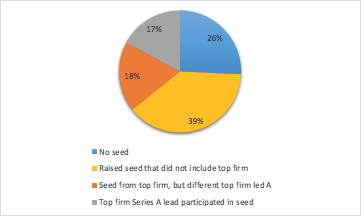
The resulting dataset comprised approximately 70 high-tier Series A transactions, categorized geographically to capture regional nuances across the United States, including national aggregates, Bay Area-specific transactions, and combined data from the Boston and New York metropolitan technology hubs.
What the Data Reveals: Dispelling the Myths
When the researchers mapped out the historical seed funding patterns of companies that successfully closed a Series A with a top-30 firm, the results thoroughly dismantled conventional signaling theories. The data was categorized into distinct pathways based on whether the startup raised a seed round, and whether that seed round included a top-tier venture firm.
The findings revealed that the market largely disregards purported negative signals. Most notably, a significant portion of startups that successfully raised a Series A from a top-tier firm had previously included a different top-tier firm in their seed round. Across the entire United States dataset, roughly one-fifth of all analyzed A rounds fit this description. In the hyper-competitive ecosystem of the Bay Area, that figure spiked to an astonishing one-third. Even in the Boston and New York markets, where regional investment dynamics differ slightly, 9% of companies followed this trajectory.
This statistical reality directly contradicts the foundational premise of adverse signaling. If top-tier VCs actively avoided companies backed by rival institutional funds during the seed stage, this category of transactions would be statistically negligible. Instead, the data demonstrates that high-performing companies backed by a premier seed investor are frequently courted and ultimately led at the Series A stage by a completely different top-tier firm. In the Bay Area, a startup that took top-tier money at the seed stage was actually twice as likely to have its Series A led by an external top-tier firm as it was to be preempted by its original seed investor.
Furthermore, the data challenged the notion that smart entrepreneurs heed the warning to exclude prominent VCs from their seed rounds. More than a third of the analyzed companies—and roughly half of those that raised an institutional seed round at all—chose to partner with a top-tier VC right from the beginning. In the Bay Area, this trend was even more pronounced, with approximately half of all high-quality companies, and 62% of those with institutional seed backing, intentionally bringing a major fund on board early. When accounting for modern venture structures such as scout funds and affiliated seed vehicles, the true integration of major funds at the earliest stages is likely even higher.
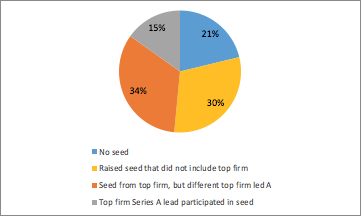
The data also illuminated the rarity of what industry insiders colloquially term "marrying your high school sweetheart"—the scenario where a startup raises its seed from a top fund and seamlessly transitions to the same fund for Series A without ever opening a competitive process. Fewer than one in five startups in the dataset experienced this linear trajectory, proving that founders routinely test the broader market and evaluate alternative partners when transitioning to their Series A.
Market Efficiency and Industry Implications
The broader implications of this empirical analysis point toward a more mature, efficient, and rational venture capital marketplace than prevailing folklore suggests. In a high-velocity environment driven by fierce competition for breakout technological innovations, investors simply do not have the luxury of engaging in Byzantine palace intrigue or avoiding lucrative deals over antiquated superstitions about signaling.
For founders, the takeaway is deeply empowering. The data suggests that entrepreneurs should prioritize finding the absolute best strategic and interpersonal partners at every single stage of their company’s lifecycle, rather than second-guessing how a cap table composition might be misinterpreted by future investors. If a top-tier institutional fund offers valuable guidance, operational networks, and capital during the seed stage, accepting their investment does not act as a death sentence for Series A prospects. Founders retain the freedom to maintain relationships, foster competition, and select the best lead investor when the time comes to scale.
For investors, the research reinforces the importance of fundamental-driven analysis over herd mentality. Elite venture capitalists are incentivized to uncover outliers, proprietary technology, and exceptional founding teams. Passing on a promising enterprise purely out of fear of what a competing fund might think is an inefficient strategy that ultimately costs firms access to category-defining companies.
While critics of the study have correctly noted that the dataset focused exclusively on companies that successfully crossed the finish line to a top-tier Series A—leaving out failed ventures or those that chose alternative paths—the directional clarity remains undeniable. Series A lead investors do not appear to penalize startups for having institutional backing in their seed rounds. As the venture ecosystem continues to evolve past rigid dogmas, data-driven insights like these serve as a vital reminder that execution, product-market fit, and team capability will always outweigh unwritten rules and speculative market lore.
Related posts: