ChartMogul Unveils Native Subscription AI Analyst and Makes CRM Integration Free for All Users

The subscription analytics landscape has undergone a significant transformation with the official launch of ChartMogul AI, an advanced in-product artificial intelligence analyst designed to parse complex revenue data, trace financial shifts directly to individual customer behaviors, and democratize deep business intelligence. Spearheaded by CEO Nick Franklin, the release addresses a foundational hurdle in the Software-as-a-Service (SaaS) and recurring-revenue sectors: the inherent difficulty of translating messy, multi-layered billing data into actionable insights without requiring advanced data science skills. Alongside the AI rollout, ChartMogul announced that its integrated Customer Relationship Management (CRM) platform will now be available completely free of charge to all users, removing prior paywalls to ensure the AI engine has unhindered access to holistic customer context.
The Complexity of Subscription Metrics and the Genesis of the Tool
For more than a decade, ChartMogul has positioned itself as a primary authority in turning real-world, highly convoluted billing scenarios into trustworthy, standardized subscription metrics. Subscription data is notoriously difficult to manage accurately. Calculating core Key Performance Indicators (KPIs) involves harmonizing a web of variables, including upgrades, downgrades, churn, reactivations, multi-component subscriptions, refunds, credits, and multi-currency conversions. A minor logical flaw in handling these transactions can invalidate an entire financial dashboard, forcing finance and leadership teams to constantly audit and explain discrepancies.
While platforms like ChartMogul have successfully automated the calculation of headline figures such as Annual Recurring Revenue (ARR) and Monthly Recurring Revenue (MRR), uncovering the underlying narrative has historically demanded substantial human capital. Understanding why a specific metric fluctuated required a high degree of technical curiosity, deep familiarity with the platform’s data model, and manual labor—knowing precisely which filters to apply, which cohorts to isolate, and how to follow the evidentiary trail.
Consequently, deep data investigations have traditionally been reserved for high-stakes inflection points, such as major pricing restructuring, venture capital fundraising rounds, quarterly board meetings, or sudden, inexplicable metric anomalies. On a day-to-day basis, most operators simply glance at their top-line ARR, verify that it aligns with general expectations, and close the tab. ChartMogul AI was engineered to bridge this gap, transforming routine metric verification into an interactive, exploratory dialogue.

Technical Architecture: Beyond a Simple Dashboard Chatbot
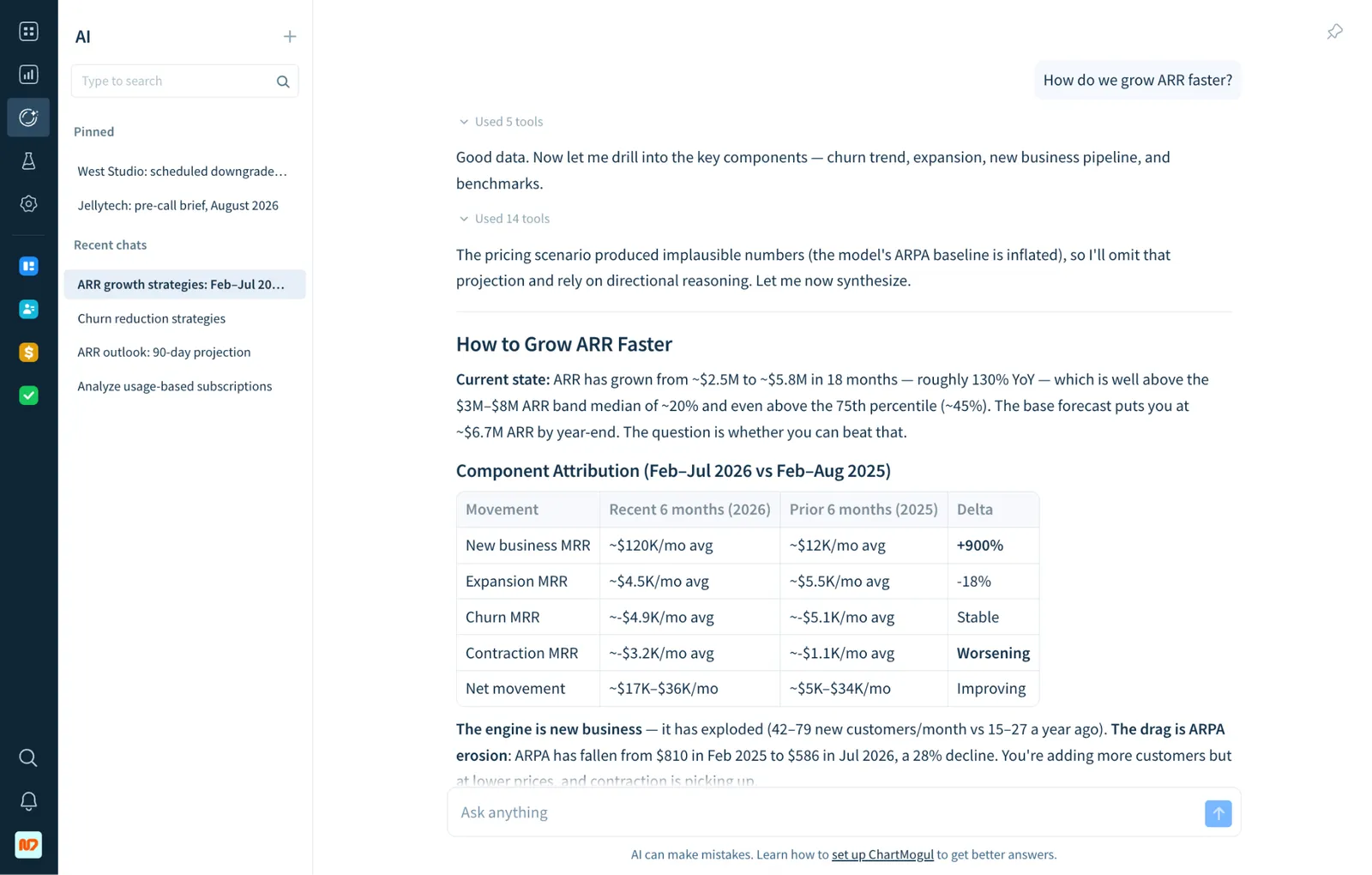
Unlike generic chatbot overlays tacked onto software interfaces, ChartMogul AI is deeply integrated into the core product architecture, granting it native awareness of the specific reports, data segments, and customer records currently on display. The system is designed to execute multi-step investigations autonomously. It can select relevant metrics, construct precise data filters and segments, examine individual customer transaction histories, synthesize CRM data, and summarize its findings in plain language.
The development team addressed common AI failure modes—such as tool misselection, hallucinated filters, and superficial data analysis—through a specialized, multi-agent architectural approach. According to engineering leads behind the project, the underlying language models (sourced primarily from Anthropic) are paired with deterministic routing mechanisms and specialized programmatic skills. For instance, filter building is delegated to a specialized sub-agent that first cross-references real subscription plans and system tags before writing code in ChartMogul Filter Language (CFL). Similarly, customer and chart links are programmatically bound to the underlying data architecture, eliminating the risk of hallucinations.
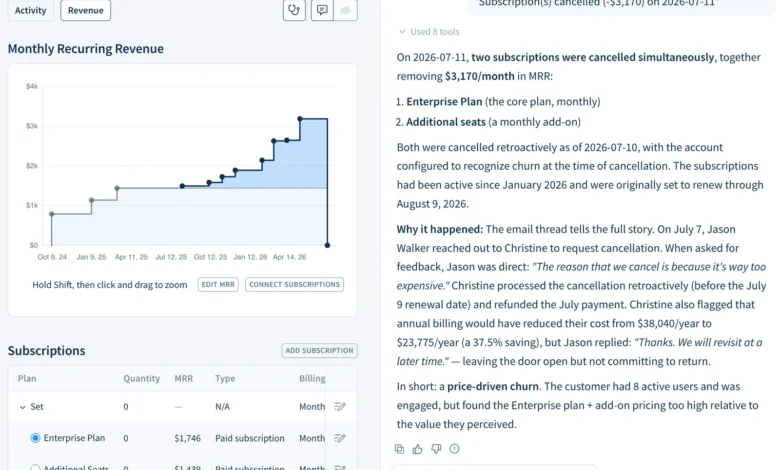
A critical differentiator for the platform is its ability to synthesize quantitative revenue data with qualitative customer interactions. While traditional analytics tools can precisely detail what financial event occurred, they frequently fail to explain why. To resolve this, ChartMogul AI processes unstructured data streams—including customer support emails, internal notes, call logs, and meeting transcripts—pre-processing them to extract cancellation reasons, competitor mentions, customer sentiment, and product feedback. This enables queries that seamlessly blend financial performance with qualitative customer sentiment.
Democratizing Customer Context by Unlocking the CRM
To function effectively, an AI analytical engine requires a comprehensive, uninterrupted view of the customer lifecycle. Recognizing that fragmented data silos severely limit analytical accuracy, ChartMogul has fundamentally restructured its pricing and product strategy regarding customer relationship management.
Effective immediately, ChartMogul CRM is included at no additional cost as a core platform feature. Previously, synchronizing external communication channels such as corporate email accounts required users to purchase dedicated "CRM Pro" seats. By eliminating paid CRM seats entirely, the company has lowered the barrier to entry for holistic data integration. Every user can now connect their inbox and leverage the complete suite of CRM capabilities, ensuring that the AI analyst possesses maximum contextual depth when evaluating customer churn risks, expansion opportunities, and cohort behaviors.
Contextual Entry Points and Natural Language Processing
The integration of ChartMogul AI extends across the entire user interface through contextual entry points. For example, when a user navigates to a specific customer cancellation record, a single click initiates a comprehensive background investigation into that account’s entire operational history, surfacing likely catalysts for the churn event.
Furthermore, the system introduces powerful natural language processing capabilities to data segmentation. Complex analytical requests—such as comparing ARR growth and retention metrics across every individual state in the United States—previously required manual configuration across multiple dashboards and filter parameters. Users can now execute these complex data slices simply by typing conversational prompts. In its initial release, ChartMogul AI operates in a read-only capacity, though the company has outlined plans to introduce write-actions and automated execution capabilities in subsequent updates.
Broader Industry Implications and the Shift Toward Conversational Interfaces
The launch of ChartMogul AI reflects a broader, accelerating paradigm shift across the enterprise software sector: the transition from static graphical user interfaces (GUIs) to conversational, AI-driven data exploration. While the company continues to maintain robust API integrations for general-purpose AI ecosystems—such as its Model Context Protocol (MCP) server listings within the Claude and ChatGPT directories—its native product experience emphasizes vertical specialization. By combining certified subscription accounting logic with conversational AI, the platform demonstrates how domain-specific AI can outperform generalized models operating on raw data exports.
Industry analysts note that as software interfaces evolve, natural language is increasingly becoming the primary abstraction layer for complex data analysis. While visual charts, toggle switches, and nested menus will retain utility for power users, the routine operation of software controls is steadily migrating toward automated, agentic systems. For recurring-revenue businesses grappling with mounting data complexity, tools that bridge the gap between financial ledgers and qualitative customer behavior represent a vital step toward proactive, data-driven decision-making. ChartMogul AI is available immediately to all platform users, marking the beginning of a multi-phase corporate roadmap aimed at redefining how subscription companies interact with their financial data.