AI Agents versus AI Workflows: A Technical Framework for Strategic Implementation

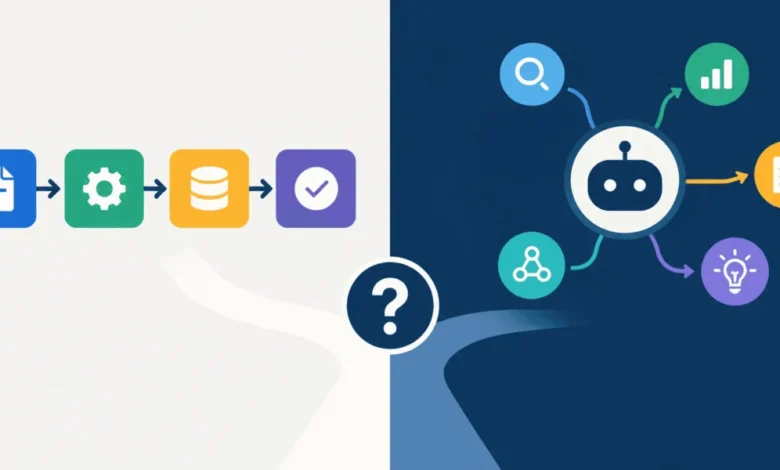
The rapid proliferation of large language models (LLMs) has introduced a significant nomenclature crisis in the software engineering sector, where the term "AI Agent" is increasingly applied to almost any system utilizing an LLM. This semantic dilution often obscures a fundamental architectural distinction: the difference between a predetermined, deterministic workflow and an autonomous, non-deterministic agent. As enterprises shift from experimental generative AI pilots to production-grade infrastructure, distinguishing between these two paradigms is no longer a matter of preference but a critical requirement for operational stability, cost management, and regulatory compliance.
Defining the Architectural Divide
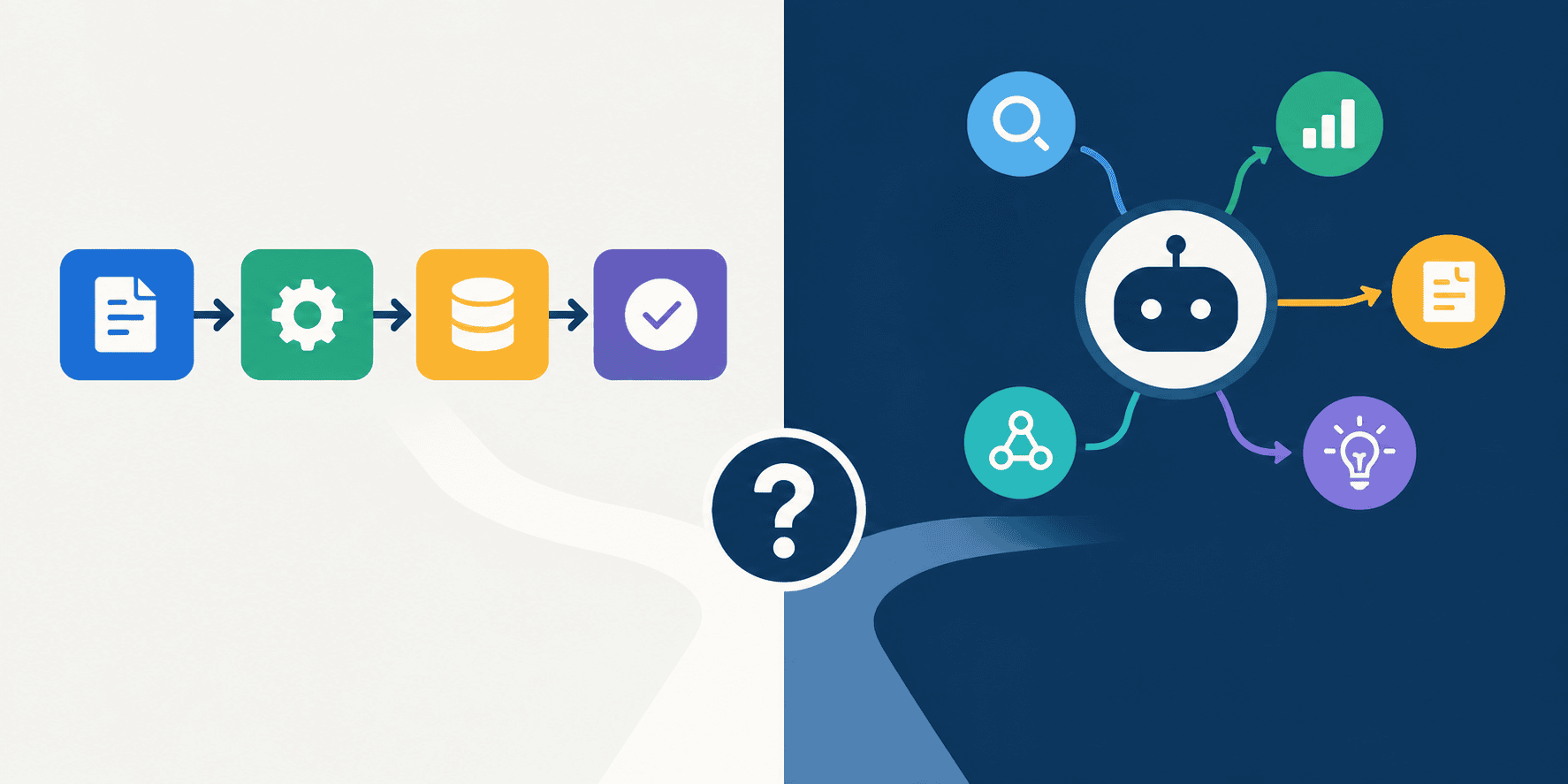
To understand the divergence, one must examine where the control logic resides. A workflow, often referred to as a pipeline or a chain, is defined by a rigid sequence of operations established at the design phase. Even when these pipelines incorporate advanced LLMs for specific tasks—such as sentiment analysis or data extraction—the path taken by the data remains fixed. The developer explicitly defines the branching logic, the error-handling protocols, and the final exit conditions.
Conversely, an agent represents a paradigm shift where the control flow is delegated to the model at runtime. In this architecture, the developer provides the agent with a high-level goal and a set of discrete tools. The LLM then assumes the responsibility of determining the sequence of operations, selecting necessary tools, and assessing whether the current state of progress satisfies the stated objective. This capability to engage in iterative planning, observation, and recursive adjustment is the defining characteristic of an agentic system.
Historical Context and the Rise of "Agentic" Hype
The term "agent" has gained prominence alongside the maturation of LLM reasoning capabilities. Between 2023 and 2025, the industry witnessed a transition from simple prompt-response interactions to more complex systems like AutoGPT and LangChain. During this period, the allure of autonomous systems—capable of browsing the web, executing code, and managing complex tasks without human intervention—led many developers to prioritize agentic frameworks.
However, industry data from early 2026 indicates a significant shift in sentiment among enterprise architects. High-profile project failures, often characterized by non-deterministic outputs and excessive token consumption, have led to a re-evaluation of when agentic autonomy is actually required. Engineers are now identifying that what was previously marketed as "agentic capability" is frequently just a standard business process that has been artificially obscured by the complexity of a model-driven control loop.
The Diagnostic Test: Mapping the Decision Tree
Before writing any code, engineers are encouraged to apply a fundamental diagnostic test: if a subject matter expert can draw a complete, comprehensive flowchart of the task before the system executes, then the task is, by definition, a workflow.
The necessity of an agent only arises when the path to the solution is unknown at the design stage. For instance, in a routine financial audit, the steps are fixed: verify identity, check credit history, apply policy, and render a decision. This is a workflow. In contrast, diagnosing an unpredictable network outage—where each step relies on the specific findings of the previous diagnostic check—requires the flexible, iterative logic provided by an agent.
Comparative Analysis of Technical Requirements
| Feature | AI Workflow | AI Agent |
|---|---|---|
| Control Logic | Predetermined at design time | Decided at runtime by the model |
| Predictability | High (Deterministic) | Low (Non-deterministic) |
| Resource Usage | Optimized (Predictable cost) | Variable (High token consumption) |
| Complexity | Managed via branching logic | Managed via prompting/reasoning |
| Auditability | High (Easy to log and verify) | Low (Black-box reasoning paths) |
Supporting Data: Cost and Latency Implications
Quantitative analysis of enterprise deployments reveals that the choice between these two architectures significantly impacts the bottom line. Agents, by virtue of their "think-then-act" cycles, typically require multiple round-trips to an LLM provider. Each step involves a new prompt, an analysis of the previous output, and a selection of the next tool.
Data from recent technical benchmarks suggest that agentic workflows can incur 300% to 500% higher latency compared to equivalent deterministic workflows. Furthermore, the cost per task is often unpredictable; an agent that enters an infinite loop or fails to reach a conclusion due to hallucinated tool calls can deplete budget allocations rapidly. Conversely, a well-optimized workflow allows for precise cost forecasting, as the number of LLM calls is fixed based on the number of documents or queries processed.
Official Perspectives and Best Practices
Leading engineering organizations and cloud providers have begun issuing guidance to curb the "agent-first" mentality. The prevailing industry consensus is that "Workflow + LLM Judgment" is the most robust starting point. By embedding an LLM into a fixed workflow—allowing the model to classify an issue or evaluate an output at specific, controlled nodes—developers gain the benefit of AI reasoning without the risks associated with complete autonomy.
"The goal is to solve the problem, not to build an agent," states one lead developer at a major financial services firm. "If you can solve the problem with a deterministic script and an LLM-based classifier, you are ahead of the game. Agents are for the frontier of unknown problems, not for the backbone of your application."
Implications for Governance and Compliance
From a regulatory standpoint, the transition to agentic systems presents significant hurdles. In sectors like healthcare, law, and finance, auditability is a primary concern. An agent that generates its own, unique path to a conclusion every time it runs poses a nightmare for compliance officers.
A deterministic workflow, however, provides a clear, verifiable audit trail. Every step is documented, and the logic is transparent. If an error occurs, developers can pinpoint the exact node in the workflow where the failure originated. This level of traceability is often impossible with autonomous agents, where the "reasoning" process is opaque and subject to the inherent stochastic nature of modern large language models.
Future Outlook and Strategic Decision Making
As the industry matures, the distinction between these two architectures will likely become more standardized. We can expect to see a hybrid model emerging, where core business logic remains locked within structured workflows, while "agentic modules" are utilized only for specific, isolated sub-tasks that require high degrees of reasoning.
The practical recommendation for development teams is to resist the pressure to adopt complex agentic frameworks prematurely. Begin by mapping the logic in a traditional flow diagram. If the process requires human-like judgment at specific junctures, integrate an LLM as a tool within that flow. Only when the task is genuinely too complex or variable to be mapped—such as in dynamic, open-ended research or creative synthesis—should the engineering team consider the complexity of an agent.
In summary, the most successful AI applications of the coming years will not necessarily be the most autonomous, but the most reliable. By prioritizing the simplicity of workflows, organizations can ensure that their AI implementations are not only intelligent but also scalable, cost-effective, and aligned with the rigorous demands of modern enterprise environments. The decision to use an agent should be a calculated move based on the inherent nature of the task, not a response to the prevailing hype of the current technological landscape.
Related posts: