Decoding the Complexities of Modern SaaS: Insights and Key Takeaways from the ChartMogul Product-Led Growth Lab Series

The modern software-as-a-service (SaaS) landscape has evolved significantly from the days of massive enterprise sales teams and rigid, six-figure contracts. Today, the vast majority of ambitious SaaS companies are built on opinionated, self-serve products that rely on product-led growth (PLG) motions. However, as these businesses scale, founders and revenue operators frequently find themselves grappling with the intricate mechanics of PLG complexity—from broken automation workflows and misaligned hybrid go-to-market (GTM) compensation structures to activation paths that break down outside controlled internal environments.
To address these operational hurdles head-on, ChartMogul, a leading subscription data and analytics platform, launched an intimate, city-based meetup series tailored specifically for PLG founders and revenue operators. Known as The Product-Led Growth Lab series, these gatherings were designed to strip away the high-level fluff often found at massive tech conferences and dive directly into the messy, tactical realities of building and scaling software businesses.
Chronology and Global Reach of the PLG Lab Series
The initiative kicked off during the spring conference circuit, making its debut in San Francisco during the high-traffic week of Stripe Sessions. At this inaugural gathering, Brenna Loury, Chief Revenue Officer of productivity software giant Doist, delivered a candid keynote addressing the friction points and operational challenges of moving upmarket within a strictly PLG business model. The discussion proved so resonant among attendees that debates over hybrid sales motions and enterprise expansion spilled over from the formal presentation rooms onto a sunlit rooftop for refreshments and networking alongside broader conference attendees.
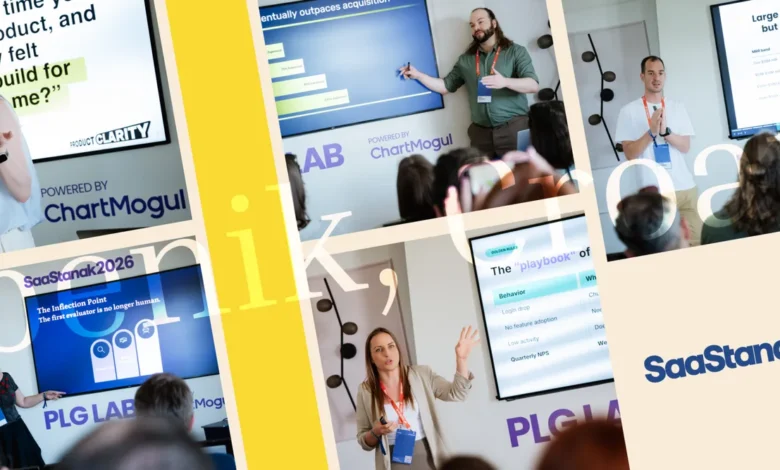
Following the success of the San Francisco launch, the PLG Lab series expanded internationally, traveling to the Adriatic coast of Croatia in partnership with SaaStanak, a premier regional SaaS conference. Despite intense regional heatwaves, the sessions drew standing-room-only crowds across two afternoons overlooking the Mediterranean Sea. Attendees demonstrated high engagement, posing targeted questions, debating industry shifts, and exchanging empirical data from their respective organizations.
Recognizing the density of operator-level knowledge shared during these international sessions, ChartMogul moved to document and distribute the core presentations. By making the slide decks and comprehensive session recaps publicly available, the organization aimed to democratize access to strategies that are typically confined behind closed boardroom doors.
The Expansion Engine: Architecting a Scalable PLG Stack for Automated Upsells
A central theme across multiple sessions was the transition of customer expansion from a manual sales execution problem into an automated infrastructure challenge. Historically, software companies treated account expansion as a task for account executives: identifying the right moment, drafting a targeted email, and closing a supplemental contract.
However, industry presentations argued that modern SaaS companies must view expansion through the lens of data architecture. When accurate usage data flows seamlessly into lifecycle and marketing automation workflows, upsells become inherently timely, contextually relevant, and exponentially easier to scale. Without robust underlying data pipelines, companies risk triggering generic campaigns that alienate active users rather than encouraging higher-tier adoption.
Bridging the Gap Between Behavioral Data and User Intent
Another focal point of the lab series was the limitation of relying solely on automated behavioral tracking. While product analytics can precisely map what a user did within an application—such as feature adoption rates, session lengths, and drop-off points—they frequently fail to explain the underlying motivation.
Presenters emphasized that behavioral data shows what happened, but direct user feedback reveals why it happened. Organizations whose lifecycle automations appear technically functional but fail to drive conversions are often missing this qualitative layer. The recommended remedy involves integrating structured feedback loops directly into the product experience, ensuring that quantitative metrics are continually cross-referenced with actual user sentiment before designing subsequent activation or retention campaigns.
Navigating the Pivot: From Traditional SaaS to AI-Native in Days
The rapid integration of artificial intelligence into software architecture was another dominant topic, dissected through real-world case studies of traditional SaaS companies transitioning to AI-native models in exceptionally short timeframes. Rather than treating "AI-native" as a nebulous brand buzzword, the sessions framed the transition as a strict product design exercise.
Successful pivots generally follow a rigorous framework: identifying a single, highly valuable user outcome, stripping away the peripheral friction required to achieve it, preserving the specific interaction that builds user trust, and engineering the user experience backward from that foundational milestone. Key operational questions for product teams include determining what the product can execute autonomously before the user is forced to learn complex navigation, deciding which decisions the AI should execute by default, and preserving deliberate human touchpoints so the user maintains a sense of ownership over the final output.
Re-evaluating Lifetime Value (LTV) Across Thousands of SaaS Businesses
ChartMogul’s internal insights team presented proprietary findings drawn from an extensive dataset encompassing 3,700 SaaS businesses over a six-year period. The research highlighted a significant blind spot in traditional customer lifetime value (LTV) calculations.
While LTV remains a vital metric for determining customer acquisition cost (CAC) thresholds, payback periods, and segment investments, the data indicates that standard formulas frequently break down when exposed to modern PLG dynamics. Analysts advised operators to audit their LTV models against actual customer behavior and cohort retention curves to avoid misallocating capital across different market segments.
Refining the First Impression: People-Led Growth and Onboarding
Addressing the critical initial touchpoint of software adoption, presenters introduced the concept of "People-Led Growth" as a necessary evolution of pure product-led onboarding. Many organizations treat user onboarding as a static process that can be configured once and left unattended.
To combat this "set-and-forget" mentality, operators were provided with frameworks to audit their onboarding flows monthly. By evaluating the user journey from an external perspective, teams can pinpoint exact moments where trust disintegrates or product momentum stalls, allowing them to isolate and optimize the specific interactions that guide users toward their "aha!" moment and initial product win.
The Rise of "Invisible PLG" and Agent-Readable Infrastructure
Looking toward the future of software distribution, the lab series introduced the concept of "Invisible PLG." As autonomous AI agents begin to play a larger role in enterprise software procurement, products must increasingly cater to non-human evaluators.
This shift presents a critical diagnostic question for modern tech companies: Could an autonomous AI agent independently discover, evaluate, test, price, and integrate with your product without human intervention? If the answer is negative, software vendors risk building products that remain visible to human buyers while becoming entirely invisible to the automated systems that increasingly dictate enterprise software evaluation and adoption.
Scaling from $1M to $20M ARR: Operational Levers and Growth Signals
For mid-stage companies navigating the difficult transition from $1 million to $20 million in Annual Recurring Revenue (ARR), workshop sessions focused on identifying the specific operational levers required to sustain momentum. Industry leaders noted that scaling through this revenue band rarely relies on a single silver bullet.
Instead, sustainable growth is typically achieved through compounding, incremental improvements across Average Revenue Per Account (ARPA), net retention rates, expansion revenue, and organizational focus. These adjustments must be paired with rigorous leadership standards to ensure that tactical execution remains aligned with long-term strategic goals as headcount and complexity increase.
Bridging the Divide Between PLG and Traditional Sales
As self-serve software companies move upmarket to capture enterprise revenue, the integration of product-led and sales-led motions has become a top priority. Experts stressed that a hybrid go-to-market strategy cannot simply consist of a self-serve funnel bolted onto a traditional outbound sales team.
True hybrid GTM design requires solving complex systemic challenges regarding account routing, revenue ownership, sales compensation incentives, and product boundaries. Because different customer segments require distinct buying paths, organizations must design frictionless transitions that meet users where they are, ensuring that self-serve adoption and enterprise sales motions complement rather than cannibalize one another.
Overcoming the Launch-to-Adoption Gap
Addressing modern product marketing challenges, presenters analyzed the "launch-to-adoption gap"—a phenomenon where software companies ship new features faster than their user base can comfortably absorb them.
Rather than treating product marketing merely as a mechanism to announce shipped code, operators advocated for a framework centered on designing for adoption. In an era where software release cycles have accelerated dramatically, market advantage increasingly belongs to companies that can effectively triage feature announcements, target the right user cohorts at precise moments, and translate technical releases into measurable behavioral changes.
Broader Impact and Implications for the Industry
Taken collectively, the discussions and data presented throughout the ChartMogul Product-Led Growth Lab series signal a fundamental maturation of the PLG movement. Industry consensus indicates that product-led growth is no longer defined simply by the absence of a sales team in the buying journey.
Instead, modern PLG encompasses sophisticated data architecture, robust feedback loops, behavioral onboarding psychology, disciplined hybrid GTM design, structured launch systems, and agent-readable technical infrastructure. Simultaneously, it continues to rely on the deeply human work of communicating clear value to the end user. As the sector evolves, PLG is proving to be simultaneously more technical, more operational, and fundamentally more demanding than in its earliest iterations.
Related posts: