RevenueCat Free Trial Length Dataset Reveals Critical Shifts for Mobile and B2B Subscription Models

The subscription software industry has relied on standardized onboarding timelines for over a decade, but a comprehensive empirical study released by subscription management platform RevenueCat challenges foundational assumptions regarding customer acquisition and retention. Spanning over 17,000 mobile subscription applications between August 2025 and July 2026, the dataset offers the largest and most granular look at consumer and business-to-business (B2B) trial behavior ever published. Because RevenueCat powers more than 60 percent of the mobile subscription market—encompassing diverse sectors from fitness and entertainment to B2B productivity, workflow tools, and artificial intelligence applications—the findings provide vital strategic implications for founders and product leaders navigating product-led growth (PLG).
Background Context and Evolution of Subscription Trials
To understand the significance of this dataset, one must examine how the modern software trial evolved. In the early days of cloud computing and software-as-a-service (SaaS), pioneer enterprises such as Salesforce and HubSpot established the 14-day free trial as an industry standard. Over the ensuing fifteen years, thousands of B2C and B2B companies adopted this timeline by default, rarely questioning whether a two-week window aligned with their specific product’s time-to-value or pricing structure.
Over the years, early-stage investors like the SaaStr Fund—which made its initial investment in RevenueCat back in 2018—have watched the platform scale from tracking a few hundred applications to becoming the default infrastructure layer for mobile subscriptions. While a significant portion of RevenueCat’s ecosystem involves consumer-facing verticals like photo editors, language learning apps, and streaming services, the inclusion of workflow tools and enterprise-adjacent utilities creates a valuable cross-section for B2B strategists. Particularly when examining annual plans, consumer purchase behavior closely mirrors enterprise procurement: buyers are making a significant financial commitment that requires deliberate evaluation.
Chronology and Scope of the RevenueCat Study
The research initiative analyzed more than 17,000 mobile applications over a full twelve-month evaluation period running from August 2025 through July 2026. By tracking how millions of users transitioned from initial downloads to active trials, paid conversions, and subsequent renewals, RevenueCat mapped out performance curves across varying subscription intervals, geographic regions, and application categories.
The findings upend several long-standing dogmas in subscription monetization. Specifically, the data demonstrates that trial duration has a profound, quantifiable impact on conversion rates and long-term retention—and that the optimal trial length depends heavily on whether the subscription is billed monthly or annually, and whether the underlying software utilizes resource-intensive technologies like generative AI.
The Annual Plan Paradox: Why Longer Trials Win Big
For annual subscriptions, the data offers an unambiguous directive: longer trials yield dramatically higher retention. When applications offered annual plans paired with trial lengths of 17 to 32 days, they achieved an average conversion rate of 44.6 percent. In stark contrast, annual plans with trials lasting four days or less converted only 24 percent of users.
The disparity grows even wider when examining first-year renewals. Users who entered through the longest trial window renewed at a rate of 47.5 percent, compared to just 18.3 percent for the shortest trials. Combining these metrics reveals that roughly 18.5 percent of users who started a 17-to-32-day annual trial ultimately paid and renewed a full year later. For shorter trials, that combined retention metric dropped to just 3.5 percent. Despite receiving the exact same number of initial trial starts, the longer trial cohort delivered more than five times the number of long-term retained customers.
Industry analysts attribute this phenomenon to the psychology of financial commitment. Subscribing to an annual contract upfront represents a substantial financial outlay that is difficult for consumers and businesses alike to reverse. Consequently, buyers demand adequate time to evaluate the product thoroughly before making a binding decision. Buyers who are granted that evaluation period and still choose to purchase exhibit much higher long-term loyalty.
Monthly Subscriptions and the Sweet Spot for PLG
For monthly subscription models—which closely mirror standard self-serve B2B product-led growth frameworks—the results present a more nuanced trade-off between conversion volume and user retention.
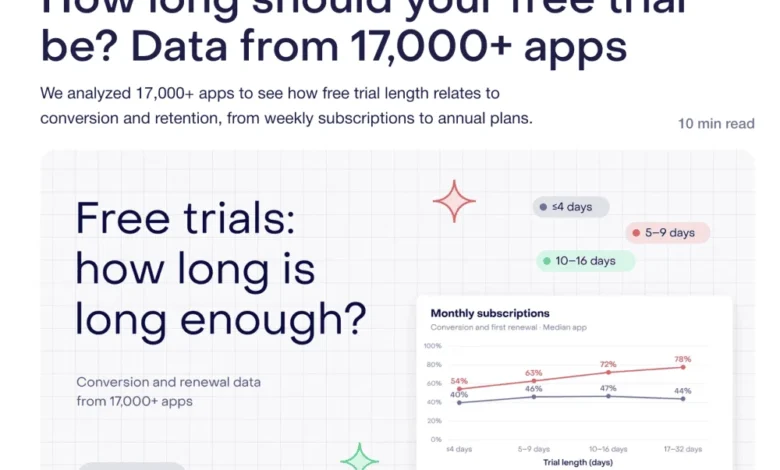
According to the data, monthly conversion rates peak at 10 to 16 days, achieving a conversion rate of 46.6 percent. Pushing trial durations beyond 16 days results in diminishing returns for initial conversion, although long-term renewal rates continue to climb. When calculating the combined percentage of users who both converted and renewed once, the 10-to-16-day window captured 30.6 percent of users, performing just as well as longer evaluation periods.
For standard B2B self-serve software, the traditional 14-day trial lands squarely within this optimal performance zone. Companies considering an expansion to a 30-day trial must weigh the marginal gains in customer retention against potential drops in initial conversion velocity.
The Cost of Eliminating Trials Entirely
Some early-stage software founders opt to remove free trials entirely in an effort to force immediate financial commitment and accelerate cash flow. However, RevenueCat’s renewal data highlights the hidden cost of this aggressive tactic.
For monthly subscriptions, buyers who purchased with no trial renewed at a rate of 49.5 percent—significantly lower than the 77.5 percent renewal rate achieved by users who transitioned through a 17-to-32-day trial. Annual subscriptions displayed a unique divergence: buyers who committed to an annual plan without a trial renewed at a rate of 26.6 percent, outperforming short trials of 9 days or less, but lagging behind trials lasting 10 days or longer.
Industry experts interpret this data by segmenting the buyer types. No-trial annual buyers typically represent high-intent, sales-assisted, or referral-driven customers who already understand the product’s value proposition prior to purchase. Conversely, users forced into an annual commitment after a fleeting 3-day trial represent the weakest, highest-churn cohort in the entire ecosystem. While eliminating trials can work if unit economics and pricing models are intentionally structured to absorb a higher churn rate, it remains a high-risk strategy for broad-market acquisition.
Artificial Intelligence Applications Face Strict Trial Ceilings
For companies operating in the B2B artificial intelligence sector, the study uncovers arguably its most critical insight. Unlike traditional software, AI-powered applications incur continuous operational expenses during evaluation: every prompt, query, and generated asset burns expensive server inference capacity.
The RevenueCat data reveals that extended trials are counterproductive for AI applications. On monthly AI plans, 5-to-9-day and 10-to-16-day trials converted at comparable rates (38.2 percent and 38.5 percent respectively), with the 10-to-16-day window offering superior renewal performance (64.2 percent versus 57.4 percent). However, when trials were extended to 17 to 32 days, monthly conversion for AI apps dropped precipitously to 31.8 percent, while renewal rates held flat at 64.1 percent. Providing two additional weeks of free inference yielded fewer paying customers and no discernible retention benefit.
Furthermore, AI applications consistently lagged behind non-AI apps in conversion and renewal across nearly all trial lengths. Consequently, product leaders in the B2B AI space must treat 14 days as a hard ceiling for time-based trials. If enterprise clients require extended evaluation periods to test complex AI agents or workflows, companies should enforce usage-based caps—such as limited credits, runs, or seat counts—rather than extending calendar duration, thereby protecting gross margins from runaway token costs.
Geographic Variations in Trial Performance
The study also underscores significant regional variations in how prospective buyers respond to trial structures. On annual plans, consumers and businesses across North America and Western Europe demonstrated higher conversion rates with every incremental step in trial length, peaking at the 17-to-32-day mark. The Asia-Pacific region followed a similar upward trajectory up to 16 days before experiencing a sharp decline.
For monthly plans, emerging markets—including the Middle East and Africa, India, Southeast Asia, and Latin America—exhibited peak conversion during shorter 5-to-9-day windows, while suffering the lowest conversions on extended trials. For example, the Middle East and Africa region achieved a 38.3 percent conversion rate on 5-to-9-day trials, which fell to 27.4 percent on trials lasting 17 to 32 days. Global SaaS expansion strategies must account for these regional divergences rather than deploying a monolithic global pricing page.
Implications and Strategic Takeaways for Industry Leaders
While RevenueCat notes that a portion of the retention lift observed in longer trials is correlational—users who remain active deep into a trial are inherently more disposed to purchase—the empirical benchmarks offer a compelling blueprint for optimization.
As software markets grow increasingly competitive, business leaders must audit the assumptions underlying their monetization models. The traditional practice of copying legacy B2B trial lengths without empirical validation may be quietly suppressing customer acquisition. By aligning trial duration with product complexity, financial commitment levels, and operational server costs, subscription businesses can unlock substantial, long-term revenue growth.