Why organizations too often fund the past instead of the future, and the four questions that can fix it.

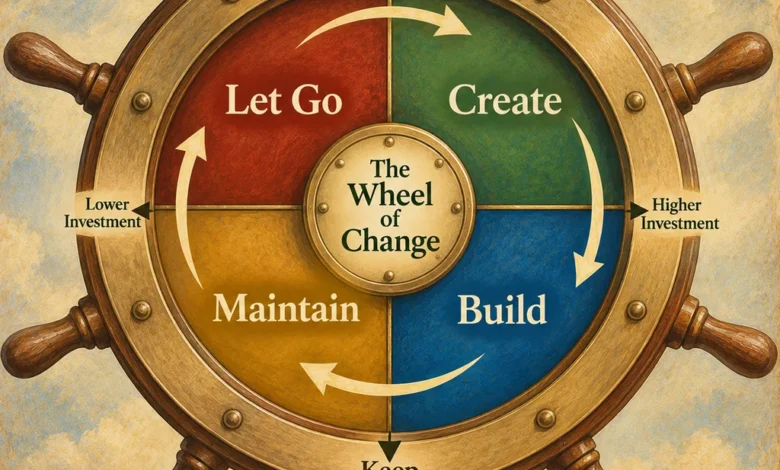
In the contemporary corporate landscape, the most persistent struggle for leadership is not merely the execution of strategy, but the rational allocation of capital across a spectrum of competing priorities. Organizations frequently fall into the "legacy trap," where historical performance dictates future resource allocation, often at the expense of necessary innovation. This misalignment between fiscal policy and strategic ambition frequently leads to the atrophy of competitive advantage. To address this, leadership experts have developed the Wheel of Change, a strategic framework designed to help executives distinguish between what must be nurtured, what must be scaled, and what must be systematically abandoned.
The Strategic Imperative: Contextualizing the Wheel of Change
The necessity for a structured approach to resource management is underscored by the accelerating pace of market disruption. Data from various market research firms indicates that the average lifespan of an S&P 500 company has plummeted from 61 years in 1958 to less than 20 years today. This compression of the business lifecycle forces leaders to make decisions faster and with less certainty than in previous decades.
The Wheel of Change, derived from principles popularized in best-selling management literature, offers a two-dimensional matrix that categorizes all organizational activities into four distinct quadrants: Create, Build, Maintain, and Let Go. These quadrants are mapped along axes of investment intensity and the degree of strategic transformation required. By evaluating business units, technologies, and even corporate cultures against this grid, leaders can identify where their "funding inertia"—the tendency to provide resources based on historical precedent—is actively hindering growth.
A Chronology of Strategic Evolution
The lifecycle of any successful initiative generally follows a predictable progression through the wheel, though few organizations manage this transition seamlessly.
- The Incubation Phase (Create): This initial stage involves high-risk, high-investment endeavors. It is the realm of the "unknown," where companies experiment with emerging technologies or untried market segments. Historically, this phase is often starved of capital because it fails to meet the short-term quarterly performance metrics that dominate modern boardroom discussions.
- The Scaling Phase (Build): Once an experiment proves viable, the organization shifts to the Build phase. This is characterized by aggressive capital infusion into infrastructure, talent acquisition, and market penetration. The primary objective here is to transition from "can this work?" to "how fast can we capture market share?"
- The Stewardship Phase (Maintain): As products or services reach maturity, they enter the Maintain phase. This is the "cash cow" period where organizations must balance efficiency with quality control. The risk here is not lack of investment, but rather over-investment or the mistaken belief that maintenance is a substitute for future-proofing.
- The Divestment Phase (Let Go): The final, and often most neglected, stage is the decision to sunset legacy assets. Whether it is an obsolete product line, a redundant technology stack, or a bureaucratic process that no longer serves the firm, this stage requires the courage to pivot away from the past.
Empirical Analysis: The Cost of Misallocation
Financial analysts have long documented the "sunk cost fallacy" within Fortune 500 capital expenditure budgets. Research consistently shows that companies that fail to reallocate resources—shifting capital from low-growth legacy divisions to high-growth innovation—underperform their peers by an average of 15% in total shareholder return over a five-year period.
The challenge is often psychological as much as it is financial. Middle management and even C-suite executives often develop emotional attachments to long-standing projects. Data suggests that departments responsible for "legacy activities" often command larger budgets due to established political power and historical precedence, rather than current market relevance. When leaders fail to force the "Let Go" transition, they essentially subsidize decline.
Expert Perspectives on Resource Reallocation
Management consultants and industry analysts often point to the "Resource Allocation Gap" as the primary reason for corporate failure. "The failure is rarely a lack of talent; it is a lack of courage," says Dr. Marcus Thorne, a strategist specializing in organizational transformation. "Boards often applaud the creation of a new, innovative product but remain silent when management fails to divest from the business unit that is bleeding cash to fund that innovation. The wheel only works if the ‘Let Go’ segment is exercised with as much vigor as the ‘Create’ segment."

The implication for leadership is clear: the most successful companies are those that view their budget not as a static record of the past, but as a dynamic reflection of their strategic future. This requires a rigorous audit of every line item in the budget.
Applying the Four Questions
To operationalize the Wheel of Change, leaders are encouraged to perform an annual or semi-annual review of their entire portfolio. This is not a task for the finance department alone, but for the entire executive leadership team. The process requires answering four critical questions for every business function:
- What should we create? This identifies the future engines of growth. If the answer is "nothing," the organization is stagnant.
- What should we build? This identifies the current engines of growth that require fuel to reach scale.
- What should we maintain? This identifies the core foundation that supports the company’s brand and ongoing operations.
- What should we let go? This identifies the drag on performance.
The "harder question," as noted by experts, is the alignment check: Does our current investment spend match our answers to these questions? If a company claims it is focused on creating a new AI-driven product line, but 80% of its R&D budget is still flowing into a legacy software division that is entering its decline phase, there is a fundamental disconnect.
The Broader Implications for Corporate Governance
The necessity of this framework extends to corporate governance. Shareholders are increasingly demanding transparency regarding how capital is deployed. When a corporation reports lackluster results, the narrative is often centered on market conditions or external headwinds. However, a closer look at the Wheel of Change often reveals that the internal allocation of resources was the true culprit.
The implication is a shift in how success is measured. Leaders who are evaluated solely on short-term EBITDA may find it difficult to invest in "Create" projects. Consequently, governance boards must consider incentivizing leaders based on the fluidity of their capital allocation. This includes rewarding the successful divestment of underperforming assets, which is currently rare in an environment that prizes top-line revenue growth at all costs.
Conclusion: The Turning Wheel
The Wheel of Change is not a static tool; it is a continuous loop. An organization’s inability to accept this cyclical nature often leads to institutional decay. The most successful global corporations—those that have remained relevant for over a century—demonstrate an uncanny ability to systematically dismantle their own successes before they become liabilities.
The core of effective leadership is the discipline to maintain this equilibrium. By ensuring that resources are constantly migrating from the "Let Go" column toward the "Create" column, executives can avoid the inertia that traps so many organizations in the past. In an era of rapid technological and social change, the wisdom to know when to start, when to scale, when to steady, and when to stop is the defining characteristic of a modern, resilient organization. The future of the firm does not depend on doing more; it depends on doing the right things, with the right resources, at the right time.
Related posts: