Navigating the New Frontier of AI Search Volatility: A Strategic Guide for Modern Marketing Teams

The digital landscape is undergoing a fundamental transformation as generative AI becomes the primary interface for information retrieval, introducing a level of unpredictability that renders traditional search engine optimization (SEO) tactics incomplete. For modern SEO managers, the era of stable keyword rankings has been supplanted by the age of Answer Engine Optimization (AEO), where volatility is no longer an anomaly but a constant feature. According to HubSpot’s State of AEO report, 58% of marketers were actively optimizing their content specifically for answer engines by the first quarter of 2026, reflecting a mass migration of resources toward this new medium. However, unlike the static, index-based nature of traditional search, AI search results are non-deterministic, creating a complex challenge for brands attempting to measure visibility, attribution, and overall performance.
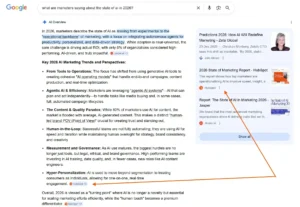
The mechanics of this volatility are rooted in the architecture of Large Language Models (LLMs). When a user inputs a query into platforms like ChatGPT, Gemini, or Perplexity, the model does not retrieve a pre-indexed list of links; rather, it synthesizes an answer based on its training data and real-time information retrieval capabilities. This process is inherently probabilistic. Research from SparkToro and Gumshoe.ai conducted in late 2025 revealed that when identical recommendation prompts were executed repeatedly, these AI models had less than a 1-in-100 chance of returning an identical brand list. This inconsistency means that a brand’s presence in an AI answer can fluctuate wildly from one session to the next, often without any changes to the underlying website or content strategy.
Understanding the Distinction Between Ranking and AI Volatility
To effectively manage this environment, stakeholders must distinguish between traditional SERP volatility and AI search volatility. In the traditional SEO context, Semrush Sensor or similar tools track movement across a fixed set of keywords, providing a score on a 0–10 scale that correlates with algorithmic updates from Google. AI search volatility, by contrast, refers to the shifting landscape of brand mentions, citations, and source authority within conversational interfaces.

The two metrics are not mutually exclusive; they are increasingly intertwined. Data from the 2026 State of AEO report indicates a significant correlation between high-ranking traditional pages and their likelihood of being cited in AI Overviews. Nevertheless, holding a top spot in Google does not guarantee a presence in AI summaries. Furthermore, the behavior of users is shifting; Pew Research Center data from March 2025 demonstrated that the presence of an AI summary in search results led to a traditional-result click in only 8% of user sessions, compared to 15% when no AI summary was present. This suggests that even if a brand maintains its traditional ranking, its actual traffic may decline as AI models consolidate the information directly on the results page.
Establishing a Methodology for Measurement and Benchmarking
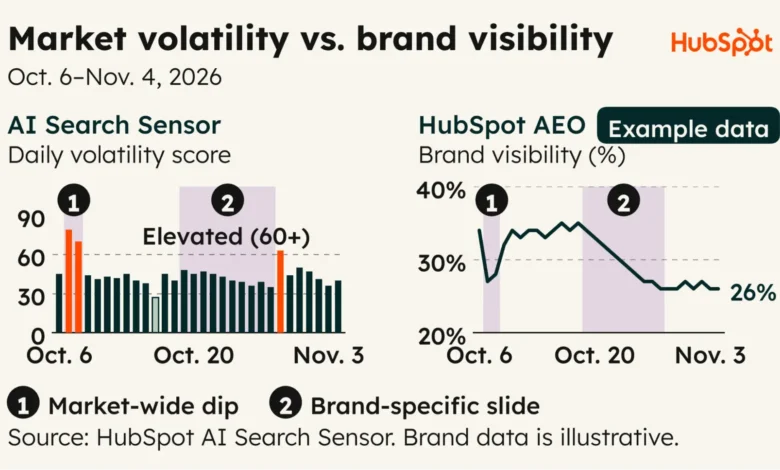
The primary risk for marketing teams is overreacting to daily fluctuations that are merely symptoms of the model’s non-deterministic nature. When visibility metrics dip, the immediate impulse to overhaul content strategy can be counterproductive. To mitigate this, organizations are adopting a benchmarking approach. By utilizing tools like HubSpot’s AI Search Sensor, teams can track daily volatility scores across four key indicators: mention rate, citation rate, citation type, and AI-referred traffic.
If a brand’s visibility declines in isolation, it suggests an internal issue, such as technical crawling errors, a drop in domain authority, or a mismatch between the content and the user’s intent. Conversely, if the drop aligns with a market-wide shift—as indicated by the Answer Engine Volatility Tracker—it points to broader changes in how the LLMs prioritize information. During these periods of "Elevated" or "Extreme" volatility (scores of 60 or higher), industry experts advise maintaining a steady course. Reactive changes during such windows often introduce more noise into the data, making it difficult to assess the true impact of the engine-level adjustments.
Chronology and Market Impact: The 2026 Shift

The rise of AI-centric search has been punctuated by significant model updates. In August 2026, the release of GPT-6 Astra triggered a notable ripple effect across the digital marketing ecosystem, as the model’s updated weighting criteria shifted which content types—such as comparison articles versus long-form blog posts—received the most citations. Organizations that had relied solely on static content formats found their share of voice fluctuating significantly during this transition period.
This volatility is further compounded by the lack of standardization in attribution. While Google Search Console has begun incorporating generative AI performance reports, these are limited to Google’s own ecosystem. For multi-channel visibility across ChatGPT, Gemini, and Perplexity, marketers are forced to build custom attribution models. As noted by MarketingProfs CCO Ann Handley, while traffic remains a vital indicator, it is increasingly insufficient as a standalone metric for success in an AI-dominated search environment. Companies are now encouraged to add "share of voice" and "citation volume" to their KPIs to capture the full picture of their digital footprint.
Strategic Reporting for Leadership
The challenge of communicating this volatility to leadership teams cannot be overstated. With 23% of B2B marketers identifying measurement as their primary AEO hurdle, the ability to contextualize data is a key competitive advantage. Effective reports for executives should be structured to bridge the gap between technical volatility and business impact.
A standard reporting framework should include:

- Business Impact: A clear summary of how AI-referred traffic influences the sales pipeline and conversion rates.
- Market Context: A comparative analysis of brand performance against a broader industry benchmark to isolate market-wide shifts from internal performance issues.
- Visibility Trends: A longitudinal view of brand mentions and citations across primary AI engines.
- Qualitative Analysis: Insights into why specific content formats are currently gaining traction.
- Actionable Recommendations: Evidence-based adjustments to the content roadmap based on the previous quarter’s trends.
By filtering data through custom properties in CRM systems—such as identifying "AI Referrals" within source properties—marketers can track the full customer journey from the initial AI interaction to the final purchase. Adding a "How did you hear about us?" field to lead-generation forms remains an essential, if manual, verification step for identifying buyers influenced by AI discovery.
Broader Implications and Future Outlook
The broader implication of AI search volatility is the end of the "set it and forget it" era of SEO. As LLMs continue to evolve, the criteria for being cited will likely shift toward factors like data accuracy, structured formatting, and the ability to provide concise, authoritative answers. The reliance on non-deterministic models means that brands must adopt an agile posture, favoring high-quality, verifiable information that can be easily parsed by AI.
Furthermore, as legal and ethical scrutiny of AI training data grows, the relationship between publishers and AI companies is expected to change. Potential shifts in licensing and data-sharing agreements may redefine what constitutes a "citation," adding yet another layer of potential volatility. For now, the most resilient organizations are those that treat AI search not as a replacement for traditional search, but as a distinct channel requiring its own dedicated measurement infrastructure, consistent benchmarking, and a measured response to the inevitable swings in visibility.
As the industry moves through the remainder of 2026 and into 2027, the focus for SEO professionals will remain on the balance between algorithmic compliance and brand identity. While the technical,, and often frustrating, nature of AI volatility will persist, the ability to parse noise from meaningful trends will separate the leaders in the space from those still struggling to reconcile outdated metrics with the new reality of generative AI. Success will depend on the synthesis of traditional analytical rigor with a new, flexible strategy capable of navigating the unpredictable nature of machine-generated answers.