The landscape of digital retail is undergoing a structural shift as developers move away from the binary choice of restrictive, template-based platforms or the arduous task of building commerce infrastructure from the ground up. The emergence of headless commerce platforms, such as Thor Commerce, has fundamentally altered this paradigm, allowing developers to maintain a robust, purpose-built backend while retaining total control over the frontend customer experience. By integrating this headless architecture with AI-driven coding assistants like Claude Code, Cursor, or Codex, businesses can now accelerate the development of high-performance, branded digital storefronts with unprecedented efficiency.
The traditional dilemma in ecommerce development has long been defined by high-stakes trade-offs. Choosing a rigid, "monolithic" platform often guarantees stability but imposes severe limitations on design, user experience (UX), and unique brand identity. Conversely, building a custom solution from scratch demands months of intensive labor to replicate critical commerce logic, including complex catalog management, dynamic pricing, inventory tracking, secure checkout flows, and customer account persistence. Headless commerce reconciles these two extremes by separating the commerce engine—the "plumbing" of the store—from the application layer, which serves as the canvas for the brand’s unique buying journey.
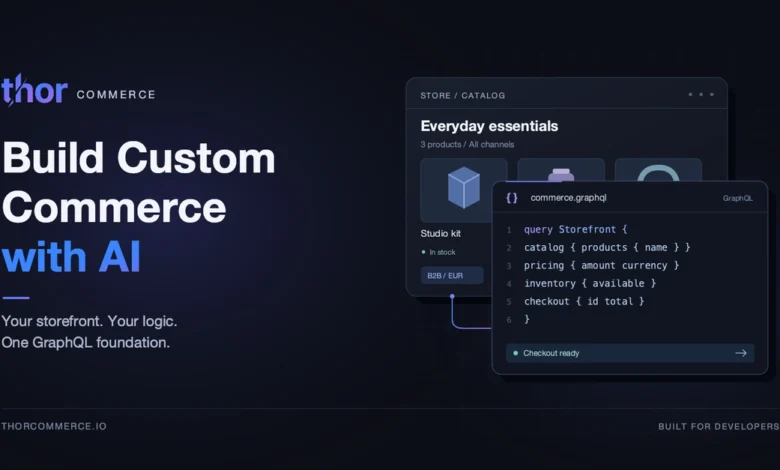
Thor Commerce has emerged as a significant player in this space, offering a platform designed for B2B, DTC (Direct-to-Consumer), and hybrid businesses. By managing the complexities of the commerce engine while providing a flexible GraphQL-based API, Thor enables developers to query only the data necessary for a specific storefront. This approach, supported by generated TypeScript types, ensures that the storefront remains strictly aligned with the schema, reducing the potential for runtime errors and maintaining data integrity across all customer interactions.
One of the most compelling advantages of this architecture is its synergy with AI coding agents. For an AI to be effective in a development workflow, it requires clear boundaries and a reliable source of truth. Ecommerce, by its nature, is a high-stakes environment where errors in tax calculation, stock availability, or payment processing can have direct financial and legal consequences. Thor Commerce provides these necessary guardrails by defining the commerce contract, effectively limiting the agent’s scope to UI and experience logic while protecting the integrity of the transaction engine.

The development workflow begins with a reference implementation rather than a blank canvas. Developers start by cloning the Thor Commerce Next.js storefront, which utilizes modern web standards including React, Next.js, and GraphQL. This foundation is not a locked theme; it is a functional starting point that includes the essential components, routes, and queries required for a modern store. The developer’s task is not to reinvent the wheel, but to iterate upon a functional model.
The process of connecting a storefront to the Thor backend involves a precise sequence of configuration steps. Developers must manage project slugs, storefront API tokens, and market-specific settings—such as currency, country-specific availability, and price channels—within a secure, server-side environment. By isolating these credentials, developers ensure that sensitive data is never exposed in the browser or committed to public repositories, adhering to security best practices essential for any retail application.
A critical phase in this development cycle is the generation of typed GraphQL clients. By running a codegen command, the application synchronizes its internal data structures with the backend schema. This synchronization is what allows AI agents to function with such precision. Because the agent can "read" the schema and the project’s documentation—often encapsulated in dedicated files like AGENTS.md—it understands exactly which fields are available and how they should be handled. This prevents the agent from "hallucinating" data structures that do not exist, a common pitfall in less structured development environments.
For instance, when customizing the user interface, a developer can instruct an AI agent to redesign a product page while maintaining the integrity of the data flow. The instructions might specify: "Redesign the product detail page for a high-end Scandinavian aesthetic while keeping the existing variant selection and market-aware pricing intact." Because the backend logic is handled by Thor, the AI agent is free to focus on CSS modules, accessibility, and component architecture without risking the functionality of the cart or checkout process.
The implications of this development model extend beyond simple aesthetic customization. It allows for the rapid implementation of advanced features, such as custom metafields. A business can define a specific material specification, or a set of sustainability certifications, and have these fields validated and surfaced throughout the frontend with minimal manual coding. The AI agent can assist in updating the GraphQL selection and the UI components, while the developer verifies the change through a standard linting and build process.

Testing, however, remains the most vital component of this workflow. A commerce site is not truly "ready" until the full end-to-end journey has been verified. This includes the entire lifecycle of a purchase: from product discovery and variant selection to cart persistence across sessions, shipping method calculations, tax application, and final payment processing. By using AI agents to generate unit and integration tests that check for failure paths—such as out-of-stock items or expired customer sessions—developers can ensure that their storefront is robust and prepared for real-world usage.
The broader impact of this technological shift is the democratization of high-quality commerce development. Small to medium-sized enterprises (SMEs) that previously lacked the budget for custom development teams can now leverage AI and headless platforms to build experiences that rival those of enterprise-level competitors. The ability to deploy on high-performance infrastructure, such as Cloudflare Workers, further lowers the barrier to entry, providing enterprise-grade speed and reliability out of the box.
Looking toward the future, the integration of AI into the software development lifecycle (SDLC) for ecommerce is likely to become the industry standard. As platforms continue to refine their GraphQL schemas and documentation, the "contract" between the backend engine and the frontend application will become even more explicit, allowing AI agents to perform increasingly complex architectural tasks.
In summary, the transition to headless commerce is not merely a technical migration; it is a strategic shift that empowers brands to prioritize customer experience without compromising on operational reliability. By establishing a clear separation between commerce logic and the customer-facing interface, and by utilizing AI agents as highly skilled assistants rather than architects of the system, businesses can build, test, and iterate with unprecedented speed. Whether for a specialized B2B portal or a high-volume DTC storefront, the combination of Thor Commerce and AI-assisted development provides a repeatable, secure, and scalable framework for the modern digital economy. The era of choosing between rigid templates and endless custom development has ended, replaced by an era of modular, AI-accelerated commerce innovation.