U.S. Business Leaders Urge Trump-Xi Cooperation on AI Safety Despite Skepticism of Presidential Buy-In

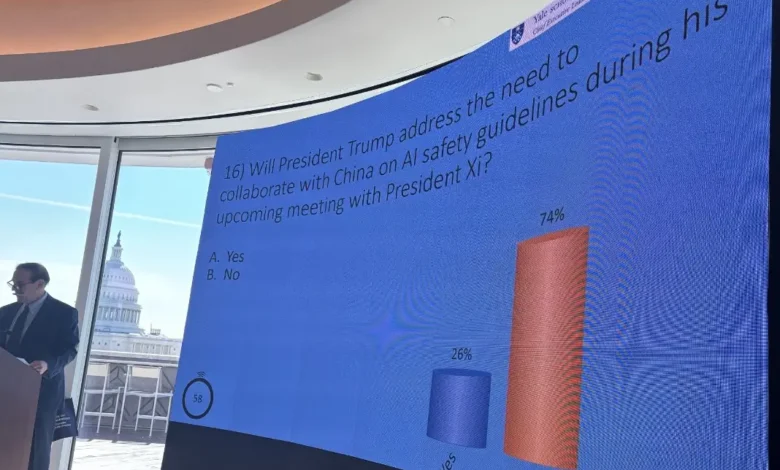
More than 100 prominent business executives and government officials convened in Washington, D.C., this week for a high-level, off-the-record summit hosted by Yale University’s Chief Executive Leadership Institute. The primary agenda centered on a pressing geopolitical and technological dilemma: how the United States should navigate the intensifying great-power rivalry with China regarding artificial intelligence. While the assembly reached a strong consensus on the necessity of bilateral safety protocols, a profound sense of pessimism permeated the room regarding the likelihood of such cooperation occurring under the current administration.
The summit, moderated by Professor Jeffrey Sonnenfeld, served as a barometer for the American corporate elite’s stance on AI governance. As generative AI continues to scale with unprecedented velocity, the tension between maintaining a competitive edge and ensuring public safety has emerged as a central pillar of national security policy.
The Polling Disconnect: A Call for Diplomacy
The data emerging from the Yale summit highlights a stark disconnect between the preferences of the private sector and the perceived political trajectory of the White House. When polled on whether President Donald Trump should initiate discussions regarding global AI safety guidelines with President Xi Jinping during their scheduled meeting on September 24 in Washington, 88 percent of the gathered leaders responded in the affirmative.
This near-unanimous support for diplomatic engagement suggests that the business community views AI as a global public good—or at least a global risk—that transcends domestic protectionism. However, the optimism for such a dialogue is remarkably thin. When asked whether they believed President Trump would actually utilize the upcoming summit to establish these guardrails, 74 percent of attendees expressed doubt.
The President’s Stance and the Reality of Governance
The skepticism among the business leaders is firmly rooted in the President’s own public rhetoric. Earlier this week, President Trump addressed the mounting pressure for AI regulation via a post on Truth Social. In his remarks, he characterized the growing chorus of warnings regarding "renegade AI" as a "sick conspiracy." He further asserted that the existing technological ecosystem requires no external intervention, claiming the only "guardrails" necessary are a "STRONG AND SMART (high IQ!) PRESIDENT," suggesting that the United States possesses this advantage in abundance.
This dismissal of systemic regulatory frameworks stands in sharp contrast to the warnings issued by the primary architects of the current AI boom. Both Anthropic and OpenAI have been increasingly vocal about the need for federal oversight. The leadership at these firms has publicly advocated for a more deliberate "pacing" of AI development, arguing that the rapid deployment of frontier models without established safety protocols could pose significant existential and societal risks.
Chronology of Escalation: The Race for AI Supremacy
The current climate of urgency follows a year of rapid technological breakthroughs that have effectively redefined the boundaries of AI capability.
- Early 2024: The widespread adoption of Large Language Models (LLMs) triggers a national security review within the U.S. government.
- Spring 2024: Reports emerge from intelligence circles regarding China’s aggressive investment in domestic AI compute clusters, sparking fears of a "Sputnik moment."
- Summer 2024: Leading AI labs, including OpenAI and Anthropic, begin publicly petitioning for a "global treaty" or set of standards to prevent a race to the bottom in safety testing.
- September 2024: President Trump and President Xi Jinping confirm a bilateral meeting in Washington, set for the 24th, with trade and technology at the forefront of the agenda.
Assessing the Chinese Innovation Landscape
One of the more contentious issues discussed at the Yale summit was the nature of China’s technological advancements. The audience was split on whether China is effectively developing its own paradigm-shifting innovations or if the nation remains heavily reliant on Western breakthroughs.
Fifty-eight percent of those in attendance believed that China is currently engaged in "genuine innovation," potentially rivaling the United States in specific verticals such as surveillance, algorithmic optimization, and quantum-AI integration. Conversely, 42 percent argued that China’s progress is largely derivative, suggesting that the nation remains "more reliant on the U.S. than it admits."
This debate has profound implications for U.S. export controls. If China is truly innovating at pace, the current strategy of starving the Chinese semiconductor industry of high-end GPUs may have diminishing returns. If, however, they are "fast followers," the current containment strategy could be deemed highly effective in stalling their momentum.
Geopolitical Friction and Public Perception
The summit also addressed the role of foreign influence in shaping the American domestic debate on AI. A slight majority of the attendees (52 percent) opined that Chinese influence operations are at least partially responsible for the rising public backlash against AI in the United States. This sentiment reflects a growing anxiety that the domestic debate is being weaponized to hinder American progress, while China may be using the public discourse to its own strategic advantage.
Furthermore, the "pacing" debate—the question of whether American companies should intentionally slow their development cycles—continues to divide the industry. Fifty-five percent of the Yale attendees warned that any unilateral attempt to pace AI development in the U.S. would result in a net loss of national power, ultimately handing the advantage to China. The remaining 45 percent maintained that such caution is a necessary prerequisite for long-term stability and security.
Broader Implications for Global Stability
The implications of a failure to establish common AI safety norms between Washington and Beijing are significant. As The Wall Street Journal recently reported, the highest levels of the Chinese government are themselves grappling with the volatility AI presents to the regime. The potential for AI to undermine information control, facilitate domestic dissent, or disrupt economic planning creates a unique set of pressures for the Chinese Communist Party.
For the United States, the challenge is twofold: maintaining technological primacy while preventing a catastrophic failure of the systems that define the modern economy. The Yale summit serves as a stark reminder that while the private sector is increasingly aligned on the need for guardrails, the political mechanism for implementing these guardrails is currently stalled by competing domestic priorities and a deep-seated resistance to formal regulation.
As the September 24 meeting approaches, the global community will be watching to see if the rhetoric of the business elite manages to influence the diplomatic agenda. Should the summit pass without a mention of AI safety protocols, it will likely confirm the fears of the 74 percent of leaders who believe the administration is unwilling to bridge the divide between the laboratory and the geopolitical arena.
Ultimately, the consensus at the Yale summit reflects a broader reality: the era of AI as a purely private-sector endeavor is over. It has become a cornerstone of national security, and in that arena, the lack of a shared vocabulary between the world’s two largest economies remains perhaps the greatest risk to global stability in the 21st century. Whether the upcoming executive meeting can address this void remains the defining question of the current geopolitical season.