ChartMogul Launches AI-Powered Subscription Analytics Analyst to Revolutionize Revenue Intelligence

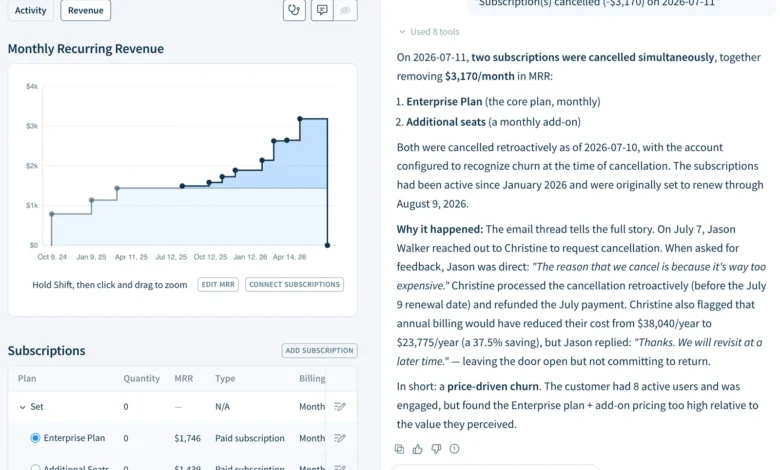
Subscription analytics platform ChartMogul has officially launched ChartMogul AI, a native data analyst designed to investigate underlying revenue movements, trace metric changes back to individual customer activities, and demystify complex financial data. The release marks a significant milestone for the 12-year-old software-as-a-service (SaaS) company, aiming to bridge the gap between high-level headline metrics and the granular customer interactions that drive them. In tandem with the product launch, ChartMogul has announced that its core CRM features will now be available to all platform users free of charge, removing previous paywalls associated with email integrations and customer context gathering.
Background and Context in Subscription Analytics
For over a decade, subscription businesses have grappled with the inherent messiness of recurring revenue data. Calculating accurate metrics requires accounting for a labyrinth of variables, including upgrades, downgrades, churn, reactivations, multi-component subscriptions, refunds, credits, and multi-currency conversions. While platforms like ChartMogul have successfully automated the foundational logic required to translate raw billing scenarios into reliable metrics, understanding the narrative behind those numbers has traditionally demanded substantial time, technical skill, and manual filtering.
Historically, deep-dive data investigations were restricted to high-stakes scenarios such as imminent fundraising rounds, quarterly board meetings, unexpected metric fluctuations, or major pricing overhauls. Day-to-day operations typically relied on surface-level dashboard monitoring—checking Annual Recurring Revenue (ARR) to confirm it aligned with general expectations before moving on. ChartMogul AI has been engineered to democratize these complex investigations, allowing users to initiate comprehensive data queries simply by typing natural language questions directly into the platform.
Technological Architecture and Multi-Step Investigation Capabilities
Unlike generic AI chatbots pasted onto existing dashboards, ChartMogul AI is deeply integrated into the platform’s core architecture. It possesses native awareness of the specific reports, segments, and customer records currently viewed by the user. Rather than merely summarizing visual charts, the AI can perform multi-step investigations by selecting relevant metrics, constructing precise filters, and synthesizing findings from multiple disparate data streams.

To answer sophisticated business queries, the system bridges financial data with customer relationship management (CRM) records, product usage metrics, and direct customer interactions. Unstructured information—such as customer cancellation emails, support notes, call logs, and feedback transcripts—is preprocessed to extract actionable intelligence, including specific cancellation reasons, competitor mentions, and prevailing customer sentiment.
The engineering team behind the feature emphasized that the reliability of the AI stems from specialized guardrails built specifically for subscription analytics. Rather than relying solely on large language models to guess filters or choose tools, the system employs modular sub-agents. A specialized routing mechanism selects appropriate tools for each query, while a dedicated filter-building agent cross-references active subscription plans and tags before writing queries in ChartMogul Filter Language (CFL). Furthermore, data links are securely attached to the underlying data layer to prevent AI hallucination or inaccurate referencing.
Elimination of CRM Paywalls to Enhance AI Context
A critical bottleneck for AI-driven revenue analysis has been the fragmentation of customer data. To generate accurate and meaningful insights, predictive analytics tools require comprehensive context regarding customer behavior and communication history. Recognizing this limitation, ChartMogul has fundamentally restructured its platform access by integrating ChartMogul CRM directly into the core offering at no additional cost.
Previously, connecting email accounts and unlocking advanced CRM capabilities required users to purchase dedicated CRM Pro seats. By eliminating paid CRM seats entirely, the company enables every user to connect their inbox and leverage the complete suite of CRM features. This strategic shift ensures that the AI model has maximum visibility into customer interactions, thereby improving the depth, accuracy, and relevance of its analytical outputs.
Product Integration and Current Capabilities
ChartMogul AI introduces contextual entry points throughout the software interface. Users viewing a recently canceled subscription, for example, can trigger a targeted investigation into that specific customer’s lifecycle history with a single click. Furthermore, complex multi-variable segmentation—such as comparing ARR growth and net revenue retention across various geographic regions—can now be executed via natural language prompts rather than manual dashboard configuration.
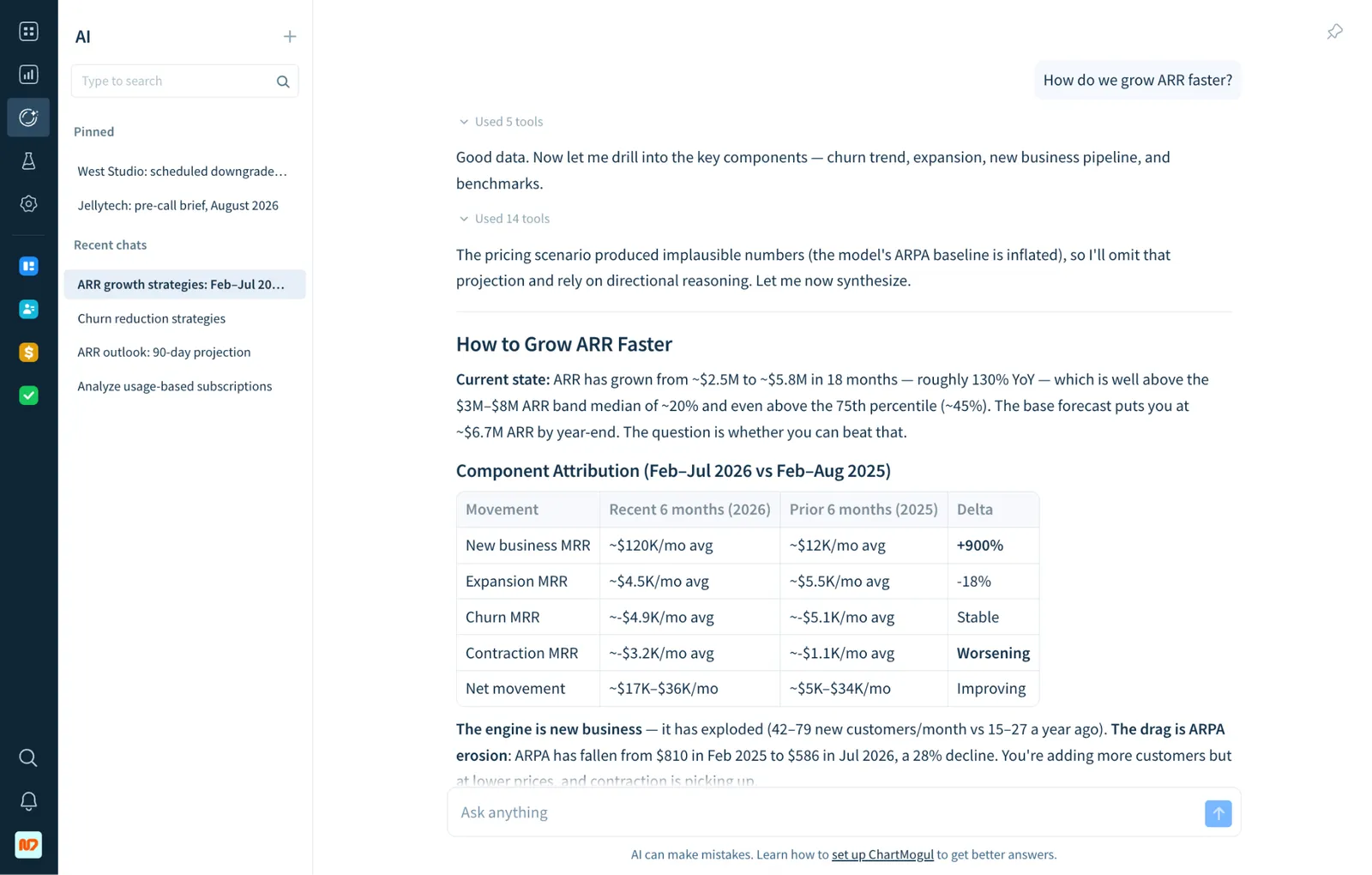
While the current iteration of ChartMogul AI operates in a read-only capacity, the company has outlined plans to introduce write actions and advanced workflow automation in future updates. The tool currently leverages advanced foundational models provided by Anthropic, supplemented by proprietary domain expertise developed over twelve years of recurring-revenue data management.
The release complements ChartMogul’s broader AI strategy, which includes an extensive Model Context Protocol (MCP) server featuring over 80 specialized tools. This MCP infrastructure provides verified listings in integration directories for platforms such as Claude and ChatGPT, enabling developers and enterprise teams to query secure ChartMogul data from within general-purpose AI environments.
Industry Implications and Future Outlook
The introduction of ChartMogul AI signals a broader paradigm shift across the enterprise software sector: the transition from static dashboards to conversational, action-oriented analytics systems. While traditional data visualization tools, charts, and manual filters will retain their utility, industry observers note that conversational interfaces are rapidly becoming the primary layer for deep data exploration.
By reducing the friction associated with querying financial databases, tools like ChartMogul AI lower the barrier to entry for operational decision-making. Founders, finance teams, and customer success managers can now investigate complex revenue trends without depending entirely on dedicated data analysts or complex SQL queries.
ChartMogul AI is available immediately to platform users. As businesses increasingly adopt AI-driven analytics, the success of such platforms will depend heavily on their ability to maintain data integrity while simplifying the complex mechanics of recurring revenue management.