Evernote vs OneNote: The Best App for Note-Taking, Researching and Organizing? | Process Street | Compliance Operations Platform


The Evolution of Personal Knowledge Management
The landscape of digital note-taking has shifted dramatically over the past decade. Initially, applications like Evernote dominated the market by positioning themselves as "Everything Buckets"—centralized repositories designed to house everything from web clippings and receipts to high-level project drafts. However, as the volume of digital information has exploded, users have increasingly struggled with "archive decay," a phenomenon where massive, unindexed collections of data become essentially useless.
Benjamin Brandall, a writer for Process Street, highlighted the volatility of this user experience after a personal hardware crisis. Following the destruction of his primary workstation, Brandall spent two years exclusively in the Windows ecosystem before transitioning back to macOS. This period served as an accidental longitudinal study, revealing that while Evernote remains a powerhouse for structured retrieval, the freeform, canvas-based nature of OneNote offers a distinct advantage for those who prioritize visual and spatial organization.
Technical Comparison: Structural Frameworks
At the core of the Evernote vs. OneNote debate lies a fundamental difference in architecture. Evernote utilizes a hierarchical model based on notebooks, stacks, and tags. This system is designed for high-density information retrieval. A note in Evernote is a discrete entity that can be tagged with multiple labels, allowing it to exist in several conceptual contexts simultaneously. This makes it highly efficient for users who need to perform advanced searches across thousands of disparate items using complex Boolean logic and metadata filters.

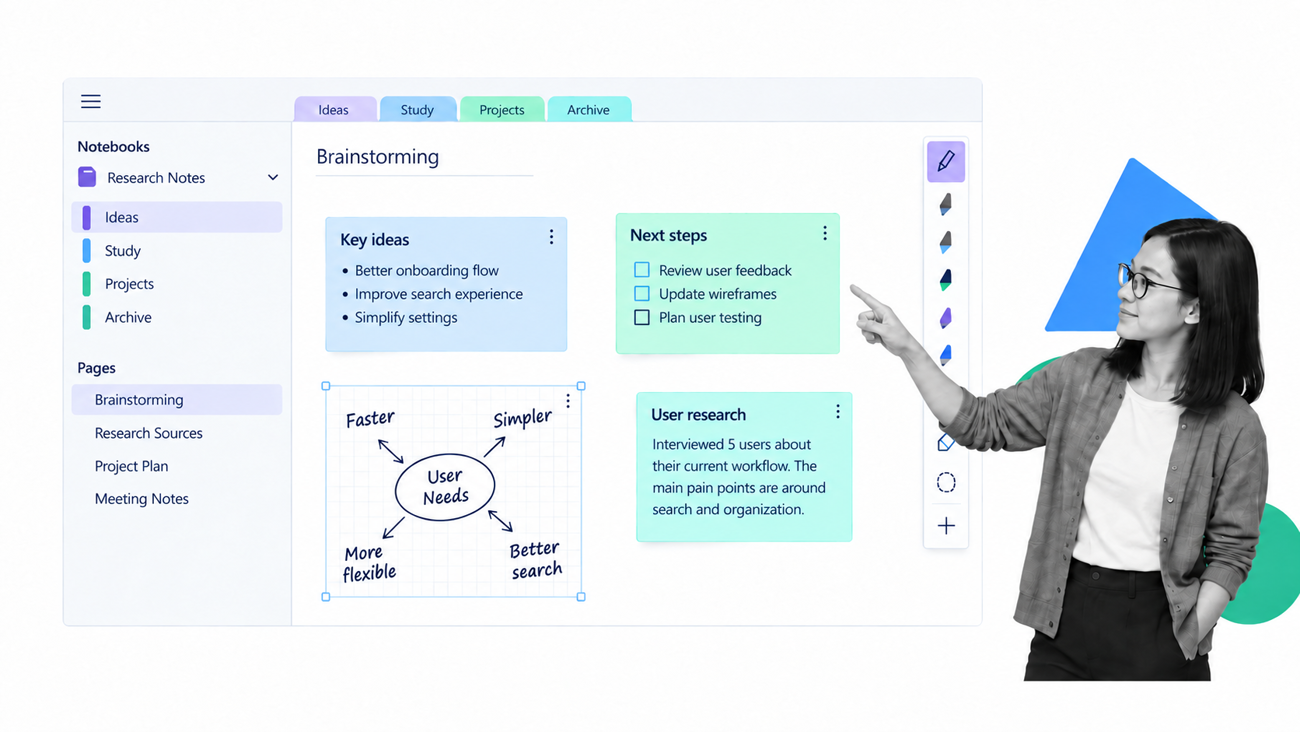
Conversely, OneNote operates on a spatial canvas. It organizes information into notebooks, section groups, sections, and pages. Unlike a traditional word processor, OneNote allows users to click anywhere on the page to create text containers, images, or sketches. This design mimics a physical whiteboard or a researcher’s scrapbook, making it particularly effective for brainstorming sessions where the relationship between ideas is as important as the ideas themselves.
Comparative Data and Feature Sets
To understand the functional divide, one must examine the specific tools each platform provides for distinct tasks.

| Feature Category | Evernote | OneNote |
|---|---|---|
| Primary Philosophy | Structured, searchable archive | Freeform, spatial canvas |
| Organization | Notebooks, tags, stacks | Sections, pages, subpages |
| Web Research | Advanced clipping, annotation | Basic capture to notebook |
| Editor Interface | Linear, formatted, document-like | Spatial, multi-container layout |
| Search Capabilities | Advanced syntax, OCR, filters | Scoped by section/notebook |
| AI Integration | AI-assisted search and recall | Microsoft Copilot (M365) |
The Role of Web Clipping and Information Capture
One of the most persistent reasons for Evernote’s market longevity is its Web Clipper. This tool allows users to strip away advertisements and clutter from web pages, saving them into a clean, annotated format. It is an essential utility for journalists, researchers, and students who must synthesize large amounts of external data.
OneNote also offers a Web Clipper, but its integration is geared toward placing content into a specific section of a notebook for later reference. Where Evernote excels at "capture and forget" (knowing the search index will find it later), OneNote excels at "capture and manipulate." For instance, a student might use OneNote to clip a diagram, move it to the side of the page, and annotate it with handwritten notes using a stylus—a task for which Evernote’s linear interface is less optimized.

Implications of Artificial Intelligence
The current wave of generative AI has reshaped how both platforms function. Evernote has introduced features that leverage AI to summarize notes, perform natural language searches, and assist in editing. This is particularly useful for users with large, legacy archives who need to retrieve specific data points from documents captured years ago.
OneNote, supported by Microsoft’s deep investment in AI, offers Copilot integration for eligible Microsoft 365 users. Copilot can generate ideas, summarize long-form meeting notes, and help restructure complex pages. Because it operates within the broader Microsoft ecosystem, it is uniquely positioned for enterprise users who are already utilizing Word, Excel, and Outlook.

The "Everything Bucket" Trap and Organizational Strategy
A recurring issue for both platforms is the "Everything Bucket" trap. When users treat these apps as a dumping ground for every screenshot, PDF, and URL, they inevitably create a digital landfill. The effectiveness of either tool is ultimately determined by the user’s maintenance routine.
Experts suggest a "capture-to-curation" workflow. In this model, an inbox—whether it is a specific notebook in Evernote or a dedicated "Quick Notes" section in OneNote—should be emptied and processed on a weekly basis. Disposable information, such as temporary screenshots, should be deleted or moved to an archive, while high-value project research should be moved into active project folders.

Failure to perform this maintenance leads to "archive clutter," where the sheer volume of data makes finding relevant information impossible, even with advanced search algorithms. Users who successfully maintain these systems often find that they spend less time searching and more time synthesizing, regardless of which application they choose.
Choosing the Right Tool for the Task
The decision between Evernote and OneNote should be dictated by the specific "output" of the user.

- Choose Evernote if: You manage a high volume of web-based research, require sophisticated tagging to cross-reference projects, and rely on advanced search filters to navigate a massive, long-term archive.
- Choose OneNote if: You require a flexible, paper-like surface for visual thinking, frequently use a stylus for handwritten annotations, or are deeply embedded in the Microsoft 365 enterprise environment.
The Intersection of Knowledge Management and Workflow
It is important to recognize that note-taking applications are not substitutes for operational software. A common failure in modern workplace productivity is the attempt to use a note-taking app to manage complex, multi-stage workflows that require accountability, deadlines, and approvals.
When research transitions from a "note" to a "procedure," it should move into an operations platform. For example, a marketing team might use OneNote to brainstorm a campaign strategy, but once the strategy is approved, the actual execution—tasks, approvals, and compliance—should occur in a dedicated platform like Process Street. This separation ensures that the note-taking environment remains a clean space for ideation, while the operational environment remains a secure, governed record of truth.
Final Synthesis: The Human Element
Ultimately, no software can replace the cognitive habit of intentional organization. Whether one prefers the rigid, indexed structure of Evernote or the loose, visual freedom of OneNote, the value derived from these tools is a product of the user’s discipline. A robust setup should support ordinary outputs without unnecessary ceremony. It should facilitate the transition from a rough idea to a refined document, and finally, into a completed action. By defining clear boundaries for how data is captured, stored, and eventually archived, users can turn their digital note-taking apps from cluttered scrapbooks into powerful engines for professional and academic success.