ChartMogul Unveils Native Subscription AI Analyst and Makes CRM Integration Free for All Users

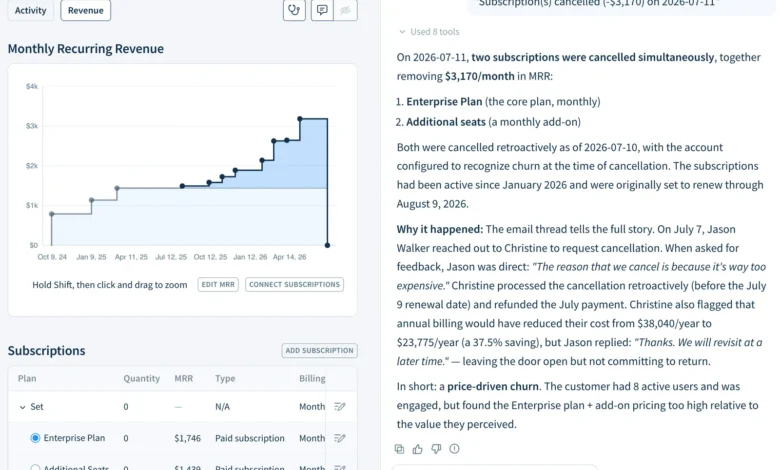
The subscription analytics landscape shifted significantly today as ChartMogul, a leading player in recurring-revenue management, officially launched ChartMogul AI. Billed as an embedded intelligent analyst rather than a superficial dashboard chatbot, the newly released tool is engineered to investigate raw subscription data, trace metric fluctuations back to individual customer accounts, and synthesize contextual qualitative factors behind headline financial figures. Alongside the software rollout, the company announced that its integrated Customer Relationship Management (CRM) platform is now completely free for all users, removing prior paywalls associated with email syncing and advanced customer context tracking.
Decoding the Complexity of Subscription Metrics
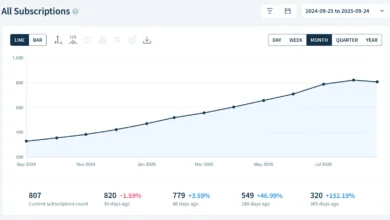
For nearly twelve years, software-as-a-service (SaaS) providers and subscription businesses have grappled with the intricacies of handling accurate billing data. Subscription metrics are notoriously difficult to standardize. Translating thousands of real-world billing scenarios—ranging from mid-cycle upgrades, tier downgrades, and involuntary churn to reactivations, multi-component subscriptions, refunds, credits, and multi-currency conversions—requires rigorous underlying logic. Without sophisticated data processing, financial dashboards frequently produce misleading figures that demand constant manual explanation during board meetings or investor updates.
While platforms like ChartMogul have historically automated the heavy lifting of calculation, uncovering the qualitative "why" behind quantitative shifts has remained a labor-intensive endeavor. Executives, finance teams, and product managers typically needed specialized knowledge of data models, proficiency in applying complex filters, and substantial time to trace anomalies. Consequently, deep-dive investigations were usually reserved for high-stakes inflection points, such as pricing model overhauls, major fundraising rounds, or sudden, inexplicable contractions in Annual Recurring Revenue (ARR). In daily operations, teams generally checked top-line numbers, confirmed alignment with expectations, and moved forward. The introduction of ChartMogul AI is designed to lower the friction of these investigations, allowing users to initiate complex data inquiries simply by typing natural language questions.
Inside the Architecture: Beyond Surface-Level Chatbots
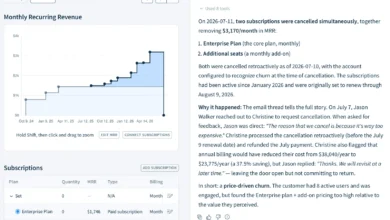
Unlike generic AI add-ons that merely describe visual charts or summarize static web pages, ChartMogul AI is deeply embedded within the core infrastructure of the product. The tool possesses the capability to execute multi-step operations: selecting relevant metrics, constructing precise data filters and segments, inspecting granular customer movements, incorporating qualitative CRM context, and synthesizing coherent narrative summaries.

A critical limitation of traditional financial reporting is its focus on numerical outcomes. Revenue metrics reliably illustrate what occurred within a business, but explaining why those events transpired often requires qualitative context. To bridge this gap, ChartMogul AI processes unstructured information—including customer service interactions, email correspondence, support tickets, internal account notes, and call logs. By preprocessing this unstructured text, the system extracts critical insights such as specific cancellation rationales, competitor mentions, customer sentiment trends, and direct product feedback, making them queryable even across high data volumes.
Engineering teams behind the feature emphasized that the depth of the AI’s capability stems from specialized architectural guardrails rather than relying solely on off-the-shelf language models. Engineers noted that general-purpose AI systems frequently fail in financial contexts due to tool misselection, filter-guessing errors, and shallow analytical investigations. To counteract these vulnerabilities, ChartMogul implemented a multi-agent structure. A dedicated secondary agent verifies plan names and structural tags before constructing queries using ChartMogul Filter Language (CFL). Furthermore, predefined behavioral skills guide the system through step-by-step investigative workflows tailored to specific types of business questions, ensuring that generated links and customer records remain strictly bound to verifiable underlying data points.
Strategic Shift: CRM Features Now Included at No Additional Cost
To power its analytical depth, ChartMogul AI requires a comprehensive view of the customer lifecycle. Recognizing that financial metrics alone provide an incomplete picture, company leadership made the strategic decision to dissolve the paywall surrounding its proprietary CRM tool.
Previously, users wishing to synchronize external email communications or access advanced CRM functionality were required to purchase a dedicated, paid "CRM Pro" seat. Effective immediately, these paid seats have been eliminated. Every active ChartMogul user can now connect their corporate inbox and utilize the platform’s full suite of CRM capabilities without incurring incremental fees. By broadening access to qualitative customer touchpoints, the company aims to feed its newly minted AI engine a richer, more continuous stream of operational data, thereby improving the accuracy and depth of automated analytical insights.
Integration with General-Purpose AI and Ecosystem Expansion
The launch of ChartMogul AI builds upon the company’s broader technological roadmap initiated earlier in the year. In June, the firm released an expanded version of its Model Context Protocol (MCP) server, featuring more than 80 specialized tools integrated directly into developer directories for platforms like Anthropic’s Claude and OpenAI’s ChatGPT.
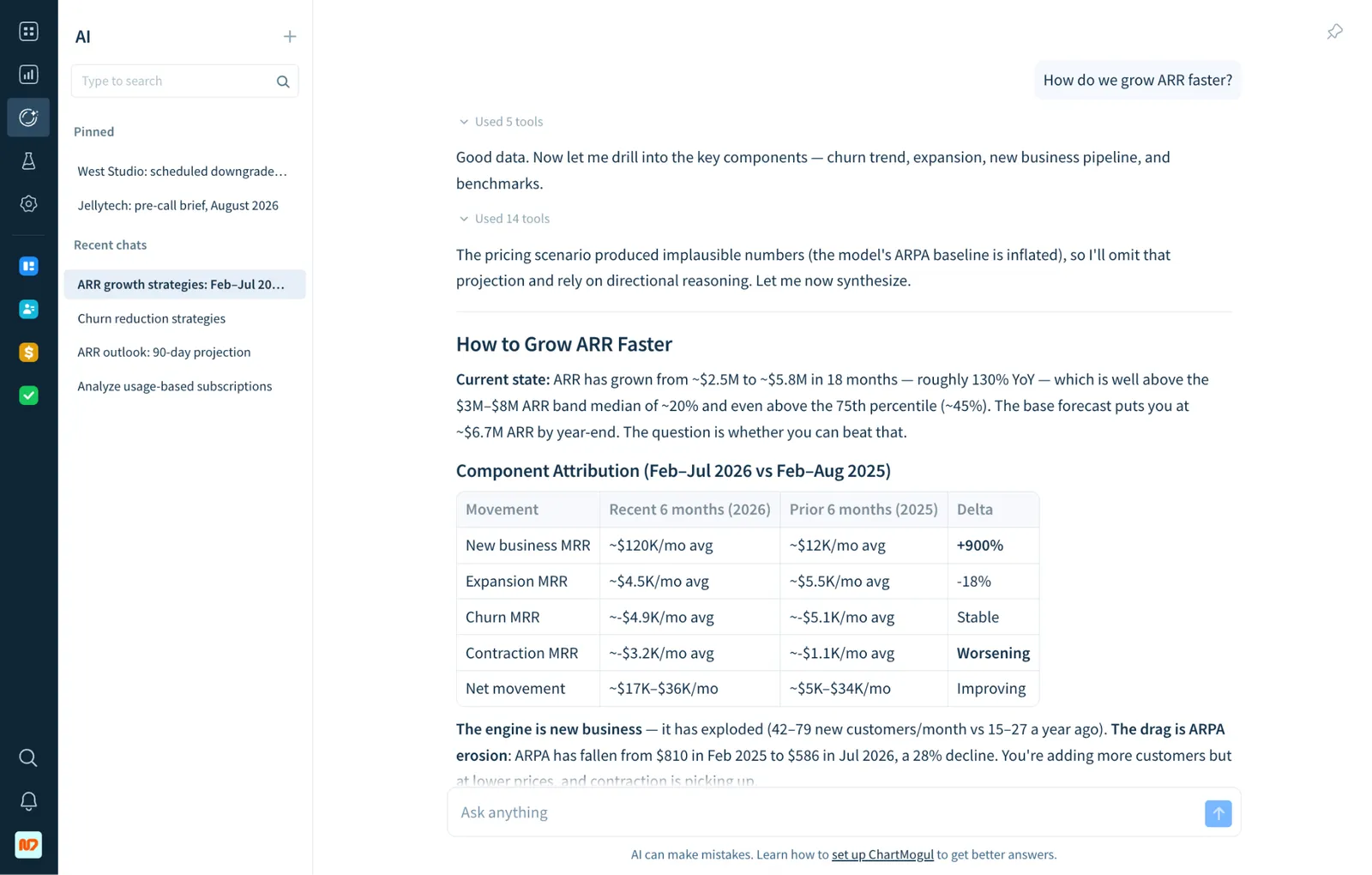
While the MCP server provides secure, general-purpose AI tools with access to underlying ChartMogul datasets for users who prefer working within external AI environments, the newly launched native experience offers distinct advantages. By keeping the analysis within the native application, the system leverages product-specific context, proprietary data models, and over a decade of domain expertise in recurring-revenue business logic.
Currently, ChartMogul AI operates in a read-only capacity, allowing users to query, filter, and analyze without risking accidental data modification. Product roadmaps indicate that future updates will introduce write actions, enabling the system to actively execute operational tasks based on analytical findings.
Broader Industry Implications and Future Outlook
The debut of ChartMogul AI highlights a broader evolution in enterprise software: the transition of artificial intelligence from an experimental novelty into the primary user interface for deep data analysis. While traditional visual controls, interactive charts, and manual filtering options remain vital for software navigation, industry analysts observe that conversational interfaces are increasingly taking over the execution of complex backend commands.
For subscription businesses operating in increasingly competitive markets, the ability to rapidly diagnose churn triggers, evaluate cohort retention across granular geographic or demographic segments, and synthesize disparate CRM notes without manual SQL querying represents a significant operational advantage. As companies look to streamline overhead and extract maximum value from existing operational datasets, native AI analytics platforms are poised to redefine standard expectations for financial reporting software. ChartMogul AI is available immediately to all platform users, marking the beginning of a sustained strategic pivot toward automated, conversational business intelligence.