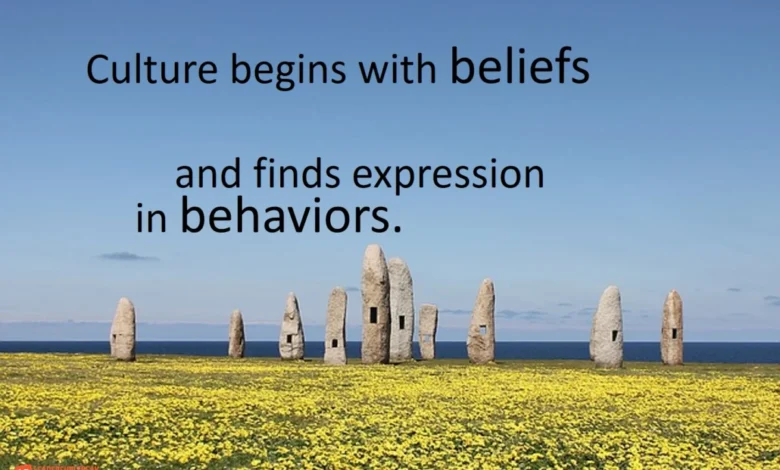
Organizational culture remains one of the most elusive yet impactful components of corporate success, frequently cited by CEOs and organizational psychologists as the primary determinant of long-term sustainability. At its core, culture is a dual-layered construct: it begins with internal beliefs and finds tangible expression in observable behaviors. While many organizations attempt to codify culture through mission statements or posters hung in breakrooms, the reality of workplace environment is defined entirely by the actions that occur on the office floor. If a behavior cannot be observed, it does not exist as part of the culture.
The Mechanics of Cultural Development
The foundational premise of organizational health is that values are meaningless unless they are operationalized through specific, repeatable behaviors. When a leadership team decides to prioritize a core value, such as "excellence," the transition from abstract concept to organizational reality requires a mapping process. For every core belief, there must be a corresponding behavior that serves as evidence of that belief.
Data from the Harvard Business Review and various longitudinal studies on workforce productivity indicate that companies with high alignment between stated values and operational behaviors outperform their counterparts by up to 200% in net income growth. This is because organizational culture acts as an informal control system. When employees understand the behaviors expected of them, they require less supervision and are more likely to make decisions that align with the company’s broader strategic goals.

Mapping Beliefs to Observable Behaviors
To effectively build a culture, leaders must rigorously define the bridge between internal mindset and external performance. This process often follows a structured framework:
- Curiosity versus Complacency: An organization that values innovation must believe that curiosity is superior to the status quo. The observable behavior is a consistent questioning process, typified by the inquiry, "How can we be better?" This moves the needle from passive acceptance of current results to active pursuit of improvement.
- The Rejection of Mediocrity: The belief that "good enough is not good enough" is a common corporate refrain, but it only becomes culture when leaders engage in the uncomfortable task of identifying and discussing mediocre performance. Silence in the face of sub-par work is an endorsement of that work; therefore, the behavior must be the willingness to hold difficult, performance-based conversations.
- Persistent Professional Development: A culture that promotes growth requires leaders to actively cultivate their own skills. The behavior associated with this is the public sharing of personal development plans. By making these plans transparent, leaders signal to their teams that improvement is a universal requirement, not a remedial action for those who are struggling.
- The Eradication of Isolation: Excellence is rarely an individual pursuit. When organizations believe that isolation is the enemy of quality, the required behavior is the open exchange of strengths. Teammates must be encouraged to seek help regularly, breaking down silos and fostering a collaborative environment.
- Feedback as a Catalyst: Perhaps the most challenging aspect of culture is the reception of feedback. A healthy culture treats feedback as fuel for improvement. The behavior of an effective leader is not just giving feedback, but inviting it—and, crucially, responding with gratitude rather than defensiveness.
- Failure as a Growth Metric: Finally, the transition from failure to growth requires a pivot from punishment to inquiry. When a failure occurs, the behavior of a leader should be to ask: "What did you learn? What will you do differently next time? How can we help?" This fosters a "psychological safety" net that encourages calculated risk-taking.
Chronology of Cultural Evolution
The evolution of workplace culture studies has shifted significantly over the last three decades. In the 1990s, the focus was primarily on "Corporate Identity" and branding. By the 2000s, this shifted toward "Employee Engagement," with a heavy emphasis on perks and physical work environments. Since 2015, the conversation has moved toward "Behavioral Consistency."
In 2018, seminal research into high-performing teams, most notably popularized by Daniel Coyle in The Culture Code, solidified the idea that culture is not a product of posters or mission statements, but a product of "micro-moments." These are the small, repetitive interactions—the way a meeting starts, the way a failure is addressed, and the way a victory is celebrated—that accumulate over time to create a dominant cultural force.
Supporting Data and Statistical Context
Recent industry reports from the Society for Human Resource Management (SHRM) suggest that nearly 60% of employees leave their positions due to cultural mismatches rather than compensation issues. Furthermore, companies that undergo "culture transformation" initiatives report that the most successful efforts focus on changing only two or three key behaviors at a time, rather than attempting to overhaul an entire corporate philosophy at once.

The data suggests that when behaviors are clearly linked to rewards and recognition, the rate of cultural adoption increases by 40%. Conversely, when leaders fail to model the behaviors they espouse—such as preaching collaboration while rewarding individual competition—the resulting "cultural dissonance" leads to a 30% drop in employee trust metrics.
The Role of Leadership in Cultural Sustainability
Leadership serves as the primary filter for organizational culture. Because culture is essentially a reflection of what is rewarded and what is tolerated, the leader’s behavior is the standard by which all other employees align themselves.
Official statements from organizational development experts emphasize that "the leader is the chief culture officer." This does not mean the leader is the only person who builds culture; rather, it means the leader is responsible for the environment in which culture is permitted to flourish. If a leader says they value transparency but penalizes employees for bringing bad news to the table, the "belief" of transparency is effectively nullified by the "behavior" of retaliation.
Broader Implications for Modern Enterprise
The implications of this behavioral approach are vast, particularly in the era of remote and hybrid work. In a decentralized environment, culture is no longer reinforced by physical proximity or office osmosis. It must be intentional. Organizations that fail to codify their culture into explicit, observable behaviors often find their team morale fragmenting as employees interpret company values through their own personal lenses.

Furthermore, the rise of AI and automation in the workplace places a higher premium on human-centric behaviors. Skills such as curiosity, collaborative problem-solving, and the ability to process constructive feedback are becoming the primary competitive advantages for firms. As technical tasks are offloaded to machines, the "culture of behavior" remains the final frontier of human differentiation in the labor market.
Conclusion: Sustaining the Cultural Standard
Building a healthy culture is an iterative process that requires constant calibration. It begins with the clarity of belief, but it is sustained through the consistency of behavior. Organizations that succeed in this endeavor are those that treat culture as a living entity, constantly asking, "What is working?" and celebrating progress toward their stated goals.
Ultimately, the litmus test for any culture is simple: observation. If a manager claims to value "open communication" but does not hold forums for staff to express concerns, that culture does not exist. The bridge between the aspirational and the actual is the behavior. Leaders who bridge this gap by aligning their actions with their beliefs create more resilient, higher-performing, and more satisfied workforces. As the landscape of work continues to shift, the fundamental truth remains unchanged: culture is not what you say; it is what you do.