Data processing architectures have reached a critical inflection point as the volume of log-based telemetry and raw dataset dumps continues to expand exponentially. When Python-based data pipelines encounter massive files—often exceeding available system RAM—the standard practice of loading entire records into memory via list comprehensions frequently leads to catastrophic system failures, characterized by the dreaded MemoryError. This article examines the structural transition from eager, memory-intensive data ingestion to lazy, stream-oriented processing, a paradigm shift necessary for maintaining system stability in modern enterprise computing environments.
The Anatomy of a Memory Failure
The history of this issue is rooted in the ubiquity of high-level abstractions in Python. For years, developers have relied on list comprehensions for their brevity and speed. A common scenario involves a script designed to parse, filter, and summarize logs. In stable environments, such scripts function efficiently. However, the introduction of log rotation—a common operational necessity where system logs are aggregated into single, multi-gigabyte files—transforms these scripts into liabilities.
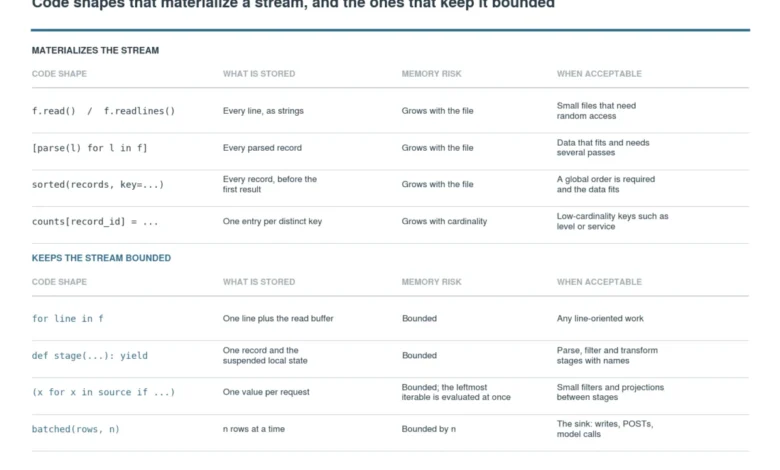
A script that processes a 9 GB log file using a simple list comprehension, such as records = [parse(line) for line in f], effectively attempts to allocate 9 GB of memory instantaneously. When the physical RAM limit is breached, the operating system’s OOM (Out-of-Memory) killer or the Python interpreter terminates the process. The failure is not a logical error in the parsing code but an architectural failure in the data handling strategy. The industry has identified this as a "materialization trap," where the developer inadvertently forces the entire dataset into existence simultaneously, rather than processing individual records in sequence.
The Iterator Protocol: A Foundation for Streaming
At the core of memory-efficient Python development lies the iterator protocol, a contract established in the language’s design that allows for forward-only data traversal. Unlike a list, which exists in its entirety in memory, an iterator acts as a cursor. It provides the mechanism to retrieve a single element, process it, and then discard it before moving to the next.
The protocol relies on two primary methods: __iter__() and __next__(). When a developer uses a for loop, the Python interpreter invokes iter() on the target object, then continuously calls next() until a StopIteration exception is raised. This mechanism is the secret to handling datasets that are larger than the available physical memory. By utilizing this protocol, a system can process terabytes of data while keeping only a few kilobytes of buffered information in RAM at any given time.
Evolution of Data Pipelines: From Eager to Lazy
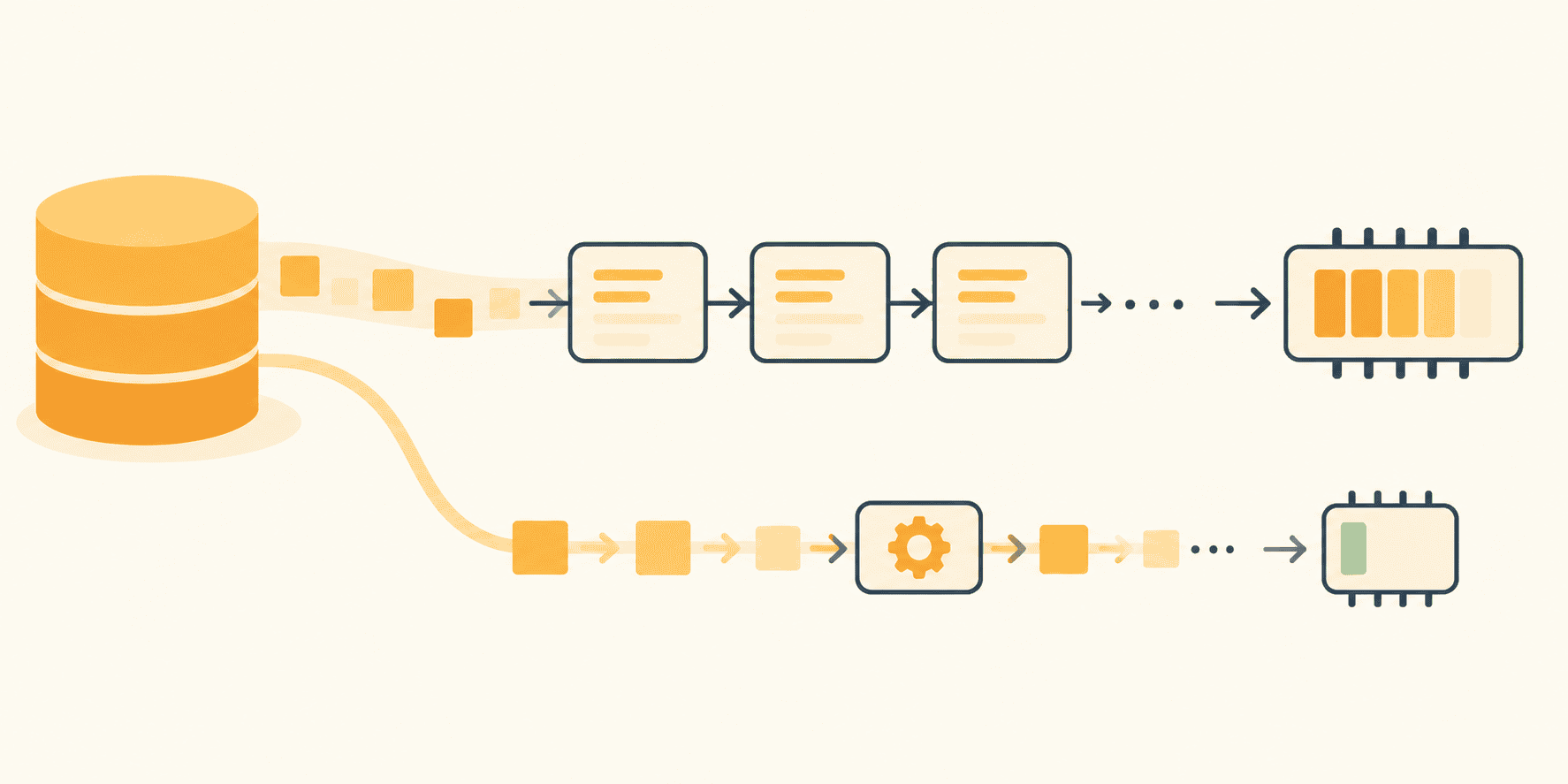
Historically, the transition from eager to lazy processing followed the evolution of data-heavy applications. In the early 2010s, developers often attempted to solve memory issues by manually managing chunks or relying on external database storage. However, the maturation of Python’s generator functions—using the yield keyword—has provided a more elegant, native solution.
A generator function allows a block of code to suspend its state, including local variables and the instruction pointer, and return a value to the caller without terminating the function. When the caller requests the next value, the generator resumes precisely where it left off. This state-retention capability is why generators are inherently memory-efficient; they do not require the storage of the entire dataset, only the state of the current iteration.
Chronology of Pipeline Optimization
The standard approach to refactoring these pipelines involves four distinct stages, each serving as a barrier against memory bloat:
- Source Stage: Instead of
readlines(), which reads an entire file into a list of strings, developers now use file object iteration. This reads only the necessary buffered chunk. - Transformation Stage: Generator functions, using
yield, parse raw lines into structured dictionaries or objects, discarding irrelevant data immediately. - Composition Stage: Using generator expressions, developers chain multiple filters and projections together. These expressions, while appearing similar to list comprehensions, perform no work until requested.
- Sink Stage: Data is only materialized at the very end of the pipeline, typically in bounded batches, to be written to a database, API, or output file.
This staged approach ensures that at any given moment, the memory footprint of the entire application is effectively constant, regardless of whether the input file is 10 MB or 100 GB.
Empirical Analysis: The Cost of Eager Materialization
To demonstrate the impact of these changes, performance analysis using tracemalloc provides clear, objective evidence. In a controlled test comparing an eager script (which loads all records) against a streaming script (which uses generator pipelines), the results are stark.
On a 17 MB test dataset, the eager script peaked at 198 MB of memory usage. In contrast, the streaming implementation maintained a peak usage of approximately 0.4 MB. Crucially, as the dataset size was scaled upward, the streaming script’s memory consumption remained nearly flat, while the eager script’s consumption scaled linearly with the data size. This highlights the risk: the more successful a data-driven application becomes, the more likely it is to crash due to its own success, unless the underlying architecture is streaming-native.

Industry Implications and Best Practices
The implications of adopting these techniques are significant for data engineers and machine learning practitioners. Many "dataset too large" errors in machine learning preprocessing, such as those encountered during JSONL file ingestion for model fine-tuning, are essentially the same memory-management failures seen in log processing.
Industry experts advocate for the following "Rules of Streaming":
- Avoid Global Transformations: Avoid
sorted()or full-list deduplication on streams. These operations require the entire dataset to be held in memory, effectively nullifying the benefits of a generator pipeline. - Batch at the Boundary: Use
itertools.batched()(available in Python 3.12+) or similar recipes to handle data output in manageable chunks. This is the only point where materialization is encouraged. - Measure Early and Often: Integrate
tracemallocinto unit tests to detect "leaky" abstractions that might be inadvertently materializing data.
Conclusion: The Future of Data Handling
The move toward memory-efficient processing is not merely a technical optimization; it is a shift toward more resilient and scalable software design. As organizations continue to generate data at unprecedented scales, the ability to build pipelines that treat data as a continuous flow rather than a static collection is becoming a core competency for developers.
By adhering to the principles of lazy evaluation, developers can ensure their applications remain performant regardless of the data scale. The goal is to create code that is as readable as it is efficient—code where the path of the data is clear, the stages are modular, and the memory footprint is intentionally and permanently bounded. This approach provides the necessary framework for the next generation of data-intensive applications, ensuring they can handle the inevitable growth of digital information without compromising system integrity.
Related posts: