Accelerating Machine Learning Workflows with Seekable OCI Indexing for Amazon SageMaker AI Training and Processing

The persistent challenge of container image download latency has long acted as an invisible tax on machine learning development cycles, consuming valuable billable compute time before a single model training epoch can commence. Today, Amazon Web Services (AWS) addressed this bottleneck with the general availability of Seekable OCI (SOCI) indexing for Amazon SageMaker AI training and processing jobs. By implementing lazy-loading technology, this update fundamentally shifts the operational paradigm for large-scale model development, effectively removing image retrieval from the critical path of job execution and allowing developers to transition from infrastructure waiting to model building in seconds rather than minutes.
The core issue facing AI engineers is the sheer scale of modern deep learning environments. As container images—which house the necessary runtimes, libraries, and dependencies for complex neural network training—regularly exceed 10 gigabytes, the standard process of pulling and decompressing these images from the Amazon Elastic Container Registry (ECR) creates a significant "cold start" problem. In a high-velocity environment, where hyperparameter tuning sweeps may involve hundreds of concurrent jobs, these minutes of idle time aggregate into significant financial costs and diminished research productivity.
The Technological Evolution of Container Efficiency
The introduction of SOCI indexing marks a departure from the traditional "pull-then-run" container lifecycle. SOCI is an open-source technology originally developed to address the latency inherent in large-scale container deployments. By creating a metadata index that maps the internal structure of a container image, the runtime can intelligently determine which files are required for initial execution.
Instead of waiting for the full binary payload to be transferred across the network and written to the local disk, the SageMaker AI runtime initiates the container immediately, streaming only the necessary files. The remaining layers of the image are fetched asynchronously in the background as the application logic requests them. This approach mimics the behavior of "on-demand" loading, which has been a staple in high-performance computing but is now being democratized for the broader machine learning community.
Chronology and Implementation Strategy
The development of this feature follows a strategic timeline aimed at reducing the friction of cloud-native AI development. Following the open-source community’s initial adoption of the SOCI snapshotter, AWS began integrating this capability into its managed AI services to simplify the user experience.
For developers, the adoption path is intentionally low-friction. Users have two primary methods to leverage this technology:
- Pre-indexed AWS Deep Learning Containers (DLCs): AWS has published specialized variants of its most popular training images, denoted by a
-socisuffix in the image tag. These include environments optimized for PyTorch, TensorFlow, vLLM, and SGLang. Switching to these images requires nothing more than an update to the job definition, ensuring no disruption to existing codebases or data pipelines. - Custom Indexing for Proprietary Images: For organizations maintaining custom container images, AWS provides a workflow to generate indices. By utilizing tools such as
containerdand thesoci-snapshotteron a Linux-based host, developers can create an OCI-compliant index artifact. This index exists as a separate entity within the ECR, preserving the original image digest and ensuring that existing security signatures remain intact and valid.
Analytical Assessment of Performance Gains
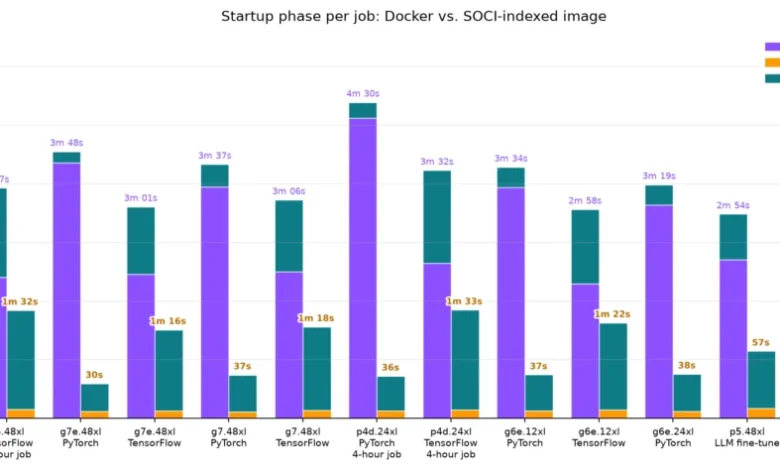
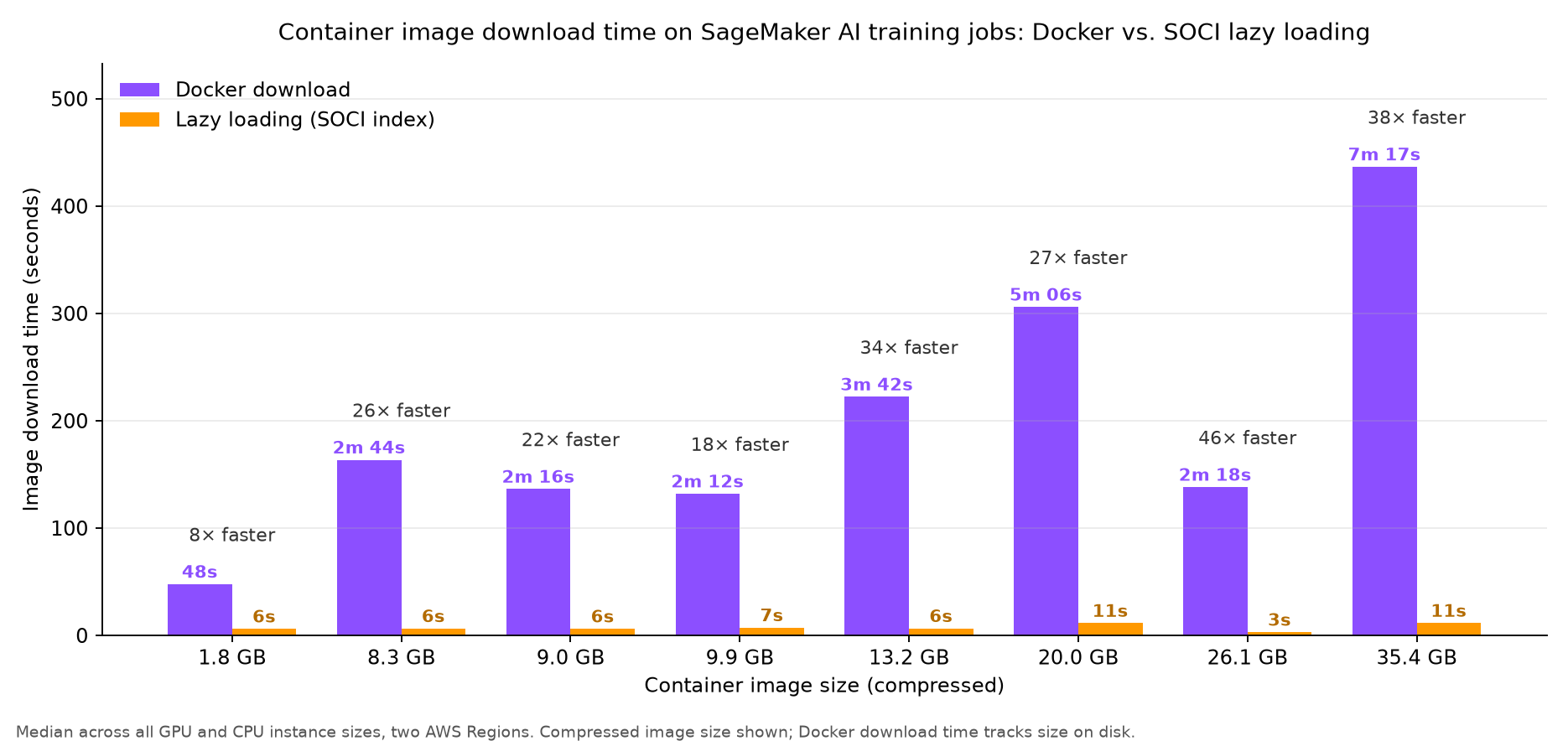
Internal benchmarks conducted by AWS engineers highlight the dramatic shift in performance. When comparing standard Docker pull operations against SOCI-indexed lazy loading, the time savings scale linearly with image size. For a 13.2 GB image, standard download procedures typically require three minutes and 42 seconds. With SOCI indexing, that time is compressed to approximately six seconds.
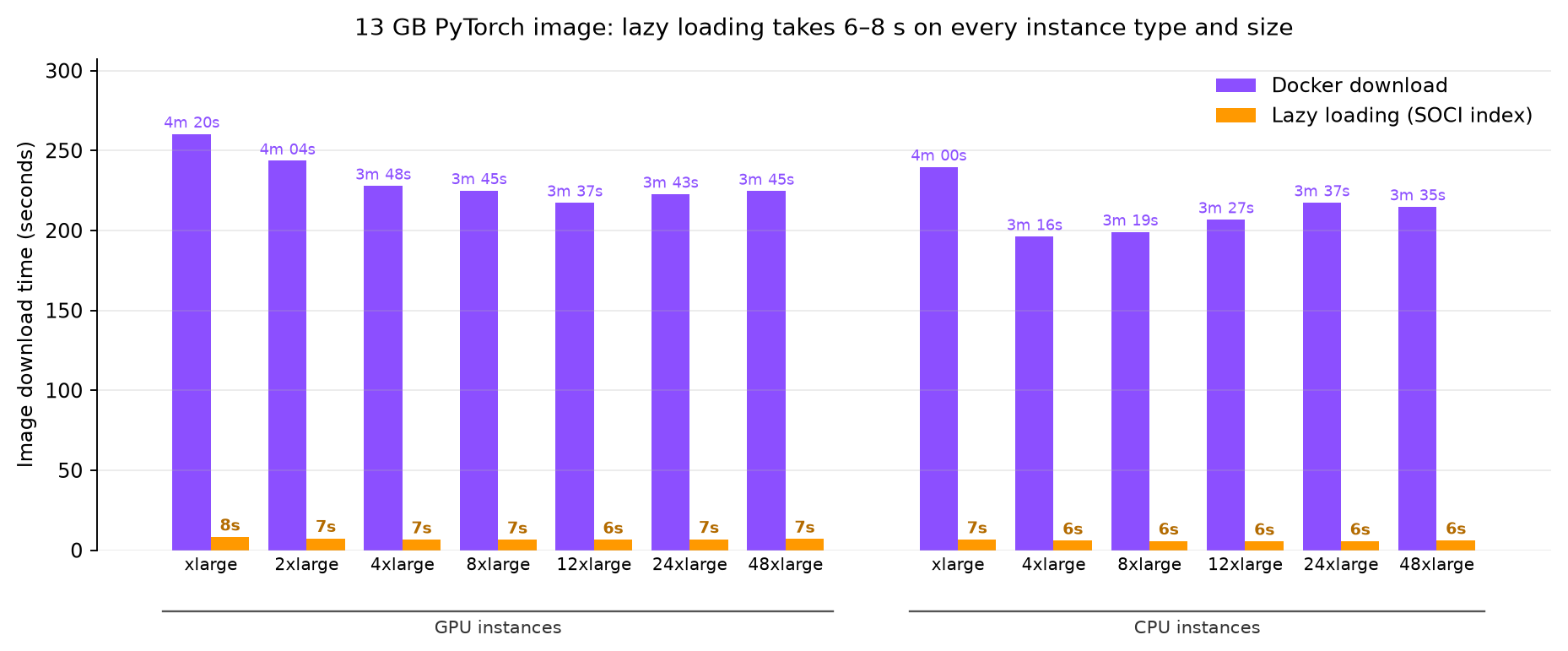
Even more impressive is the consistency across varying infrastructure configurations. Tests conducted across 13 distinct instance types demonstrated that the performance gain is platform-agnostic; regardless of the underlying hardware, the latency reduction remained consistent, hovering around a 34x improvement.
From an economic perspective, this represents a meaningful optimization of cloud expenditure. By minimizing the duration that an expensive GPU-accelerated instance remains idle during the image-loading phase, organizations can allocate a higher percentage of their budget toward actual compute cycles, rather than overhead. While there is a minor "first-epoch" penalty—a slight increase in processing time as the container fetches the remaining layers during the initial training phase—the overall net gain in productivity and cost-efficiency remains overwhelmingly positive for most standard deep learning workloads.
Safety and Compatibility Protocols
A critical aspect of the SOCI rollout is the design of the SageMaker AI integration, which prioritizes system stability over feature enforcement. When a job is launched, the service automatically detects the presence of a SOCI index. If an index is detected, the lazy-loading protocol is invoked. If the index is missing, corrupted, or otherwise unreadable, the service gracefully falls back to the standard, legacy download method.
This fail-safe mechanism ensures that existing production workflows are not jeopardized by the introduction of the new feature. It allows teams to transition to SOCI-indexed images incrementally, testing the performance improvements on individual jobs before migrating entire fleets or automated CI/CD pipelines.
Implications for the Machine Learning Lifecycle
The implications of faster container startup times extend beyond simple stopwatch metrics. In the context of large-scale machine learning, the "iteration cycle"—the time between submitting an experiment and receiving initial logs—is a key driver of model performance. When wait times are reduced from minutes to seconds, researchers can perform more frequent experiments, tune hyperparameters with greater granularity, and pivot between different architectural strategies with minimal friction.
Furthermore, the integration with CI/CD pipelines through the CFN ECR SOCI Index Builder allows for the automation of this process. By utilizing Amazon EventBridge to trigger index generation upon every image push to the ECR, organizations can ensure that their development environments are always optimized for the fastest possible startup. This "set it and forget it" architecture removes the burden of manual optimization from the individual developer.
Future Perspectives
As the industry continues to gravitate toward larger foundational models and more complex training architectures, the size of container images will likely continue to grow. Technologies like SOCI indexing represent a necessary evolution in cloud-native infrastructure, providing a buffer against the performance degradation that typically accompanies the increasing complexity of AI software stacks.
Industry analysts observe that such infrastructure improvements are indicative of a broader trend: the commoditization of high-performance computing efficiency. By offloading the complexities of container management and image optimization to the managed service provider, AWS is effectively enabling smaller development teams to compete with the compute-heavy workflows of larger enterprises.
For practitioners looking to evaluate the impact of this update on their own specific workloads, the recommendation is clear: begin by replacing existing standard DLCs with their -soci counterparts. Given the lack of required changes to API calls, entry points, or data channels, the barrier to entry is effectively non-existent. The adoption of this technology marks a significant step forward in streamlining the machine learning lifecycle, ensuring that compute resources are focused on intelligence, not waiting for bits to move across the network.
As SageMaker AI continues to evolve, the integration of SOCI indexing serves as a testament to the importance of "hidden" infrastructure optimizations. While the headlines of the AI era are often dominated by parameter counts and training data volume, it is the efficiency of the underlying deployment mechanisms that ultimately determines the speed of innovation. With this update, the path from code submission to training completion has been shortened, offering a glimpse into a more responsive and cost-effective future for machine learning at scale.