Bridging the Gap: ChartMogul Launches MRRaudit to Solve the SaaS Billing Discrepancy Puzzle

For as long as subscription-based software-as-a-service (SaaS) companies have relied on dedicated analytics platforms to monitor their financial health, executives and finance teams have confronted a persistent, frustrating riddle. The core question—“Why is my Monthly Recurring Revenue (MRR) in ChartMogul different from what I see in my billing system?”—has echoed across weekly sales calls, customer onboarding sessions, and technical support queues with unwavering regularity.
This discrepancy rarely stems from a software bug or a systemic failure. Instead, it is the natural consequence of differing methodological philosophies. Calculating SaaS metrics requires making deliberate, foundational decisions about how to treat complex real-world billing events. If a customer misses a scheduled payment due to an expired credit card, at what exact juncture should they officially transition from delinquent to churned? If an enterprise client requests to temporarily pause their subscription for a two-month summer hiatus, should their recorded MRR immediately drop to zero, or should the platform smooth out the revenue stream? When a sales representative issues a one-time, discretionary discount on an annual contract, should that reduction directly impact the recurring baseline?
ChartMogul applies rigorous, consistent analytical rules to raw billing data, offering administrators customizable settings to reflect their specific business models. However, these specialized rules do not always mirror the native accounting mechanics of underlying billing systems such as Stripe or Chargebee. Consequently, figures diverge. Historically, resolving these numerical gaps required intensive, manual detective work. ChartMogul’s sales and support engineers regularly guided clients through side-by-side system audits, tracing individual discrepancies back to specific subscriber profiles, auditing multi-line invoices, and meticulously explaining the underlying subscription lifecycle events. While this hands-on approach ultimately fostered trust and deep comprehension of ChartMogul’s analytical framework, it remained an exceptionally labor-intensive process for both the provider and the consumer.
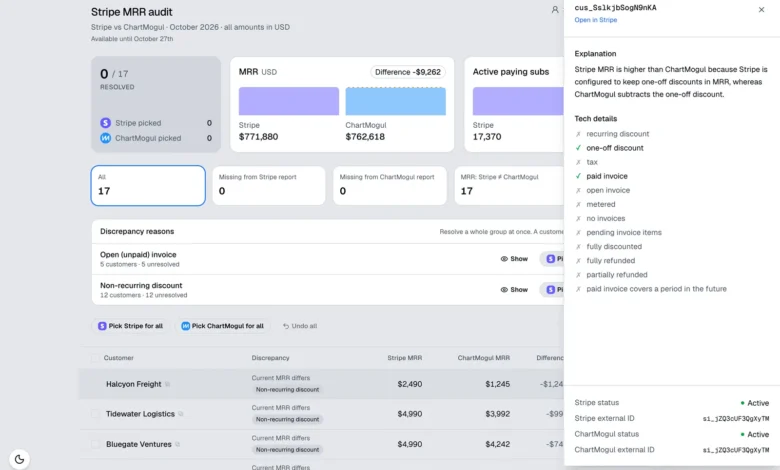
Recognizing the scalability limitations of manual investigations, ChartMogul has officially introduced MRRaudit, a specialized diagnostic tool designed to place comprehensive financial reconciliation directly into the hands of operators, founders, and finance leaders.
Anatomy of a Discrepancy: Tracing Numbers to the Customer
To understand the necessity of a tool like MRRaudit, one must examine how minor operational workarounds in billing software create massive analytical divergences. Consider a common scenario in B2B SaaS: a mid-market customer agrees to upgrade their software tier to a $4,800 annual plan. During the transaction, the account executive’s internal team voids the automatically generated, system-driven recurring invoice and replaces it with a custom, one-off manual invoice to accommodate unique procurement requirements. The customer promptly pays the custom invoice.
From the perspective of Stripe, which tracks the underlying subscription object, the system still registers a recurring billing schedule corresponding to $400 in MRR. Conversely, ChartMogul, scanning for structured recurring invoice events to substantiate the revenue, finds no matching recurring invoice and records $0 in MRR for that specific cycle. The commercial reality is indisputable—the cash has successfully landed in the company’s bank account. Yet, the method of recording and processing that payment fundamentally alters how analytical dashboards interpret the recurring revenue stream.
These structural nuances—compounded by complex variables such as prorated refunds, promotional discounts, transient failed payment cycles, usage-based consumption revenue, and retroactive subscription status modifications—have long plagued financial reporting. MRRaudit consolidates these disparate factors into a single, cohesive interface. The platform automatically cross-references MRR figures between Stripe and ChartMogul, groups identified discrepancies by root cause, and translates complex API logic into plain, accessible language. Crucially, every single numerical variance includes a direct hyperlink to the underlying customer profile, specific invoices, and chronological subscription events, allowing financial controllers to inspect, verify, and audit the analytical reasoning independently.
The Historical Burden of Evolving SaaS Pricing

As SaaS companies mature, their pricing strategies rarely remain static. Over a span of several years, organizations frequently pivot through multiple pricing iterations, introduce grandfathered legacy plans, negotiate bespoke enterprise contracts, and execute ad-hoc billing exceptions for strategic accounts. When leadership demands an accurate accounting of Annual Recurring Revenue (ARR) or MRR, financial teams are frequently forced to embark on exhaustive archaeological digs through years of billing history. They must manually isolate timing anomalies, reconcile invoice discrepancies, and decipher why two distinct software systems treat identical billing events through fundamentally different lenses.
The magnitude of this administrative burden is vividly illustrated by Lavender, an AI-powered sales email assistant. When Lavender’s executive leadership sought a definitive answer regarding their precise ARR, the internal team discovered they could not formulate a confident response without undertaking a massive data reconstruction project.
Elliott Fisher, Chief Operating Officer at Lavender, recalled the challenge: “Our CEO asked a simple question: ‘What’s our ARR?’ None of us could answer with confidence. We had to rebuild four years of Stripe invoice history from scratch. With MRRaudit, we could have found the differences ourselves in a fraction of the time and shown exactly what was behind the number.”
The operational friction experienced by Lavender is emblematic of a broader industry trend. As macroeconomic pressures place a heavier premium on financial visibility, burn-rate efficiency, and accurate forecasting, the tolerance for ambiguity in foundational metrics has effectively evaporated. Investors, board members, and executive teams demand absolute alignment between cash realization and recognized recurring revenue.
Implications for the SaaS Ecosystem and Financial Governance
The launch of MRRaudit signifies a maturation in the tooling surrounding SaaS financial operations (FinOps). Historically, analytics providers focused primarily on forward-looking visualization—dashboards, cohort retention curves, and predictive churn models. However, as billing ecosystems have grown increasingly modular and complex, the point of failure has shifted upstream into data hygiene and reconciliation.
By democratizing the audit process, ChartMogul is effectively shifting the burden of proof from customer support queues to automated, self-service diagnostics. This paradigm shift offers several notable implications for the broader software industry:
- Enhanced Audit Readiness: For venture-backed startups preparing for institutional due diligence or late-stage enterprises navigating impending public offerings, clean financial audits are non-negotiable. Tools that can instantly trace and explain variance between billing gateways and metric engines significantly reduce the time and capital expended during financial audits.
- Cross-Departmental Alignment: Discrepancies between billing systems and analytics dashboards frequently foster friction between sales, finance, and customer success teams. When sales reps promise commissions based on billing system inputs that do not align with executive dashboards, internal trust erodes. Transparent reconciliation tools establish a single, verifiable source of operational truth.
- Lower Barrier to Analytical Adoption: Historically, organizations hesitant about data migration or fearful of perceived metric discrepancies delayed adopting specialized SaaS analytics. By allowing users to run comprehensive MRR audits without requiring complex data cleansing or even an active, paid ChartMogul subscription upfront, the platform lowers psychological and technical barriers to entry.
Looking Forward: Self-Service Data Governance
The introduction of MRRaudit underscores a broader industry realization: perfect data is a myth in high-growth commercial environments. Human error, custom enterprise contract terms, and the inherent rigidity of automated billing engines guarantee that operational discrepancies will perpetually arise. The competitive advantage no longer belongs to companies that achieve immaculate, error-free data entry from day one, but rather to those equipped with the diagnostic tools required to identify, understand, and rectify anomalies with speed and precision.
As ChartMogul rolls out access to the platform, the message to the SaaS community is clear. Financial transparency should not require a degree in data engineering or hours of exhausting customer support back-and-forth. By turning years of institutional troubleshooting expertise into an automated, self-service utility, MRRaudit transforms one of the most persistent administrative headaches in the software industry into a manageable, transparent workflow. For finance leaders and founders striving to answer the foundational question of exactly how much recurring revenue their business generates, the path from confusion to absolute clarity has just become significantly shorter.
Related posts: