ChartMogul Launches MRRaudit to Solve the Age-Old SaaS Dilemma of Discrepancies Between Billing Systems and Metrics Platforms

For as long as subscription-based software businesses have relied on specialized analytics platforms, a single, recurring question has echoed through sales calls, onboarding sessions, and customer support queues: “Why is my Monthly Recurring Revenue in ChartMogul different from what I see in my billing system?”
This inquiry, deceptively simple on the surface, touches upon the complex reality of modern financial engineering in the software-as-a-service (SaaS) industry. For years, answering this question required painstaking, manual investigations by customer success teams, data analysts, and sales representatives. Today, subscription analytics provider ChartMogul is officially changing how businesses diagnose these financial discrepancies with the launch of MRRaudit, a dedicated diagnostic tool designed to automatically trace, categorize, and explain the exact causes of variances between Stripe and ChartMogul data.
The Root of the Discrepancy: Conflicting Financial Logic
To understand the necessity of a tool like MRRaudit, one must first examine the inherent structural differences between transactional billing systems—such as Stripe, Chargebee, or Recurly—and subscription analytics engines like ChartMogul. Billing systems are optimized for collection, invoicing, payment processing, and ledger management. They record events precisely as they occur in real-time, reflecting specific human interventions, custom invoicing workarounds, and unique payment gateway states.
Conversely, analytics platforms are designed to normalize revenue streams to provide a predictable, standardized view of business health. They rely on rigid, rule-based frameworks to evaluate subscription events. For instance, if a subscriber misses a payment, a billing system may continue to list the account as active pending retries, while an analytics engine might immediately classify the account as churned or paused depending on the user’s configured settings. Similarly, short-term subscription pauses, one-time promotional discounts, prorations, usage-based billing spikes, and manual invoice voids are frequently interpreted differently by the two systems.
Over time, these nuanced variations accumulate. A single administrative shortcut—such as a sales team voiding an automated subscription invoice and replacing it with a custom one-off payment document to accommodate an enterprise client—can cause a profound mathematical divergence between platforms. In such scenarios, Stripe might still register the underlying recurring subscription value at four hundred dollars per month, while ChartMogul, detecting no associated recurring invoice line item, records zero dollars in MRR.
The Historical Burden of Manual Investigations
Historically, bridging this analytical gap demanded significant operational overhead. ChartMogul’s internal support and sales teams spent countless hours comparing system ledgers side-by-side, tracking down individual invoice IDs, reviewing subscription event timelines, and explaining the granular logic behind algorithmic calculations. While this high-touch approach successfully built deep customer trust and demystified the underlying metrics, it was inherently unsustainable as a long-term solution for a rapidly scaling user base.
Furthermore, these discrepancies often emerge at the most inconvenient times—frequently during high-stakes board meetings, investor due diligence processes, or annual financial audits. When executives ask baseline questions regarding Annual Recurring Revenue (ARR) or net revenue retention, even mature companies occasionally discover that their internal data sources do not cleanly align.
Consider the experience of Lavender, an AI-powered sales email assistant. According to Elliott Fisher, Chief Operating Officer at Lavender, the company faced a critical internal reckoning when leadership requested a definitive figure for their ARR.

“Our CEO asked a simple question: ‘What’s our ARR?’” Fisher recounted. “None of us could answer with confidence. We had to rebuild four years of Stripe invoice history from scratch.”
Situations like Lavender’s are remarkably common in the SaaS ecosystem. As companies evolve, they frequently alter pricing models, grandfather legacy clients onto specialized plans, apply custom contractual discounts, and execute mid-cycle upgrades or downgrades. Each of these administrative actions leaves a distinct footprint in the billing history, multiplying the potential points of divergence between operational ledgers and analytical dashboards.
How MRRaudit Operates
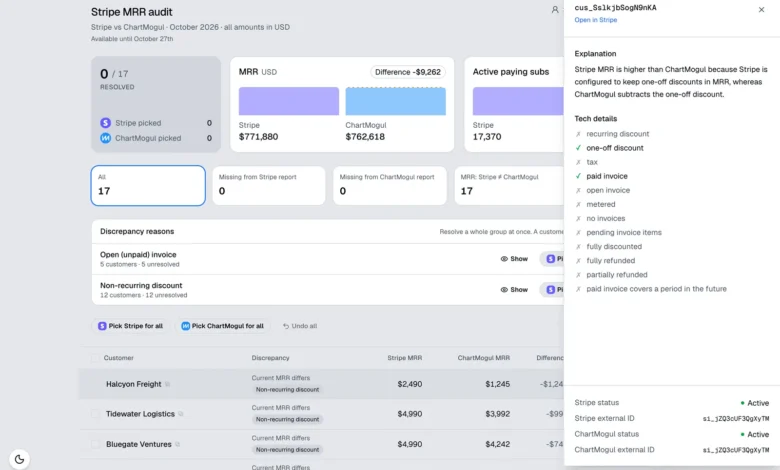
MRRaudit is engineered to automate the arduous forensic work previously performed by consultants and support engineers. By securely connecting to Stripe and ChartMogul data environments, the tool performs a comprehensive cross-system audit, comparing revenue figures at the most granular level.
Rather than merely highlighting that a discrepancy exists, MRRaudit groups variances by their root cause—distinguishing between issues driven by refunds, discounts, failed payment retries, uncollected revenue, usage metrics, and structural subscription status changes. Crucially, every identified difference is linked directly to the specific customer profile, invoice, and underlying subscription event responsible for the variance. This allows finance teams, operations managers, and executives to independently inspect the algorithmic reasoning without requiring specialized data science support or direct intervention from ChartMogul’s support staff.
Industry Implications and the Future of Financial Transparency
The launch of MRRaudit arrives at a critical juncture for the broader technology sector. In an economic climate characterized by heightened scrutiny over financial burn rates, unit economics, and growth efficiency, data integrity is no longer a back-office luxury—it is an existential operational requirement. Investors, board members, and executive leadership teams demand absolute fidelity from their financial reporting pipelines.
By shifting the burden of investigation from manual human analysis to automated software diagnostics, ChartMogul is addressing a universal friction point in the subscription economy. The implications extend beyond mere convenience; by providing absolute transparency into how operational actions translate into analytical metrics, tools like MRRaudit empower businesses to make more informed strategic decisions regarding pricing, discounting, and customer retention strategies.
Significantly, the utility of the platform is designed to be accessible without friction. Organizations are not required to maintain complex data integration pipelines or even possess an active ChartMogul subscription to begin leveraging the diagnostic capabilities of the new tool. By lowering the barrier to entry for comprehensive financial auditing, the company aims to establish a new standard for transparency and reconciliation within the SaaS metrics landscape.
As subscription business models continue to grow in complexity—incorporating hybrid tiers, usage-based components, and increasingly customized enterprise agreements—the potential for data divergence between billing layers and analytics layers will only expand. Solutions that bridge the gap between operational reality and analytical reporting will prove indispensable to the modern financial stack. With the introduction of MRRaudit, ChartMogul has transformed a longstanding industry headache into a streamlined, automated process, ensuring that when executives ask about their recurring revenue, they can find the answer with absolute confidence.