ChartMogul Integrates with Crono to Streamline SaaS Outbound Sales and Revenue Tracking

In an evolving enterprise software landscape defined by rising customer acquisition costs and the maturation of artificial intelligence applications, subscription management platform ChartMogul has announced a strategic product integration with outbound sales engine Crono. The collaboration aims to bridge the operational gap between early-stage pipeline generation and long-term customer lifecycle management, offering Software-as-a-Service (SaaS) organizations a unified workflow from initial cold outreach to post-conversion revenue monitoring.
The partnership, spearheaded by ChartMogul Chief Revenue Officer Sara Archer, addresses a fundamental shift in how modern revenue teams approach customer acquisition. Rather than relying exclusively on inbound marketing or high-volume, indiscriminate cold emailing, contemporary go-to-market teams are returning to precision outbound strategies powered by enriched data and generative artificial intelligence.
The Mechanics of the Integration
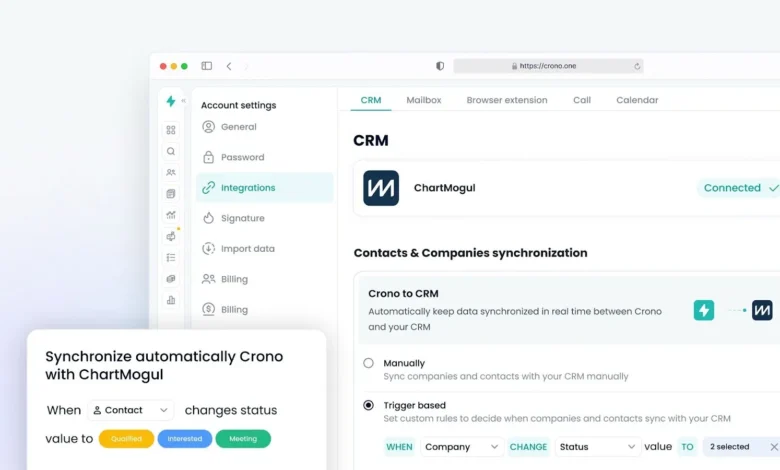
Under the newly deployed integration, sales development representatives (SDRs) and account executives can execute their prospecting workflows entirely within Crono, leveraging the platform’s lead list building, sequence management, and engagement tracking capabilities. However, the operational bottleneck historically associated with outbound sales—the friction of manually transferring qualified leads into a primary Customer Relationship Management (CRM) or subscription tracking database—has been eliminated.
When a prospect reaches a qualified status within Crono, such as a change in contact status to "Interested," the corresponding company and contact records can be routed directly into ChartMogul CRM. This data transfer can be configured to execute automatically through trigger-based synchronization or initiated manually via a single-click action by the sales representative.
Upon creation within the ChartMogul ecosystem, the records are automatically tagged with Crono designated as the originating source. This attribution tracking ensures that revenue operations teams maintain complete visibility into which customer relationships originated via outbound channels, preventing valuable prospects from remaining isolated in disparate sales engagement tools.
Background Context: The Resurgence of Outbound Sales in SaaS
The timing of the ChartMogul-Crono integration reflects broader structural shifts across the technology sector. Throughout the late 2010s and early 2020s, many SaaS startups heavily favored inbound-led growth and paid digital advertising, treating outbound sales as an antiquated or overly aggressive tactic.
However, market conditions have altered significantly. Customer Acquisition Cost (CAC) metrics have risen steadily across the SaaS industry over the past several years. Paid acquisition channels have grown increasingly saturated and expensive, driven by heightened competition and privacy regulations that have diminished ad targeting efficiency. Consequently, inbound traffic alone is frequently insufficient to sustain predictable pipeline growth, particularly for companies operating in crowded B2B software categories.

Simultaneously, the maturation of artificial intelligence has redefined the operational parameters of outbound sales. Modern AI tools enable hyper-personalization, automated data enrichment, and sophisticated prospect targeting at a scale that was previously unattainable for lean teams. As a result, outbound sales is shedding its historical reputation as a brute-force volume game, transforming instead into a precise, highly targeted discipline focused on delivering genuine value through industry insights, relevant data points, and tailored messaging.
Industry Analysis and Strategic Implications
Sales and revenue operations experts point out that the primary vulnerability in modern go-to-market stacks is data silos. While sales engagement platforms are optimized for sequencing and initial communication, they frequently lack deep visibility into financial metrics such as Monthly Recurring Revenue (MRR), Annual Recurring Revenue (ARR), net retention rates, and historical customer usage patterns. Conversely, core subscription platforms and revenue accounting systems rarely possess the granular activity logs generated during the early prospecting phase.
By connecting Crono directly to ChartMogul CRM, the integration attempts to resolve this dichotomy. The methodology aligns with established sales frameworks, such as those popularized by author Daniel Pink in To Sell Is Human, which posits that professional persuasion is fundamentally about initiating constructive dialogue and moving ideas forward rather than applying pressure tactics.
By ensuring that the contextual data gathered during the initial conversation in Crono is preserved when the account transitions into ChartMogul’s subscription-centric environment, companies can maintain continuity throughout the buyer’s journey. Analysts note that maintaining this continuity is vital for accurate attribution modeling, forecasting, and understanding the true return on investment (ROI) of outbound sales campaigns.
Current Scope and Future Roadmap
According to representatives from both organizations, the initial iteration of the integration focuses strictly on core synchronization use cases: transferring qualified companies and contacts seamlessly into ChartMogul CRM.
Product teams at both ChartMogul and Crono plan to monitor user adoption and gather feedback from joint customers to guide subsequent development phases. Potential roadmap expansions could include deeper synchronization of granular sales activities, engagement histories, and pipeline opportunity stages, depending on the evolving operational requirements of high-growth SaaS enterprises.
The integration is available immediately to all users operating within the ChartMogul ecosystem. As software companies continue to refine their go-to-market strategies to optimize capital efficiency and drive predictable revenue, infrastructure partnerships that eliminate operational friction between prospecting and revenue management are expected to play an increasingly central role in enterprise tech stacks.