ChartMogul Launches AI-Powered Subscription Analyst to Transform SaaS Revenue Intelligence

Subscription revenue management has long been defined by a fundamental friction point: while core metrics like Annual Recurring Revenue (ARR) and Monthly Recurring Revenue (MRR) are readily visible on executive dashboards, uncovering the operational and behavioral realities driving those numbers requires intensive, manual data archaeology. Today, subscription analytics platform ChartMogul is officially releasing ChartMogul AI, a native intelligence layer designed to function as an expert financial analyst embedded directly within the software.
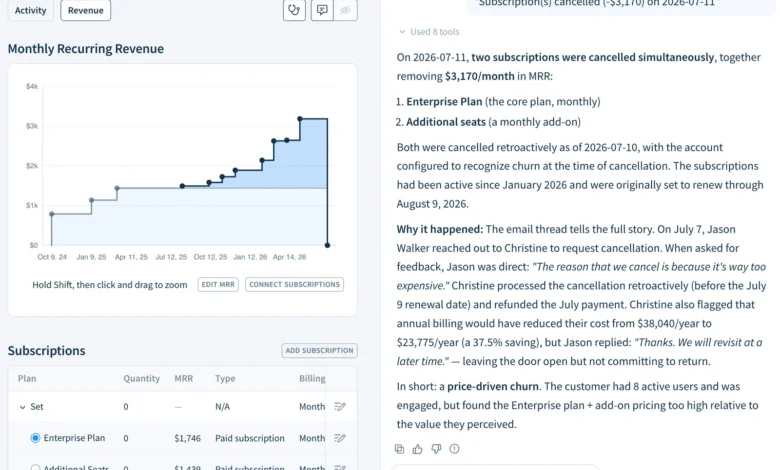
The launch represents a significant evolution in how software-as-a-service (SaaS) companies, digital publishers, and recurring-revenue businesses interact with complex financial ledgers. Rather than merely presenting high-level summaries of financial health, the newly introduced tool is built to trace metric fluctuations back to individual customer accounts, synthesize qualitative CRM data, and execute multi-step diagnostic investigations using natural language processing.
The Structural Complexity of Subscription Accounting
To understand the operational necessity of an AI-driven analyst, one must examine the inherent complexity of subscription data models. Unlike traditional retail or transactional commerce, recurring revenue is a living, moving target. A single customer account can experience upgrades, mid-term downgrades, partial refunds, multi-component package modifications, cancellations, reactivations, and currency conversions within a single billing cycle.
Getting the underlying accounting and attribution logic correct is the operational dividing line between metrics executive teams can trust implicitly and numbers that require constant explanation during board meetings, pricing overhauls, or funding rounds.
For the past twelve years, ChartMogul has focused heavily on standardizing these real-world billing scenarios into reliable, unified subscription metrics. However, identifying the "why" behind a sudden shift in MRR or churn rates has traditionally demanded a high degree of technical proficiency. Stakeholders needed to understand the nuances of the underlying data schema, know precisely which filters and segments to apply, and spend valuable hours tracing the audit trail. Consequently, deep-dive investigations were frequently reserved for high-stakes inflection points, such as quarterly board reviews or impending capital raises. Day-to-day interactions with analytics tools typically began and ended with confirming that headline figures aligned roughly with internal forecasts.
Moving Beyond the Dashboard Chatbot
Industry observers might initially categorize this release alongside the wave of conversational AI wrappers currently populating the enterprise software market. However, engineering and product leadership emphasize that ChartMogul AI is fundamentally distinct from a superficial chatbot bolted onto a reporting interface.

The system operates natively within the product ecosystem, meaning it possesses comprehensive situational awareness of the specific report, cohort, or customer record currently under examination. By leveraging specialized internal architectures—including dedicated routing mechanisms and focused sub-agents—the tool avoids common generative AI pitfalls such as tool-selection errors or shallow data queries.
A critical component of this architecture is its capacity to synthesize quantitative financial data with unstructured qualitative inputs. While standard revenue analytics can illuminate what occurred within a specific timeframe, explaining the underlying motivations typically requires qualitative context buried across disparate systems. ChartMogul AI ingests and preprocesses customer communication logs, support emails, call transcripts, and CRM notes. This unstructured text is systematically transformed into categorized knowledge objects, mapping out cancellation motivations, recurring competitor mentions, customer sentiment trends, and granular product feedback.
Consequently, financial and operational teams can execute complex queries that bridge disparate data silos. A user can prompt the system to investigate correlations between product usage drops, recent customer support sentiment, and subsequent account churn, receiving a synthesized diagnostic report in seconds rather than days.
Democratizing CRM Access to Enhance Data Completeness
To deliver optimal analytical accuracy, predictive and diagnostic AI systems require maximum contextual visibility. Recognizing that data silos degrade the efficacy of automated analysis, ChartMogul has instituted a major structural shift in its platform pricing and packaging.
Effective immediately, ChartMogul CRM is included natively within the core platform for all users. Historically, integrating external email environments and leveraging comprehensive CRM features required purchasing dedicated, paid seats. By removing these paid seat barriers entirely, the company is incentivizing broader organizational adoption and more complete data integration. Every user can now connect their corporate inbox and utilize the full suite of customer relationship management tools without incurring additional licensing fees. Company executives note that the expansion of foundational customer context directly correlates with the depth and precision of the insights generated by the newly launched AI analyst.
Technical Foundations and Integration Ecosystems
The development of ChartMogul AI builds upon the company’s broader infrastructure investments, including the June introduction of an expanded Model Context Protocol (MCP) server featuring more than 80 specialized tools. These verified listings within major general-purpose AI directories—such as Claude and ChatGPT—allow external intelligence models to securely access the same underlying subscription data layers utilized by the native application.
Despite this openness, company engineers emphasize that the native ChartMogul AI interface provides structural advantages that general-purpose tools cannot easily replicate. By combining trusted subscription billing data, native product context, and proprietary methodologies developed over more than a decade of recurring-revenue specialization, the system operates with domain-specific rigor.
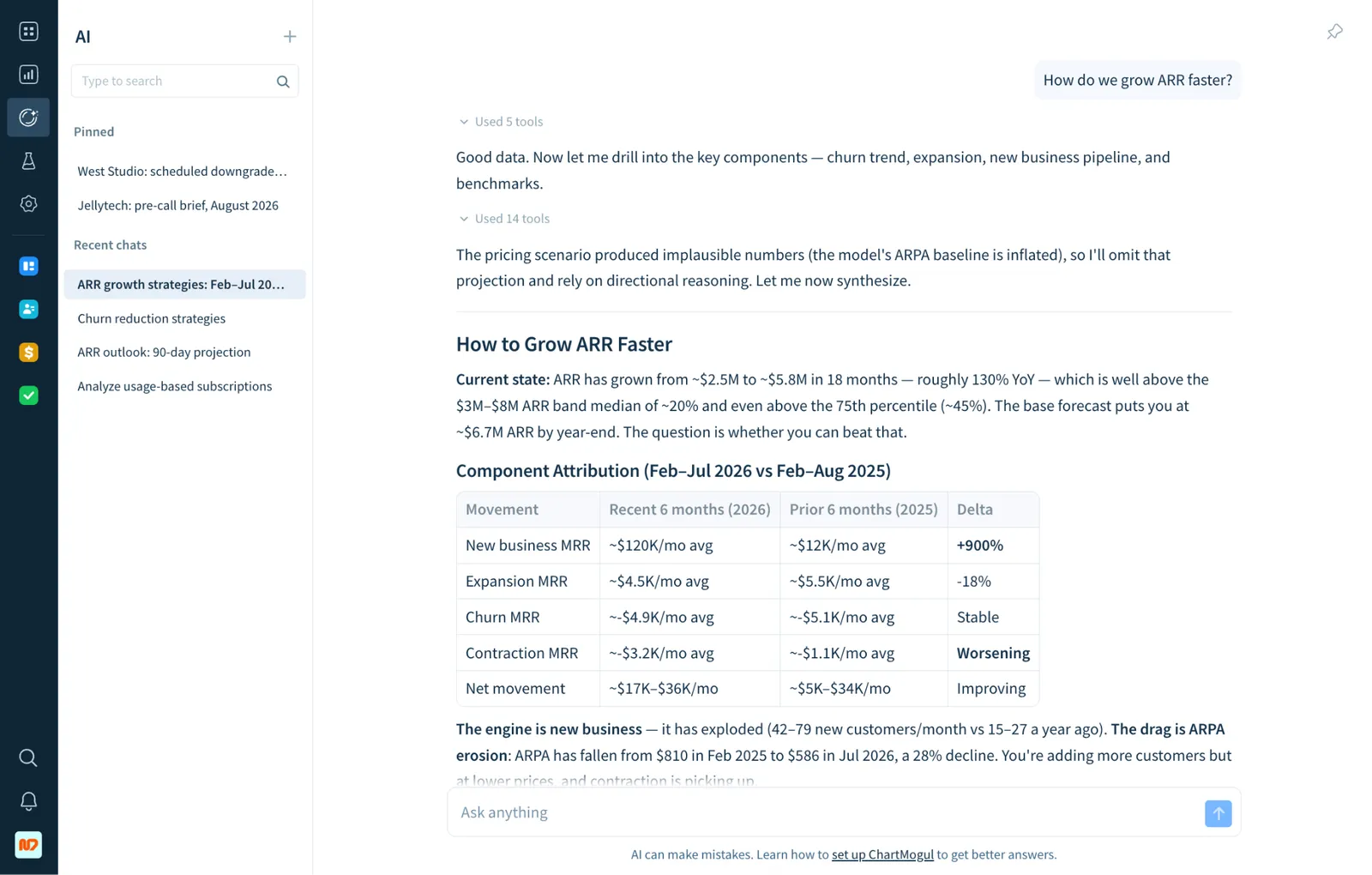
Behind the conversational interface lies a sophisticated validation layer. Rather than allowing an overarching language model to guess filter parameters or write complex queries unassisted, specific tasks are delegated to specialized sub-agents. For instance, filter generation is handled by a dedicated routine that cross-references the user’s active subscription plans and custom tags before constructing precise queries using the proprietary ChartMogul Filter Language (CFL). Furthermore, system-generated deep links to specific customer records and cohort charts are anchored directly to the raw data objects, eliminating the hallucinations or broken pathways common in generic AI integrations.
Current Limitations and the Roadmap Ahead
While the launch represents a major milestone for subscription analytics, platform architects are transparent regarding the current boundaries of the technology. In its initial deployment, ChartMogul AI operates strictly in a read-only capacity. The system cannot yet execute automated operational changes, modify billing configurations, or directly alter CRM records.
Furthermore, while natural language processing successfully handles complex segmentation requests—such as comparing ARR growth and net retention across distinct geographic states or cohorts—the system is not designed to replace human financial judgment. It functions as an analytical accelerator, designed to streamline discovery and surface hidden trends that might otherwise go unnoticed during routine dashboard reviews.
Looking forward, the product roadmap outlines aggressive expansion. Future iterations will introduce generative write actions, allowing users to move seamlessly from diagnostic discovery to direct operational execution within the platform.
Broader Industry Implications and the Future of SaaS Interfaces
The release of ChartMogul AI underscores a broader, structural transition occurring across the enterprise software landscape. As artificial intelligence models mature from novelty toys into deeply integrated operational layers, the traditional user interface—defined by static dashboards, manual filter toggles, and rigid menu navigation—is increasingly giving way to conversational and intent-driven interactions.
Industry analysts note that as software products absorb greater analytical capabilities, the primary value proposition shifts from data presentation to automated synthesis and guided decision-making. For the subscription economy, where operational margins and churn dynamics can make or break an enterprise, the ability to instantly interrogate historical ledgers using plain language could soon transition from a nice-to-have productivity enhancement to a baseline operational requirement.
ChartMogul AI is available immediately to all platform users. As organizations begin integrating the tool into their daily financial workflows, the broader market will be watching closely to see how automated diagnostic analysis alters the rhythm of SaaS financial management, board governance, and strategic revenue planning.