Snowflake Q2 2027 Earnings Show Staggering AI-Driven Acceleration to a $6 Billion Run Rate

Cloud-data platform provider Snowflake has delivered a fiscal second-quarter financial report for 2027 that defied typical corporate scaling limits, showcasing an impressive reacceleration of product revenue growth to 37% at a staggering $6 billion annual run rate. Released on September 2, the financial results challenged prevailing market narratives that large enterprise software giants inevitably experience decelerating growth as they mature.
The company’s performance has sent positive shockwaves through the enterprise technology sector, proving that established players can successfully capture the artificial intelligence boom without sacrificing their core operating leverage.
Reaccelerating Growth at Scale: The Main Facts
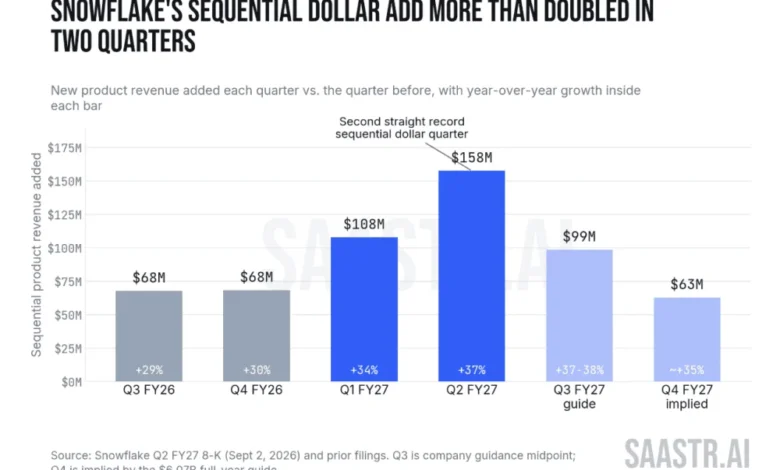
For fiscal 2026, Snowflake’s product revenue growth tracked at 26%, 32%, 29%, and 30%. Entering fiscal 2027, that trajectory sharply ticked upward to 34% in the previous quarter, and has now reached 37%. In absolute dollar terms, Snowflake added more net new product revenue over the trailing three months than in any quarter throughout its history. Furthermore, this achievement marks the second consecutive quarter the company has broken its own record for sequential dollar additions.
Sridhar Ramaswamy, Snowflake’s Chief Executive Officer, addressed the market during the earnings call, emphasizing the tangible nature of the growth. While a percentage-based growth metric can occasionally appear inflated due to a weak year-ago comparison period, generating record dollar additions against a company’s own historical highs provides undeniable proof of genuine business expansion.
Despite the stellar performance, conservative guidance remains the rule at Snowflake. Management’s forward-looking statements project product revenue for the third quarter to land between $1.588 billion and $1.593 billion. This guidance implies a sequential addition of approximately $99 million, with the fourth quarter expected to add roughly $63 million, bringing Q4 year-over-year growth back down toward the 35% threshold. Analysts note that Snowflake has consistently beaten and raised its guidance figures throughout the fiscal year, suggesting that the current forecasts are intentionally prudent. Additionally, approximately one percentage point of the full-year growth projection is attributed to the recent acquisition of Observe, placing the organic growth guide closer to 35%.
The Catalyst: The Dual Engine of AI Products and Core Consumption
When queried by analysts regarding the specific drivers behind the sudden leap in revenue growth, CEO Ramaswamy provided a precise breakdown. Roughly half of the acceleration was attributed directly to standalone artificial intelligence products—including developer tools like CoCo, CoWork, AI functions, and the Cortex AI Gateway. The remaining half of the acceleration came as an indirect benefit: these advanced AI tools successfully pulled increased core platform consumption along with them.
The adoption rates for these AI tools have scaled rapidly. Approximately 60% of Snowflake’s total account base is currently interacting with the company’s coding agent. Because these figures are calculated using an average of the final four weeks of the quarter across both capacity and on-demand accounts, the measurement denominator requires nuance, but the customer attach rate remains exceptionally fast.
Crucially, Snowflake’s strategic pricing decision played a pivotal role in this adoption curve. Rather than isolating artificial intelligence features into a separate product line with independent stock-keeping units (SKUs), distinct sales motions, and dedicated quotas, Snowflake integrated AI directly onto the existing consumption meter. Because every AI query operates on data already securely stored and governed within the Snowflake ecosystem, core data storage dollars and advanced AI compute dollars arrive simultaneously on a single invoice. This structural integration explains why the resulting revenue acceleration manifests cleanly within a single line item rather than fragmenting into a new commercial division.
In an interesting strategic twist, one of the top ten most utilized features within the CoCo coding agent is an automated cost-management skill. Snowflake effectively shipped an agent designed to help its own enterprise clients spend less money on the platform. Despite this built-in optimization, overall consumption accelerated by seven percentage points. Management framed this dynamic as a lesson hard-earned during the pandemic-era optimization cycle: actively helping customers achieve cost efficiency builds the deep institutional trust required to win larger, more complex multi-year projects.
Crucially, executive leadership emphasized that this growth is broad-based, driven heavily by traditional enterprise buyers within the Global 2000 rather than a niche group of heavily funded artificial intelligence model laboratories running up temporary bills.
Strategic Trade-Offs: Gross Margin Compression and Operating Margin Expansion
Financial details from CFO Brian Robins highlighted a calculated trade-off between gross margins and operating leverage. Non-GAAP product gross margin registered at 74.7%, down from 76.4% in the corresponding period of the previous fiscal year. Consequently, management updated its full-year gross margin guidance downward to 74.0%.
Robins attributed this compression directly to a higher revenue mix shifting toward fast-growing artificial intelligence workloads, which inherently carry a lower initial contribution margin. This phenomenon is becoming an industry-wide trend across the enterprise software landscape. Similar margin pressures have appeared at firms like Figma, which saw gross margins decline by roughly five points year-over-year due to AI credit consumption, and Canva, which faced similar hurdles within its free tier. Conversely, content-layer platforms like Box have maintained higher gross margins near 81% because they manage permissions layers rather than purchasing raw underlying compute inference. Because Snowflake directly purchases the inference power required for AI operations, it absorbs the associated infrastructure costs.

However, Snowflake successfully compensated for this gross margin dilution through disciplined operational expense management. Non-GAAP operating margin reached 15.3%, representing an expansion of more than 400 basis points year-over-year. Building upon this success, management raised its full-year operating margin guidance from 13.5% to 14.5%.
During the quarter, overall revenue grew by 35% while total operating expenses increased by just 17% across a stable workforce of approximately 9,250 employees. In essence, the company elected to trade two points of gross margin to secure four points of operating margin expansion and seven points of top-line growth, absorbing the rising cost of cloud infrastructure by deliberately slowing headcount growth.
Remaining Performance Obligations and Short-Term Versus Long-Term Bookings
Remaining performance obligations (RPO) stood at $9.00 billion, representing a 30% year-over-year increase. While robust in absolute terms, the RPO growth rate has trended downward over recent quarters—registering 42% at the close of fiscal 2026, 38% in the first quarter of fiscal 2027, and 30% in the latest reporting period. In total dollar terms, RPO decreased slightly from the $9.77 billion recorded at the end of the prior fiscal year.
However, a closer inspection of the composition reveals a different narrative. Approximately 54% of total RPO is scheduled for recognition as revenue over the next twelve months. This current portion (cRPO) expanded by roughly 42% year-over-year, even as long-term deferred revenue decreased from $3.35 billion to $2.57 billion over a six-month window.
In a consumption-based business model, forward bookings and realized revenue can frequently diverge in appearance. RPO quantifies the contractual value when an enterprise client signs a capacity commitment, whereas recognized revenue measures how rapidly that capacity is burned. Snowflake’s net revenue retention (NRR) rate of 126% indicates that customers are exhausting their committed capacity much faster than initial contracts anticipated. This rapid consumption pulls revenue forward into current periods while pushing formal recommitments into future quarters.
Customer Concentration and Seven-Figure Account Expansion
Snowflake reported a Net Revenue Retention rate of 126%, marking an improvement from the 125% recorded at the end of the previous fiscal year. This figure places Snowflake well above the broader public B2B software sector, where NRR figures hovering in the low 100s have become standard.
Despite the strong NRR, the creation of new seven-figure accounts remained relatively measured, with the company adding 49 net new customers generating over $1 million in product revenue, bringing the total cohort size significantly higher. Because product revenue grew by 37% while the count of million-dollar accounts expanded by 27%, the incremental revenue was largely driven by existing large-scale accounts increasing their consumption volume.
Data from the company’s recent filings indicates that customers surpassing the $1 million threshold account for roughly 68% of total product revenue, despite representing only about 6% of the overall customer base. This revenue concentration underscores a deepening entrenchment within core enterprise accounts, a dynamic further supported by sales and marketing expenses growing at a modest 21.8% compared to a 35% expansion in overall revenue.
Broader Market Implications and Competitive Landscape
Snowflake’s fiscal second-quarter performance offers critical insights into the maturation of the enterprise software market in the age of artificial intelligence. Over the preceding two years, market sentiment frequently painted Snowflake as a legacy data warehouse vulnerable to disruption by agile AI startups, driving its valuation down significantly during market downturns.
By absorbing AI-related infrastructure costs directly into gross margins, funding operations through disciplined expense controls, and achieving a seven-point growth reacceleration at a $6 billion scale, Snowflake has demonstrated a viable blueprint for incumbent SaaS and cloud data giants.
Industry analysts frequently compare Snowflake’s trajectory with private sector competitors such as Databricks, which recently reported reaching $7 billion in annualized recurring revenue growing at over 80% against a private valuation of approximately $190 billion. In contrast, Snowflake’s public valuation reflects an enterprise value hovering near $129 billion against a projected product revenue of $6.07 billion growing at 36%. These comparative valuations suggest that public markets are pricing mature, highly scalable cloud platforms at a distinct discount compared to hyper-growth private alternatives, providing substantial room for revaluation should execution remain consistent.
Ultimately, Snowflake’s Q2 2027 financial disclosure establishes a benchmark for how established enterprise cloud platforms can successfully navigate technological transitions, maintaining strict capital discipline while scaling advanced artificial intelligence capabilities across the global enterprise ecosystem.