Manufacturing sector resilience masks growing divergence between industrial and consumer producers as CEO sentiment shifts in September

The landscape for American manufacturing underwent a subtle but significant transformation in September 2026, as the sector decoupled from broader economic trends to hold steady while non-manufacturing industries faced a sharp decline in confidence. According to the latest CEO Confidence Index, conducted by Chief Executive Group, manufacturing executives are navigating an increasingly bifurcated environment. While industrial giants lean into demand from infrastructure and data center construction, consumer-facing manufacturers are grappling with softening demand and mounting margin pressures.
The data, collected from a survey of over 150 U.S. CEOs between September 1 and September 3, reveals that manufacturing confidence now leads the broader CEO population for the first time in the 2026 calendar year. While non-manufacturing confidence plummeted by 6 percent, the manufacturing sector remained firm, maintaining a rating of 5.8 out of 10 for current business conditions—a level consistent with its 2026 high and a marked improvement from the 5.3 rating recorded in January.
A Chronology of Declining Sentiment
To understand the current state of manufacturing, one must look at the trajectory of the 2026 fiscal year. For the first eight months of the year, manufacturing confidence consistently trailed the general CEO population, averaging 5.6 against an overall average of 5.7. The momentum shifted in September as non-manufacturing sectors began to reflect growing anxiety over political uncertainty and shifting consumer behavior.
In August, non-manufacturing CEOs had reported a relatively robust confidence rating of 6.1. By September, that figure had receded to 5.7. Conversely, manufacturers held their ground at 5.8. This stability, however, masks an underlying erosion in forward-looking optimism. The 12-month outlook for manufacturers dipped slightly from 6.1 in August to 6.0 in September. While this remains higher than the non-manufacturing 12-month outlook—which saw a sharper decline to 5.8, its lowest point since March—the trend indicates a cooling of growth expectations across the entire industrial base.
The Widening Divide: Industrial vs. Consumer Goods
Beneath the aggregate data, a sharp divide has emerged between industrial manufacturers and those producing consumer goods. This divergence is perhaps the most critical narrative of the third quarter. Industrial manufacturers, buoyed by capital-intensive projects such as the expansion of data centers and large-scale infrastructure, reported current conditions at a robust 6.0, with a 12-month forecast of 6.2.

In stark contrast, consumer goods producers are reporting a significantly more challenging environment. Their current condition rating sits at 5.1, with a 12-month forecast of 5.5. The gap between these two sub-sectors grew from 0.7 points in August to 0.9 points in September, signaling that the "soft landing" or "growth" narrative is not being experienced uniformly across the factory floor.
"We are a contract manufacturer for major brands," noted the CEO of a mid-sized consumer manufacturing firm in Michigan. "All of them are much softer in demand than originally forecasted." This sentiment is echoed by reports of inventory gluts and the need to scale back production to match the waning appetite of the end-user consumer.
Economic Outlook and the Growth Spectrum
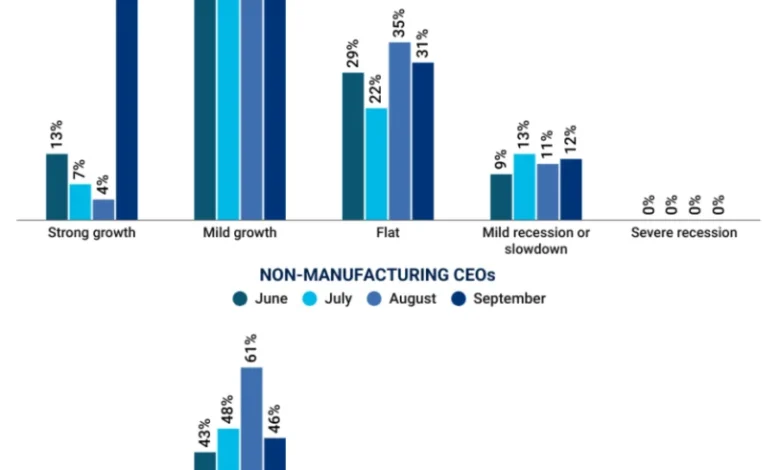
The divergence is further highlighted by the six-month economic outlook. While 57 percent of manufacturers are projecting some form of growth—up from 54 percent in August—the outlook among non-manufacturers has swung toward caution. The proportion of non-manufacturing CEOs predicting growth plummeted from 69 percent in August to 48 percent in September, while the share of those expecting a mild recession or slowdown doubled to 21 percent.
Crucially, the threat of a severe recession appears to have receded from the minds of manufacturing leaders. For two consecutive months, not a single manufacturer surveyed has predicted a severe economic downturn. However, this optimism is tempered by a lack of "strong" growth expectations. Only 2 percent of manufacturing CEOs foresee strong growth, with 86 percent of the sector clustered in a "mild growth" or "flat" outlook.
Inflationary pressures also remain a persistent headwind. Manufacturers now project headline Consumer Price Index (CPI) increases of 3.7 percent over the next 12 months, an increase from the 3.5 percent expectation recorded in August. With 35 percent of respondents anticipating inflation at 4 percent or higher, the cost-containment strategies of the previous year are likely to remain in place through 2027.
Capital, Liquidity, and Trade Policy
A key finding in the September data involves the shifting priorities regarding working capital. As interest rates remain a point of concern and liquidity becomes more constrained for smaller firms, manufacturers are adopting a more defensive posture than their counterparts in services and technology.

Fifty-six percent of manufacturers reported that they are actively working to reduce inventory levels over the next 12 months. This is a direct response to the softening consumer demand and an effort to free up cash flow. Furthermore, 31 percent of manufacturers are looking to stretch supplier payment terms to preserve liquidity.
Trade policy and geopolitical instability are exacerbating these pressures. For firms with global operations, the complexity is cumulative. "Uncertainty in the marketplace due to the Iran war, tariffs, inflation, and interest rates continue to cause a drag on our business," observed the CEO of a mid-sized industrial manufacturer based in North Carolina.
For smaller manufacturers, the situation is even more acute. One CEO of a small industrial firm in Utah highlighted a recurring structural issue: "Traditional or bank funding for small business is an ongoing issue, as it is simply not available." This suggests that while large-scale industrial projects are driving a segment of the manufacturing economy, the broader ecosystem—particularly smaller, domestic-only firms—is struggling to access the capital necessary to sustain operations during a period of economic transition.
Profitability Squeeze and Future Implications
Perhaps the most concerning shift for shareholders is the growing disparity between revenue and profit expectations. While revenue forecasts have remained relatively stable, profit outlooks have deteriorated significantly. In August, the gap between revenue and profit expectations was 7 points. By September, that gap widened to 12 points.
One in five manufacturers now expects profits to fall this year, up from one in six in the previous month. Even more concerning, the number of firms bracing for a profit decline of 20 percent or more has more than doubled, rising from 4 percent in August to 10 percent in September. As the CEO of a large industrial manufacturer in Indiana put it, "Ability to price will get more scrutiny."
This margin squeeze is forcing a strategic re-evaluation of pricing power. Manufacturers are increasingly aware that they cannot pass on rising costs to consumers as easily as they could in the previous two years. The result is a shift toward operational efficiency, as indicated by the fact that capital spending intentions remain flat, even as hiring plans have seen a slight uptick.

A Sector at a Crossroads
The September 2026 data presents a snapshot of a sector that is proving its resilience but is by no means immune to the broader economic cooling. The manufacturing sector is currently buoyed by specific, high-demand areas—namely data center infrastructure and industrial construction—that are shielding it from the declines seen in the non-manufacturing services and retail sectors.
However, the divergence between industrial and consumer goods producers serves as a warning. As the "softening" of consumer demand continues, the margin pressures observed this month are likely to intensify. With 39 percent of manufacturers planning to keep headcount stable and a significant focus on inventory reduction, the industry is clearly positioning itself for a period of defensive growth.
The long-term health of the sector will likely hinge on the resolution of global trade uncertainties and the availability of capital for smaller firms. As the gap between revenue and profit growth continues to widen, the ability of manufacturing leaders to navigate these liquidity and pricing challenges will define the success of the 2027 fiscal year. For now, the sector remains the more optimistic, yet increasingly cautious, anchor of the U.S. economy.