Wildfires in Spain Force Evacuation of NASA Madrid Deep Space Network Facility Amid Critical Infrastructure Shortages

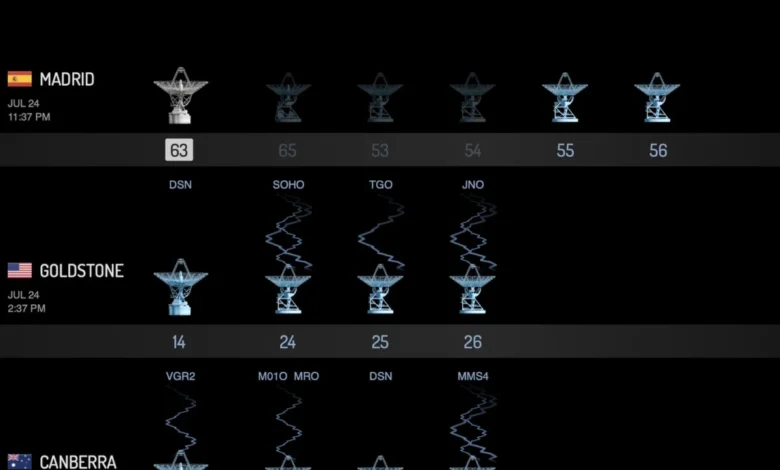
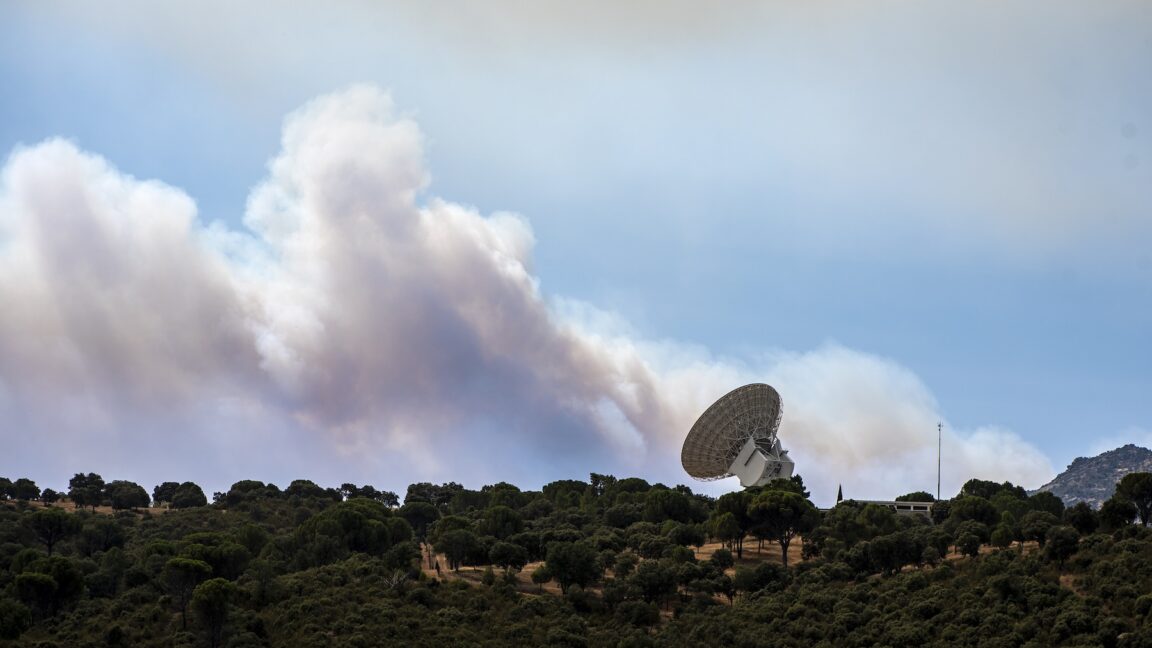
The Madrid Deep Space Communications Complex, a vital link in NASA’s global communication network, has been forced to suspend operations and evacuate personnel as aggressive wildfires sweep through the mountainous regions west of the Spanish capital. The facility, located in Robledo de Chavela, serves as one of only three such sites in the world capable of maintaining contact with robotic explorers across the solar system and beyond. On Friday afternoon, NASA’s "DSN Now" status tracking website confirmed a total cessation of activity at the Madrid site, showing no active data links while its sister stations in Goldstone, California, and Canberra, Australia, remained operational, attempting to shoulder the sudden increase in communication load.
The evacuation comes at a precarious moment for the Deep Space Network (DSN), which is currently grappling with significant technical setbacks at its other global locations. With the Madrid complex offline due to the environmental emergency, the agency’s ability to track and command missions like Voyager 2 and Juno is being severely tested. NASA officials emphasized that the safety of the workforce is the paramount concern, acknowledging the broader tragedy unfolding in the surrounding Spanish communities as thousands of residents are displaced by the fast-moving flames.
The Wildfire Emergency and Regional Impact
The wildfires in the Community of Madrid were exacerbated by a prolonged summer heatwave and chronic drought conditions that have plagued the Iberian Peninsula for several seasons. According to reports from Spanish authorities and Reuters, the situation escalated rapidly on Friday, leading to the mandatory evacuation of more than 19,000 people from towns in the mountains west of Madrid. The regional emergency services deployed more than 2,000 personnel, including members of the Military Emergencies Unit (UME), along with a fleet of 10 firefighting aircraft to combat the multiple fronts.
The NASA facility was not the only space-related casualty of the fire’s path. The Cebreros tracking station, owned and operated by the Spanish government and the European Space Agency (ESA), was also forced to evacuate. Located just a few miles from the NASA complex, the Cebreros station is a critical node in the ESA’s Estrack network, providing deep-space support for European missions. The proximity of these two vital scientific hubs highlights the vulnerability of space-ground infrastructure to the increasing frequency of extreme weather events and climate-driven natural disasters.
NASA released a formal statement regarding the situation: “The safety and well-being of our personnel is our highest priority and our thoughts are with the families and neighbors who are also experiencing the impact of the wildfires in the surrounding communities. We will provide updates as conditions evolve.” As of Friday evening, the extent of any potential physical damage to the antennas or supporting infrastructure remained unknown, as the priority remained on fire containment and personnel safety.
A Fragile Global Network: The DSN Architecture
The Deep Space Network is designed to provide 24-hour coverage of the sky as the Earth rotates. By placing three complexes approximately 120 degrees apart in longitude—California, Spain, and Australia—NASA ensures that at least one station is always in view of a given spacecraft. However, this "always-on" capability relies on the full functionality of each site.
Each complex features several high-gain antennas, including at least one massive 70-meter (230-foot) dish. These 70-meter antennas are the heavy hitters of the network, capable of capturing the incredibly faint signals transmitted by spacecraft billions of miles away. The loss of the Madrid site, even temporarily, creates a "blind spot" in the network’s coverage. While smaller 34-meter antennas at other sites can sometimes be "arrayed" (linked together) to mimic the sensitivity of a larger dish, this process is technically complex and consumes more resources across the remaining two sites.
The Goldstone Accident and Infrastructure Strain
The timing of the Madrid shutdown is particularly problematic because the DSN is already operating at reduced capacity. The 70-meter antenna at the Goldstone Deep Space Communications Complex in California, known as Deep Space Station 14 (DSS 14), has been offline since last year following a catastrophic mechanical failure.
According to NASA reports, an accident occurred during a routine operation that caused the massive structure to "over-rotate." This movement exceeded the antenna’s design limits, leading to a cascade of structural and mechanical failures. The incident resulted in the severing of critical cables and the rupture of water lines. More significantly, the base of the antenna was flooded with approximately 200,000 gallons of water mixed with glycol. Glycol is used in the antenna’s cooling systems, but it presents a significant environmental hazard when spilled in such large quantities, requiring an extensive and expensive remediation process.
The cleanup and repair efforts at Goldstone are currently projected to cost between $4.1 million and $4.6 million. Because the antenna is decades old, NASA officials have decided to combine the emergency repairs with previously scheduled upgrades to modernize the dish’s electronics and structural integrity. This comprehensive overhaul means that the United States’ primary 70-meter deep space antenna is expected to remain out of service until at least 2028.
Scientific Implications: Voyager 2 and Juno
With Goldstone’s 70-meter dish out of commission and the Madrid site evacuated, the Deep Space Network is currently relying on a single 70-meter antenna located in Canberra, Australia (DSS 43). This puts immense pressure on the Australian site to maintain contact with NASA’s most distant and scientifically significant missions.
One of the most affected missions is Voyager 2. Launched in 1977, Voyager 2 is now in interstellar space, more than 12 billion miles from Earth. Because of its southern trajectory relative to Earth’s orbital plane, the Canberra station is the only site that can transmit commands to the aging probe. However, receiving data from the probe usually requires the sensitivity of multiple 70-meter dishes across the network to ensure no data is lost.
Similarly, the Juno spacecraft, currently orbiting Jupiter, requires high-bandwidth communication to transmit the high-resolution imagery and complex magnetospheric data that define the mission. While Juno is much closer to Earth than Voyager, the loss of the Madrid complex limits the windows of time during which the spacecraft can "dump" its recorded data to Earth, potentially leading to delays in scientific analysis and mission planning.
The Artemis Factor and Future Lunar Exploration
The current strain on the DSN also raises concerns about the upcoming Artemis missions. The Artemis program, which aims to return humans to the Moon and eventually establish a sustainable presence there, places unprecedented demands on the network. Human spaceflight missions require much higher data rates than robotic missions to support live video feeds, telemetry for life-support systems, and real-time communication with astronauts.
Fortunately, the current timeline for Artemis III and IV provides some breathing room. Artemis III, which was originally envisioned as a lunar landing mission, has been adjusted to focus on testing the Orion capsule in low-Earth orbit (LEO) alongside commercial Moon landers from SpaceX and Blue Origin. Since LEO missions can utilize the Near Space Network (NSN) and TDRS satellite constellations, the burden on the Deep Space Network will be lower than that of a full lunar mission.
Artemis IV, which is slated to be the program’s first planned lunar landing with astronauts in the current configuration, is targeted for no earlier than 2028. This aligns with the expected return-to-service date for the Goldstone 70-meter antenna. However, any further delays in repairs at Goldstone or prolonged outages at the Madrid site could create a "communication bottleneck" that might force NASA to delay mission launches or prioritize human safety over scientific data collection from other planetary missions.
Chronology of Recent DSN Challenges
- Late 2024 – Early 2025: The Goldstone 70-meter antenna (DSS 14) suffers an over-rotation accident, leading to a 200,000-gallon glycol spill and significant structural damage.
- Early 2026: NASA begins a $4.6 million repair and modernization project at Goldstone, estimating a three-year downtime.
- Summer 2026: Record-breaking heatwaves and drought conditions hit Spain and Southern France, creating extreme wildfire risks.
- Friday, July 24, 2026 (Morning): Wildfires approach the mountains west of Madrid; Spanish authorities issue mass evacuation orders for 19,000 residents.
- Friday, July 24, 2026 (Afternoon): NASA and ESA officials order the emergency evacuation of the Madrid Deep Space Communications Complex and the Cebreros tracking station.
- Friday, July 24, 2026 (Evening): NASA’s DSN tracking systems show zero activity in Madrid, shifting all critical deep-space traffic to Canberra and Goldstone’s smaller 34-meter dishes.
Analysis of Global Infrastructure Vulnerability
The evacuation of the Madrid site serves as a stark reminder of the terrestrial vulnerabilities of space exploration. While the DSN is designed for redundancy, that redundancy is being eroded by a combination of aging hardware, mechanical accidents, and the increasing frequency of climate-related disasters.
The reliance on a "three-node" system means that the loss of any single site reduces the network’s capacity by 33% in terms of time, but the loss of specific large-aperture antennas can reduce data-reception capabilities even more drastically for distant missions. For missions in the outer solar system, there is no substitute for the 70-meter dishes.
Industry analysts suggest that NASA may need to accelerate the construction of additional 34-meter beam waveguide antennas to create "arrays" that can more reliably replace the 70-meter giants. While the agency is already in the process of building new antennas under the "DSN Aperture Enhancement Project," the pace of these upgrades may need to be quickened to account for a world where wildfires and extreme weather can take a major facility offline without warning.
As the fires continue to burn in Spain, the global space community remains in a holding pattern. The immediate goal is the containment of the blaze and the safety of the Spanish citizens and the dedicated staff at Robledo de Chavela. Once the danger passes, engineers will face the daunting task of inspecting the sensitive radio equipment for smoke damage or heat-related warping, which could further extend the outage and continue the current period of heightened risk for NASA’s fleet of deep-space explorers.