MRI scans reveal differences in brain regions associated with memory, attention, and visual processing

The modern adolescent experience is inextricably linked with glowing screens, whether for academic purposes, socialization, or leisure entertainment. As smartphones, tablets, and gaming consoles become primary fixtures of daily life, researchers across disciplines are racing to understand the neurological ramifications of this digital shift. A recent peer-reviewed study conducted by researchers at the University of Eastern Finland has cast new light on this pressing public health question, uncovering distinct associations between high recreational screen time and variations in brain structure among teenagers.
Published in the academic journal NeuroImage: Reports, the investigation utilized high-resolution magnetic resonance imaging (MRI) to examine the brains of healthy adolescents. The findings revealed measurable differences in grey matter volume across several critical neurological regions, including those responsible for memory consolidation, attention regulation, executive decision-making, and visual interpretation. However, neuroscientists and public health officials have issued a vital warning alongside the findings: the study identifies correlations rather than establishing a direct causal link, meaning researchers cannot yet definitively state that excessive device usage physically alters the adolescent brain.
Methodological Framework and Participant Demographics

To conduct the study, the research team at the University of Eastern Finland recruited a cohort of 44 healthy adolescents aged 16 to 19, consisting of 25 girls and 19 boys. This specific developmental window is of intense scientific interest because adolescence is a period of profound neurological reorganization, marked by the fine-tuning of neural circuits and the refinement of cognitive capabilities.
The investigators employed a multifaceted approach to evaluate the participants. Brain structures were meticulously mapped using MRI scans, focusing specifically on grey matter volume—the tissue containing neuronal cell bodies, dendrites, and synapses that processes information throughout the central nervous system. To measure lifestyle variables, the researchers utilized comprehensive questionnaires detailing participants’ daily leisure screen time, smart device habits, and physical activity levels. Furthermore, the study incorporated objective physical assessments, such as shuttle runs and standing long jumps, to gauge general physical fitness and explore potential intersections between physical vitality and cognitive architecture.
Detailed Neurological Findings: Grey Matter Variations
When analyzing the MRI data alongside the self-reported screen time metrics, the Finnish researchers observed striking patterns across distinct anatomical divisions of the brain. These differences spanned multiple regions, each governing specialized cognitive tasks.

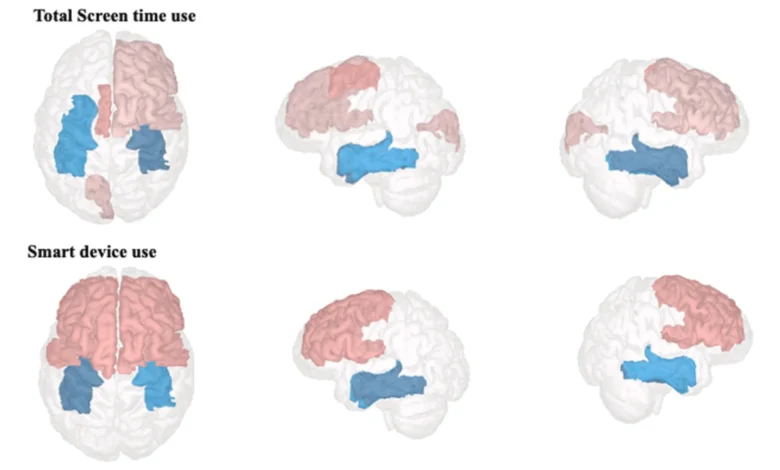
Most notably, teenagers who reported higher volumes of daily screen time and smart device usage demonstrated lower grey matter volumes in the medial temporal lobe. This anatomical structure plays a foundational role in the formation of declarative memory, spatial navigation, and the encoding of new learning experiences. A reduction or alteration in grey matter volume within this region has historically been a point of academic interest when studying cognitive load and information retention.
Conversely, the study found a positive correlation in other areas. Higher screen usage was associated with larger grey matter volumes in specific zones of the frontal lobe. This region is heavily implicated in executive functions, including sustained attention, working memory, cognitive flexibility, impulse control, and motor planning. Additionally, researchers noted structural associations within the occipital lobe, the primary processing center for visual stimuli.
Interpreting the Data: Adaptation Versus Delayed Maturation
The discovery of larger grey matter volumes in the frontal and visual lobes among heavy screen users initially presents a counterintuitive puzzle. In popular culture, larger brain volumes are frequently misconstrued as universally positive indicators of intelligence or capability. Neurologists, however, view the matter through a much more nuanced lens.

Lead researcher Hannamari Skog and her colleagues proposed two primary hypotheses to explain these structural differences. On one hand, the larger volumes observed in frontal and visual regions could reflect adaptive neuroplasticity—the brain’s ability to structurally reorganize itself in response to intensive, repeated demands. Fast-paced video games, complex social media feeds, and rapid multitasking require constant visual processing, rapid motor planning, and sustained attentional shifts. Over time, the neural pathways dedicated to these tasks may experience localized hypertrophy or heightened metabolic activity.
On the other hand, the researchers raised the possibility of delayed brain maturation. During a healthy adolescence, the human brain undergoes a crucial developmental milestone known as synaptic pruning. During this biological clean-up phase, the brain systematically eliminates unused or redundant synaptic connections, streamlining neural networks to make them faster and more efficient. An abnormally high volume of grey matter in certain areas can sometimes indicate that this natural pruning process is lagging or proceeding along an altered trajectory.
The Broader Lifestyle Picture: Physical Activity and Fitness
While screen time formed the primary focus of the investigation, the research team also sought to contextualize digital habits within a broader lifestyle framework. Physical activity and physical fitness metrics were integrated into the study to determine whether an active lifestyle might mitigate, amplify, or otherwise interact with the structural brain differences associated with screen usage.

The results regarding physical fitness were notably complex. While initial models suggested fascinating intersections between cardiovascular fitness, muscular strength, and brain morphology, the researchers noted that several of these associations did not maintain statistical significance after rigorous adjustments for multiple comparisons. Consequently, the study emphasizes that lifestyle factors do not operate in a vacuum; rather, they form an intricate web of influences on the developing adolescent mind.
Scientific Caveats and Limitations
In the wake of media headlines warning about the perils of smartphones, the authors of the NeuroImage: Reports study have been careful to contextualize their work. Science is rarely advanced by a single cross-sectional snapshot, and this investigation comes with clear methodological limitations that prevent sweeping generalizations.
First and foremost, the study is observational and cross-sectional in design. It provides a static snapshot of 44 teenagers at a single point in time, rather than a longitudinal tracking model that follows individuals across several years of development. Because of this architecture, the research cannot prove causation. It remains entirely plausible that teenagers with specific baseline brain structures are naturally drawn to heavier screen use, rather than the devices causing the structural variations.

Second, the sample size of 44 participants, while thoroughly analyzed via advanced imaging techniques, is relatively small. Replicating these findings across larger, more diverse international cohorts will be necessary before definitive public health guidelines can be formulated on the basis of brain structure alone.
Implications for Future Research and Public Policy
Despite these limitations, the study adds a valuable empirical layer to the ongoing global conversation surrounding youth digital consumption. As policymakers, educators, and parents grapple with rising concerns over digital distraction, mental health, and cognitive development, neuroscientific research provides a factual baseline to move discussions past speculative moral panics.
The findings underscore the reality that everyday lifestyle habits leave measurable footprints on human biology. As Hannamari Skog noted, the connections between modern lifestyle factors and adolescent neuroanatomy are deeply complex, requiring sustained, long-term scientific inquiry.

Future research initiatives will likely focus on longitudinal studies that track children from early childhood through late adolescence, monitoring how shifts in screen habits correspond with real-time changes in brain architecture and cognitive performance. Only through such sustained, rigorous investigation can the scientific community untangle the precise relationship between the digital world and the developing mind.
Related posts: