Navigating the Anthropic IPO Quiet Period: A Masterclass in Market Mechanics and Investor Strategy

The upcoming initial public offering of Anthropic stands as one of the most anticipated financial events of the decade, serving as a definitive case study in the complexities of the Securities and Exchange Commission’s (SEC) "quiet period" regulations. As the artificial intelligence sector matures, Anthropic’s transition from a private enterprise to a publicly traded entity in October 2026 highlights the stringent legal framework governing how companies communicate during the registration process. While the public anticipates the S-1 prospectus filing, the mechanisms of this transition remain opaque to many, requiring a clear understanding of the regulatory hurdles that prevent companies from engaging in promotional activities that could be construed as market manipulation.
The Regulatory Framework of the Quiet Period
The term "quiet period" is frequently misunderstood in the context of an IPO. Unlike the self-imposed communication blackouts common for established public companies prior to earnings releases, the IPO quiet period is a legal mandate governed by the Securities Act of 1933. This regulation is designed to ensure that the market relies on the formal, SEC-vetted prospectus rather than speculative promotional hype.

The process is segmented into three distinct phases, each carrying specific legal obligations:
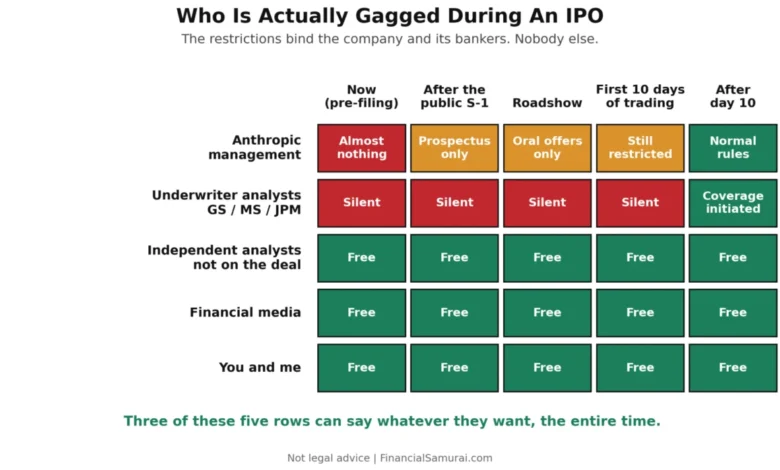
- The Pre-Filing Phase: Beginning the moment an organization decides to pursue an IPO, this phase is governed by Section 5(c) of the Securities Act. During this time, the company is strictly prohibited from making any public statements that could be interpreted as an "offer" of securities. This includes both written and oral communications. Legal teams refer to unauthorized promotional activity during this stage as "gun-jumping," which can lead to severe regulatory penalties and forced delays in the offering timeline.
- The Waiting Period: Once the registration statement—the S-1—is officially filed with the SEC, the company gains limited latitude. While the final price is not yet set, the company may circulate the preliminary prospectus and conduct the roadshow. This is the period during which underwriters gauge institutional appetite for the offering.
- The Post-Effective Phase: After the shares have been priced and are trading on a national exchange, the company enters a 25-day prospectus delivery requirement. During this time, the issuer remains under strict disclosure rules before returning to standard periodic reporting requirements.
Chronology of the Anthropic Offering
Anthropic’s path to the public markets has been meticulously managed to comply with these rigorous standards. On June 1, 2026, the company confirmed the submission of a confidential draft S-1 to the SEC. By utilizing a confidential filing, the company managed its exposure to market volatility while beginning the review process.
Throughout August and September 2026, media reports—including those from The Information and Reuters—suggested a shifting timeline, with an anticipated launch for the public filing occurring by late September. As of early September, the company has entered a critical window: Rule 163A, which provides a safe harbor for certain communications made more than 30 days before a filing, has expired. Consequently, the company’s legal counsel has transitioned to a posture of near-total silence, declining requests for comment to avoid any perception of influencing the market price prior to the official disclosure of the prospectus.

The Information Vacuum and Market Speculation
A paradoxical environment emerges during the quiet period: while the issuer is prohibited from speaking, the market is flooded with commentary from third parties. Reporters, institutional analysts, and retail commentators often fill the information void with valuations, TAM (Total Addressable Market) estimates, and revenue projections.
For example, current market discourse regarding Anthropic frequently cites revenue run rates approaching $65 billion and speculative valuations ranging from $1.5 trillion to $2 trillion. Crucially, none of these figures have been confirmed or endorsed by Anthropic management. Under SEC Rules 168 and 169, companies are allowed to release "ordinary-course factual business information," but they must refrain from commenting on forward-looking financial performance or the offering itself. This leaves the public to navigate a sea of information that lacks the regulatory "stamp of approval" found in an audited filing.
The Role of the Analyst Research Blackout
Beyond the SEC-mandated quiet period, a second layer of restriction exists under FINRA rules. Financial institutions that act as lead managers or bookrunners for an IPO—such as Goldman Sachs, Morgan Stanley, and JPMorgan—are prohibited from publishing research reports on the issuer for at least 10 calendar days following the listing.

This creates a two-tiered information release:
- The First 10 Days: The stock trades based on retail sentiment, momentum, and the analysis of firms not involved in the underwriting process.
- Day 11 and Beyond: The "bulge bracket" firms, having completed their blackout, typically initiate coverage simultaneously. These reports often contain institutional-grade price targets that can act as a secondary catalyst for the stock price, frequently leading to increased institutional participation.
Implications for Market Participants
For investors attempting to gain exposure, the quiet period serves as a critical pricing mechanism. Because the company cannot "hype" its own stock, the information gap between the current private valuation and the eventual public debut is often significant. Investors who have access to pre-IPO vehicles—such as specialized venture funds or innovation-focused exchange-traded funds—are currently operating on stale data, often relying on the most recent audited NAV (Net Asset Value).
The eventual release of the S-1 will serve as a corrective event. It will provide the first verified look at:

- Audited Financials: Specifically, gross margins, which remain the most debated metric regarding the cost of AI inference.
- Customer Concentration: Detailed insights into how much of the company’s revenue is tied to its largest enterprise partners.
- Risk Factors: A comprehensive legal document outlining every potential vulnerability, from technical obsolescence to regulatory intervention.
Strategic Considerations for the Future
The IPO of Anthropic is more than a simple listing; it is a test of how the market values the infrastructure of the next generation of AI. As the company approaches its debut, observers should distinguish between substantiated facts found within the forthcoming S-1 and the ambient noise generated by the broader market.
The "quiet period" is not an absence of information, but a compression of it. Once the legal dam breaks with the public filing of the prospectus, the market will transition from a phase of pure speculation to one of fundamental analysis. For individual and institutional investors alike, the primary risk remains the discrepancy between the market’s high expectations and the reality of the audited figures. As the company moves toward its October listing, the transition from a private entity to a public one will redefine the landscape of the AI sector, marking a definitive moment in the 2026 fiscal calendar. The challenge for stakeholders will be to maintain a balanced perspective, weighing the transformative potential of the technology against the standard risks inherent in any high-growth, large-scale initial public offering.