The Death of the Sales-Guy CEO: Why Technical Founders Are Inheriting the Enterprise Software Boom

For the past twenty years, the prevailing archetype for scaling an enterprise software company followed a well-worn playbook: a visionary founder conceives the core technology, but a seasoned, operationally minded CEO is brought in to install the "sales machine." This operator-led model transformed enterprise software into a multi-trillion-dollar industry, producing legendary executives who could manufacture commercial demand from scratch, build aggressive global sales forces, and shepherd companies through high-profile initial public offerings.
Nowhere was this archetype more clearly embodied than by Frank Slootman, the only chief executive in corporate history to successfully take three major enterprise software firms—Data Domain, ServiceNow, and Snowflake—public. At their market peaks, those three entities commanded a combined valuation exceeding $200 billion. Under Slootman’s watch, ServiceNow scaled from roughly $100 million in revenue to $1.4 billion before its IPO, and he later pulled Snowflake out of retirement in 2019 at a $4 billion valuation to orchestrate the largest software public offering ever recorded.
Yet, a closer examination of corporate histories reveals a nuance that complicates this narrative: Slootman never actually "carried a bag" as a dedicated salesperson. His resume prior to his first chief executive role was defined by product management and engineering leadership. He served as a product manager at Compuware, general manager of UNIFACE in Amsterdam, head of the EcoSystems division in Campbell, and senior vice president of products at Borland, where he oversaw engineering and product management just one year before stepping into his first CEO seat. While his reputation became synonymous with ruthless commercial execution, his ascent was rooted in product infrastructure rather than field sales.
Similarly, Marc Benioff—often cited as the quintessential sales-driven executive—began his career as a programmer. He founded Liberty Software at the age of 15 to write and sell Atari games, penned assembly code for Apple’s Macintosh division during his college years, and spent over a decade mastering product development alongside sales and marketing at Oracle.
Despite these hybrid origins, the traditional operator-led archetype is rapidly losing its monopoly on the modern tech economy. A fundamental shift is underway across the fastest-growing business-to-business (B2B) and artificial intelligence enterprises, where a new generation of leaders is rewriting the rules of corporate leadership.
The Shift in Modern Enterprise Leadership
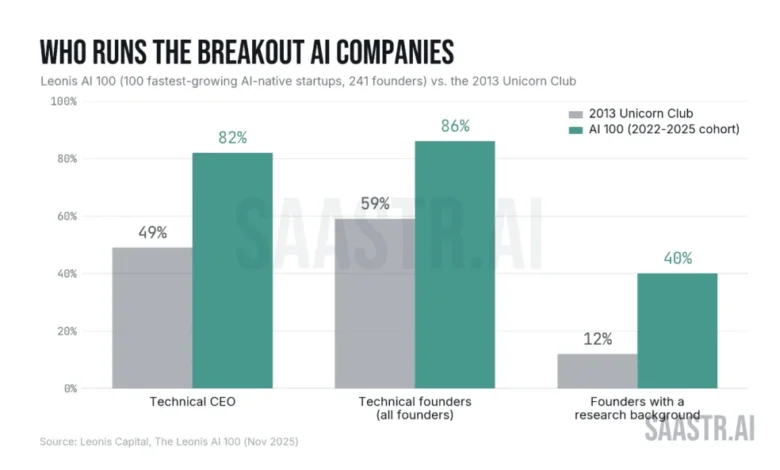
An index compiled by venture capital firm Leonis Capital, which analyzed more than 10,000 AI startups founded between 2022 and 2025, highlights a profound generational pivot. Among the 100 fastest-growing AI-native companies, 82 are led by technical chief executives, and 86% of their founding teams possess deep technical backgrounds. By contrast, a retrospective look at Aileen Lee’s original "Unicorn Club" from a decade prior reveals a much more balanced distribution, where only 49% of companies had technical CEOs and 59% of founders were technically trained.
The research pedigree of these founders has shifted dramatically as well. Approximately 40% of the AI 100 founders emerge directly from academic and industrial research backgrounds—such as Berkeley PhDs, OpenAI and DeepMind alumni, and international science Olympiad medalists—compared to just 12% in the previous unicorn cohort. Furthermore, these leaders are arriving at the helm at a significantly younger age. The median age at founding for the current AI cohort sits at 29, with 26 and 27 being the most common ages, allowing these entrepreneurs to transition straight from research laboratories into commercial leadership without spending a decade climbing traditional corporate ladders.
The Divergent Paths of Databricks and Snowflake
The operational consequences of this leadership shift are perhaps best illustrated by the contrasting trajectories of two data giants: Databricks and Snowflake. Both companies launched into the same market category during the mid-2010s, yet their boards made diametrically opposed bets on executive leadership.
In January 2016, Databricks faced severe commercial headwinds. Having raised approximately $174 million at a roughly $1 billion valuation, the company was generating negligible revenue as major cloud providers like Amazon Web Services and competitor Cloudera began absorbing Apache Spark into their native product suites. Founding CEO Ion Stoica agreed to step down and return to his academic post as a professor at the University of California, Berkeley.
The conventional Silicon Valley playbook dictated hiring a seasoned, veteran enterprise operator—the exact strategy Snowflake subsequently pursued on its path to a multi-billion-dollar valuation. Instead, Databricks co-founders championed Ali Ghodsi, then the company’s vice president of engineering and a career academic who had never run a commercial business. Early board members, including Ben Horowitz of Andreessen Horowitz, initially questioned the wisdom of swapping one founder-professor for another, eventually approving a conditional one-year trial.
That trial yielded historic results. By August 2026, Databricks announced a $5 billion funding round at a staggering $190 billion valuation, boasting year-over-year growth exceeding 80%, more than 1,000 customers spending upwards of $1 million annually, and over 100 accounts exceeding $10 million in yearly spend. Despite repeated market speculation, Ghodsi has consistently declined to take the company public, maintaining an independent growth strategy. While Snowflake has undeniably built a successful business, the company that retained its professor-turned-CEO has scaled to become significantly larger and faster-growing.
The shift was further emphasized when Snowflake itself abandoned the traditional operator model. On February 28, 2024, Snowflake announced that Slootman was retiring and handing the reins to Sridhar Ramaswamy. The market reaction was swift and punitive: Snowflake’s stock dropped 20% in a single session, erasing $15 billion in market capitalization as investors panicked over the departure of a celebrated sales-focused executive.
Ramaswamy, a computer scientist who previously scaled Google’s advertising business from $1.6 billion to over $100 billion before founding AI search startup Neeva, immediately set to work. Rather than treating sales as an external function to be managed by proxy, Ramaswamy approached go-to-market operations through an engineering lens. Over the subsequent two years, he systematically rebuilt Snowflake’s sales organization into an AI-native operational unit.
The financial results defied market skepticism. Snowflake recorded its strongest sequential dollar growth in corporate history, with net revenue retention stabilizing and remaining performance obligations surging past $9.7 billion. Ramaswamy’s technical background did not detach him from commercial execution; instead, it enabled him to optimize the sales machine from the foundational infrastructure up.
Domain Expertise and the Rise of Vertical AI
Beyond pure computer scientists, a third category of modern founders is upending traditional expectations: domain experts who possess first-hand, granular knowledge of complex workflows that advanced models have recently become capable of automating.
At Harvey, a legal AI platform valued at $11 billion, co-founder and CEO Winston Weinberg was a junior attorney at O’Melveny & Myers who performed the exact document-heavy grunt work that the software now automates. Similarly, Dr. Shiv Rao, founder of the medical documentation platform Abridge, is a practicing cardiologist who studied history and film theory before building a company that is now deployed across more than 250 health systems. In both cases, these leaders possessed an intuitive, experiential understanding of industry-specific pain points that neither a traditional sales executive nor a pure computer science researcher could acquire in a single fiscal quarter. Data from Leonis Capital indicates that 9 out of 13 vertical AI founders in their index possessed direct, hands-on domain experience prior to launching their companies.
The Resilience of the Commercial Playbook
Despite the ascendancy of technical leadership, the traditional commercial playbook has far from vanished. Bill McDermott, CEO of ServiceNow, stands as the premier exemplar of the pure commercial executive leading a major technology enterprise at scale. With a career spanning executive leadership at Xerox, leadership at Gartner, global sales operations at Siebel, and a 17-year tenure at SAP, McDermott’s path to the corner office is unreservedly commercial.
ServiceNow’s financial performance under McDermott underscores the continued potency of the sales-driven model. Reporting robust subscription revenues and operating margins well above corporate guidance, ServiceNow continues to post elite metrics, crossing significant milestones in artificial intelligence annual contract value. However, despite these exceptional operational achievements, the market valuation multiple assigned to these results has evolved. While the traditional sales playbook successfully multiplies a proven product through aggressive global distribution, modern investors increasingly prioritize the underlying technological innovation and adaptability of the asset being multiplied.
Agility and the Speed of the Pivot
The defining advantage of the technical CEO in the current technological landscape is not necessarily superior business acumen, but rather execution speed and adaptability. According to industry data, two-thirds of the fastest-growing AI startups have executed at least one major strategic pivot, with technical-led teams executing those pivots in a median timeframe of 12 months—twice as fast as non-technical leadership teams, who average 27 months.
In a rapidly evolving market where foundational AI model capabilities advance every few months and entire product categories emerge and dissolve overnight, a 15-month strategic lag can prove fatal. Founders who possess deep technical fluency can independently evaluate model releases, test capabilities firsthand, and recalibrate product roadmaps in real-time without relying on commissioned studies or filtered executive summaries. Furthermore, with over 80% of modern AI startups launching with self-serve onboarding models, customer acquisition increasingly begins with product-led adoption, relegating traditional outbound sales to a secondary stage that formalizes demand rather than manufacturing it from scratch.
Strategic Implications for Founders and Boards
As the enterprise software landscape continues to mature, this generational transition in leadership offers clear lessons for founders, corporate boards, and commercial executives alike.
For early-stage founders navigating executive transitions, the velocity gap underscores the danger of prematurely outsourcing strategic vision to an outside operator who cannot directly evaluate core technological shifts. For corporate boards overseeing CEO succession, the success stories of Databricks and Snowflake demonstrate that promoting leaders with deep product expertise—provided they are held accountable for commercial execution—can unlock unprecedented scale. Finally, for career sales leaders, the modern enterprise executive seat increasingly demands fluency in product architecture and technological capability, signaling that the most effective path to the corner office is an integrated understanding of both code and commerce.