The Financial Reality of Answer Engine Optimization: Understanding Costs, Strategies, and Market Implementation

The rapid ascent of generative AI has fundamentally altered the digital marketing landscape, shifting the focus from traditional search engine rankings to Answer Engine Optimization (AEO). As users increasingly turn to platforms like ChatGPT, Gemini, and Perplexity for synthesized information rather than a list of blue links, businesses are forced to reconsider their digital presence. Determining the cost of this transition is complex, as the market currently spans from low-cost monitoring subscriptions starting at roughly $30 per month to comprehensive, full-service agency programs exceeding $15,000 per month.
Understanding the fiscal implications of AEO requires a nuanced look at the scope of work. At the entry level, businesses invest in software tools that provide visibility tracking and competitor benchmarking. At the enterprise level, organizations are outsourcing the entire ecosystem of content production, technical schema implementation, and off-site authority building. This pricing volatility is a byproduct of a maturing industry where standardized metrics for "AI visibility" are still being defined.
The Chronology of the AEO Shift
The emergence of AEO as a distinct marketing discipline is a direct response to the integration of Large Language Models (LLMs) into search engines starting in late 2022 and accelerating throughout 2024 and 2025. Initially, businesses treated AI search as a peripheral concern, viewing it as an extension of standard SEO. However, as referral traffic data from 2025 began to show that users were spending significantly more time within chat interfaces, the need for a specialized approach became unavoidable.
By early 2026, industry reports indicated that AI referral traffic had tripled in a single year, though it still comprised a small percentage of total web traffic. This shift forced a bifurcation in marketing budgets. Companies began moving funds away from legacy SEO tactics—which prioritize keyword density and backlink volume—toward AEO, which prioritizes entity recognition, citation accuracy, and the ability of an AI model to summarize a brand’s expertise concisely.

Cost Breakdown by Operational Approach
The financial barrier to entry for AEO is intentionally low, allowing teams to experiment before scaling. However, the costs balloon rapidly once human capital is introduced to manage content and technical execution.
1. The Self-Serve Monitoring Approach
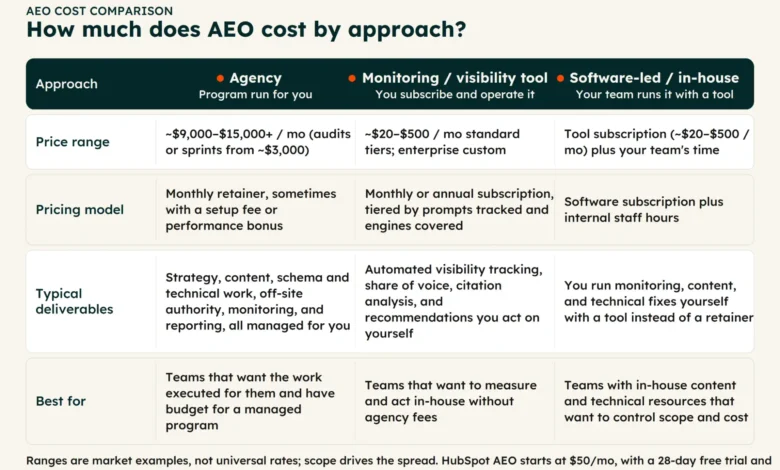
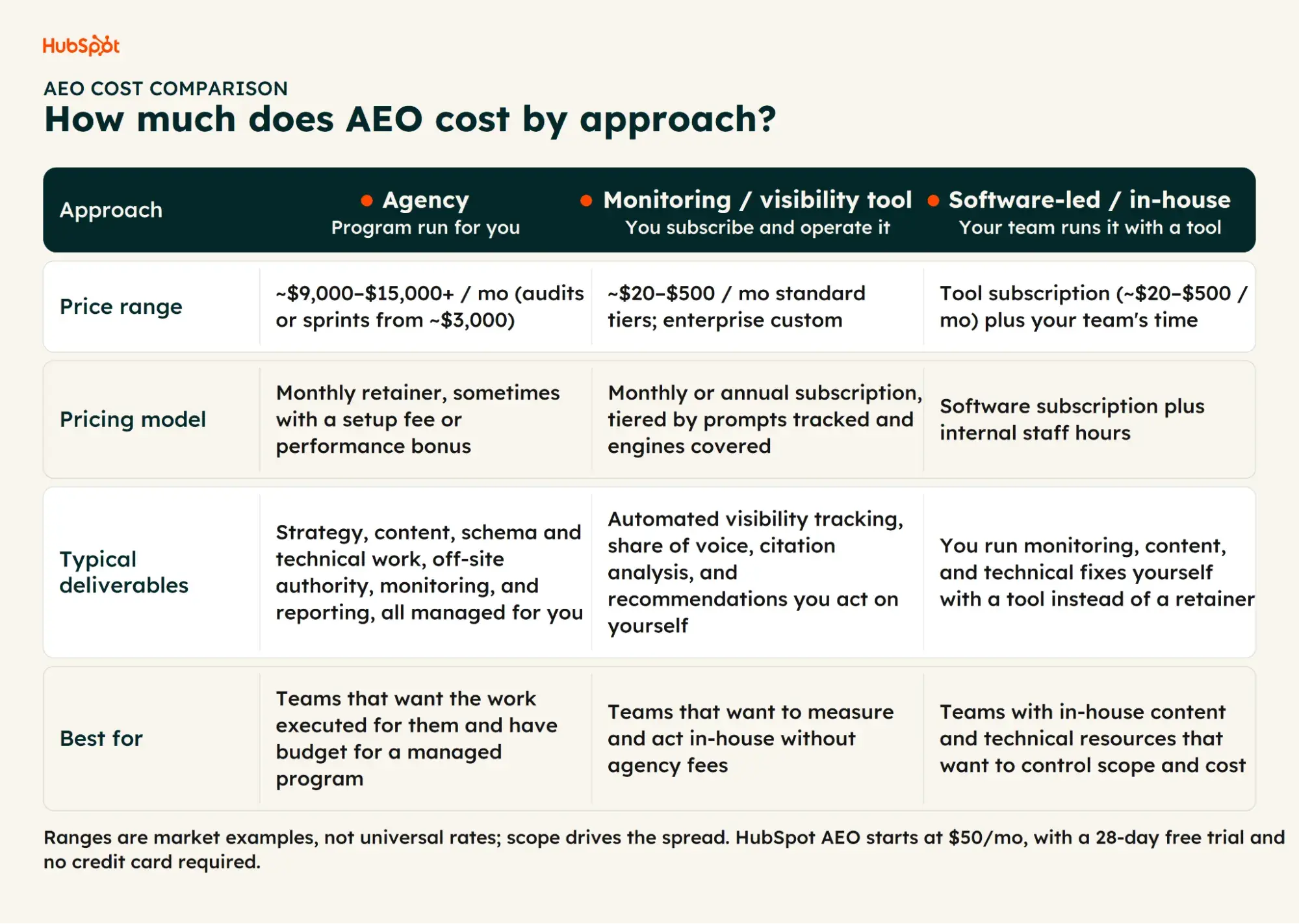
For organizations with in-house SEO or content teams, the most efficient entry point is a monitoring-first subscription. These tools, such as HubSpot AEO, Profound, or Peec AI, typically range from $30 to $500 per month. These platforms function by tracking specific prompts across major AI engines, providing a "Share of Voice" metric that tells a brand how often they are cited as an authoritative source. The cost here is largely fixed, with enterprise-level pricing usually scaling based on the number of prompts tracked or the breadth of engine coverage.
2. The In-House Managed Approach
This mid-tier strategy involves a tool subscription paired with internal labor. The cost is the sum of the software license plus the allocation of staff hours. For many mid-sized firms, this is the most cost-effective long-term model, as it keeps the strategic "brain" of the operation internal. Costs can vary significantly here, but typically require at least one dedicated resource to analyze citation data and implement the resulting technical and content recommendations.
3. The Full-Service Agency Model
Agencies have begun to offer AEO as a premium service, with retainers often starting at $9,000 per month and reaching $15,000 or more for comprehensive market coverage. These packages are not merely "monitoring" services; they include the creation of AI-optimized content, complex schema markup, and aggressive off-site digital PR to build the brand authority that AI models rely on when generating answers.
Supporting Data and Budget Allocation
Data suggests that AEO should not be viewed as a replacement for SEO, but rather as an adjacent pillar of digital presence. A significant risk for businesses is the erosion of traditional organic traffic if they neglect core SEO while chasing AI citations.

According to recent industry analysis, the ideal budget allocation for a growing enterprise is to maintain existing SEO efforts while carving out a 10–15% "innovation budget" for AEO. This strategy ensures that the website remains technically sound—which is a prerequisite for AI crawlers to trust the content—while simultaneously experimenting with the specific formatting requirements of answer engines.
Fact-Based Analysis of Pricing Drivers
The wide range in AEO pricing is primarily driven by three factors:
- Content Volume: AI engines prioritize comprehensive, synthesized answers. Producing this type of content is labor-intensive and requires high-level subject matter expertise, which carries a premium compared to traditional blog post production.
- Technical Complexity: Implementing structured data (schema) that helps AI models understand the relationship between entities is a specialized skill. Agencies charge for the audit, implementation, and ongoing maintenance of these technical frameworks.
- Off-Site Authority: Unlike traditional SEO, where backlink volume is often a primary metric, AEO is increasingly focused on "brand sentiment" and "entity mentions." Building this requires a sophisticated public relations and content syndication strategy, which is the most expensive component of an AEO retainer.
Avoiding Market Pitfalls: Red Flags
As the category matures, businesses must remain vigilant regarding how vendors pitch their services. Common red flags include:
- The "Renamed SEO" Trap: If an agency claims they are doing AEO but their deliverables are exclusively focused on traditional keyword ranking and backlink counts, they may be simply rebranding legacy services to command a higher price.
- Lack of Transparency in Reporting: AEO is, by nature, somewhat opaque because AI answers change frequently. Any vendor that guarantees a specific ranking or citation rate within 30 days is likely overpromising; the results of AEO are non-deterministic and require a long-term trend analysis.
- Metered "Per-Prompt" Fees: While software tools often charge by the prompt, agencies should ideally work on a retainer that covers a breadth of topics rather than nickel-and-diming for every specific query tracked.
The 60-90 Day Pilot Strategy
For teams hesitant to commit to a long-term retainer, a 60-90 day pilot is the recommended path forward. The primary objective of this pilot is to establish a baseline of "AI Visibility."
Week 1-4: Benchmarking. Implement a monitoring tool to identify where the brand currently appears in AI responses and, more importantly, where competitors are appearing instead.
Week 5-8: Targeted Optimization. Focus on the "low-hanging fruit"—updating existing, high-performing content with clearer headers, direct answers, and improved entity-based schema.
Week 9-12: Analysis. Evaluate the delta in share of voice. If the brand’s citation rate has improved, the business case for a larger investment is solidified.
Broader Impact and Future Implications
The emergence of AEO signifies a fundamental shift in the internet’s information economy. We are moving away from an era where the "winner" of a search query was the entity with the most clicks, toward an era where the winner is the entity with the most synthesized, credible information.
This evolution will likely lead to a consolidation of digital power. Larger, more authoritative brands that can afford the higher costs of comprehensive AEO programs may find it easier to dominate AI-generated responses, effectively creating a "citation moat" that is difficult for smaller competitors to cross. Conversely, the democratization of monitoring tools allows smaller, agile teams to compete on specific, high-intent niches if they can produce content that consistently serves as the primary source for AI engines.
Ultimately, the cost of AEO is the cost of staying relevant in a world where the user experience is no longer about browsing, but about receiving immediate, authoritative answers. As AI models become more integrated into the daily workflow of the global consumer, the ability to be cited by these systems will likely transition from a "nice-to-have" marketing tactic to a fundamental requirement for business survival. Organizations that prioritize a clear, data-driven strategy today—balanced by a cautious approach to budget allocation—will be best positioned to lead in this new paradigm.
Related posts: