
A federal judge has issued a significant ruling in favor of David Streever, a citizen who faced potential prosecution by Immigration and Customs Enforcement (ICE) for sending a highly critical email to the agency’s former acting director, Todd Lyons. In a decision handed down on Tuesday, U.S. District Judge Rudolph Contreras granted a preliminary injunction, effectively blocking ICE from pursuing criminal charges or issuing further intimidation tactics against Streever for his exercise of protected speech. The ruling marks a pivotal moment in the ongoing national debate regarding the boundaries of the First Amendment in the digital age, particularly when directed at federal law enforcement agencies.
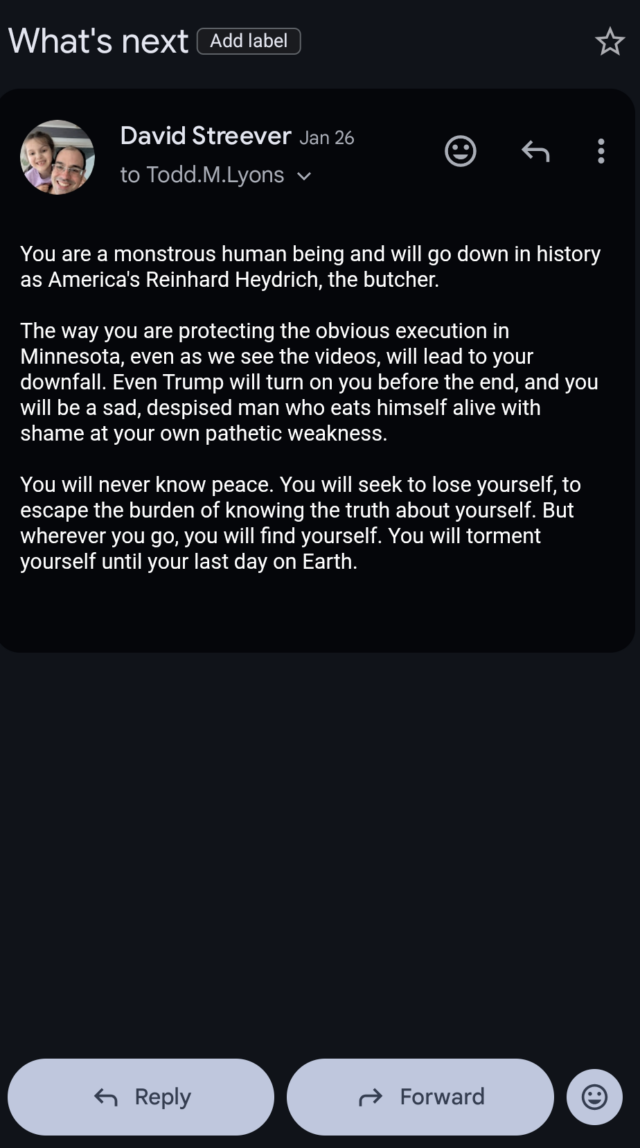
The legal battle stems from a three-paragraph email sent by Streever in January, which was fueled by his profound outrage over the deaths of two Minnesota protesters, Renee Good and Alex Pretti. In the correspondence, Streever directed his anger at then-acting director Todd Lyons, labeling him a “monstrous human being” and predicting that he would eventually be consumed by the “shame” of his actions. Streever went further, comparing Lyons to Reinhard Heydrich—a high-ranking Nazi official known as “the Butcher”—and suggesting that even political allies would eventually distance themselves from Lyons due to his defense of the controversial fatalities.
A Chronology of Escalation
The timeline of this dispute highlights a concerning gap between the initial expression of dissent and the government’s reaction. The sequence of events is as follows:

- January: David Streever sends a critical, emotionally charged email to ICE Acting Director Todd Lyons.
- January – May: For five months, ICE takes no official action. The email remains in the agency’s records without triggering a formal response or investigation.
- June: ICE agents arrive at Streever’s residence to serve a warning notice, alleging that the January email constituted a criminal threat of violence.
- Late June: Finding Streever absent from his home, agents track him to a hotel, an action that his legal representatives at the Foundation for Individual Rights and Expression (FIRE) described as “greatly alarming.”
- July – August: Streever, fearing government retaliation and potential incarceration, begins to self-censor his online activity and political communications.
- September 15: U.S. District Judge Rudolph Contreras issues an opinion granting a preliminary injunction, citing that the government’s actions created a "chilling effect" on constitutionally protected speech.
Contextualizing the Government’s Position
ICE has defended its actions by citing a significant rise in threats against its personnel. According to agency data, there was a reported 946 percent increase in threats directed toward ICE officials between 2024 and 2025. In court filings, the agency argued that it has a compelling interest in investigating any communication that might contain "threatening undertones" to ensure the safety of its staff. ICE maintained that the warning notice was a standard procedure used to deter potential violence.
However, the legal threshold for a "true threat"—which is not protected by the First Amendment—requires a serious expression of an intent to commit an act of unlawful violence to a particular individual or group. Judge Contreras noted that while Streever’s language was harsh, degrading, and certainly not "kind," it did not meet the legal criteria for a true threat. Instead, the email was characterized as an expression of political dissent, an area where the First Amendment reaches its "zenith."
The Chilling Effect and Self-Censorship
The central legal issue in the case was not just the potential for prosecution, but the coercive nature of the government’s warning. By serving notice at his home and tracking him to a hotel, the government created an environment of fear that led Streever to limit his speech.
Judge Contreras’s opinion was particularly scathing regarding the government’s conduct. He noted that the threat of investigation loomed over Streever "like the sword of Damocles," forcing him to abandon his right to participate in public discourse. The judge highlighted that the Department of Homeland Security (DHS) had provided contradictory information regarding whether the case was actually closed, leaving Streever in a state of perpetual anxiety. Even though ICE claimed in court that the investigation had been dropped within a month of the email, the agency failed to communicate this to Streever, and an official DHS social media post suggested that the probe remained active.
Broader Implications for First Amendment Rights
The ruling has drawn attention from civil liberties advocates who worry that federal agencies are increasingly utilizing national security and safety justifications to suppress political criticism. If the government were allowed to label moral condemnation as "criminal threats," the result would be a narrowing of the public square.
Legal experts point out that the injunction serves as a vital safeguard. By ordering ICE to stop enforcing the warning notice and to refrain from issuing similar threats, the court has signaled that government agencies must distinguish between legitimate security threats and intense political vitriol. The decision affirms that individuals have the right to express their conscience, even in ways that are deeply offensive or derogatory to government officials, provided they do not cross the line into inciting or threatening physical violence.
Official Responses and Future Outlook
As of the date of the ruling, ICE has not publicly confirmed whether it intends to appeal the decision. FIRE, which represented Streever throughout the litigation, has expressed confidence that the court’s decision will withstand future legal challenges. Adam Steinbaugh, a senior attorney for FIRE, noted that the issuance of ominous letters to citizens is a tactic intended to coerce silence, a practice he argued is fundamentally at odds with democratic principles.
For Streever, the relief is palpable. "I am deeply relieved that the court affirmed what I knew all along: that I am permitted to speak my conscience in the United States of America, including when I criticize government officials," Streever said following the ruling. He expressed hope that his case will serve as a precedent for others who may be discouraged from engaging in political speech due to fear of state-sponsored intimidation.

Analysis of Legal Precedents
The court’s reliance on the "zenith" of speech protections is a standard legal doctrine, but its application here is notable for its refusal to grant deference to law enforcement when political speech is the target. The court effectively balanced the agency’s stated need to protect its employees against the fundamental necessity of a robust, even if angry, political discourse.
By refusing to narrow the injunction to the extent that ICE requested, Judge Contreras has ensured that the protection covers future speech, not just the specific email sent in January. While the government may still initiate investigations based on actual, credible threats, they are now under a heightened judicial expectation to demonstrate that their actions are not merely retaliatory.
This case is expected to serve as a bellwether for future disputes between citizens and federal agencies regarding the definition of "threatening speech." As technology makes it easier to contact public officials directly, the balance between safety and free speech will remain a contentious front in American law. For now, the ruling provides a clear victory for the right to dissent, ensuring that citizens remain free to hold their government to account, even when the language used is far from diplomatic.