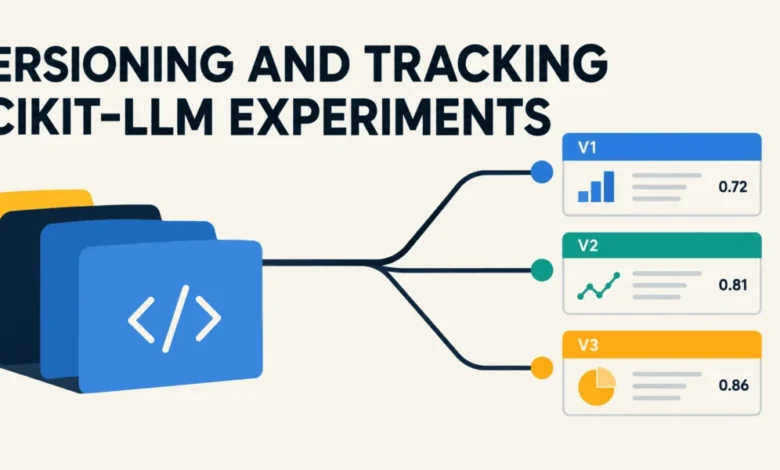
The Challenge of LLM Lifecycle Management
In the traditional machine learning landscape, tracking experiments typically involves monitoring hyperparameters, training datasets, and model weights. However, the introduction of LLMs adds a layer of complexity: the model backend. Whether an application relies on proprietary APIs like GPT-4 or open-source weights hosted locally via GPT4All, the underlying "brain" of the pipeline is prone to frequent updates, version drifts, and environment-specific dependencies.
For data scientists and machine learning engineers, this creates a significant reproducibility challenge. If a model’s performance shifts, determining whether the culprit is the training data, the prompt engineering, or a subtle change in the underlying LLM backend is notoriously difficult without rigorous versioning. By leveraging MLflow’s tracking and registry components, teams can establish a clear, auditable trail that maps specific pipeline configurations to their corresponding model versions. This systematic approach ensures that when a model is promoted to production, its entire lineage—from the initial zero-shot classification trial to the final registered artifact—is documented and verifiable.
Establishing the Technical Foundation
To begin the process of implementing a robust tracking system, developers must first ensure the proper configuration of their environment. The installation of essential libraries—specifically scikit-llm with the gpt4all extension and mlflow—serves as the entry point. The use of gpt4all is particularly significant for organizations that require local, air-gapped execution, as it allows for the deployment of language models without exposing sensitive data to external cloud providers.
Once the environment is primed, the next phase involves initializing the configuration. By setting dummy credentials for local execution, developers can maintain the API-like structure of their code even when running models entirely on local hardware. This consistency is crucial; it allows the codebase to remain agnostic regarding whether the backend is a local GGUF file or a remote cloud endpoint. The configuration of the MLflow model registry, typically backed by a persistent database like SQLite, provides the "source of truth" for all experimental runs. Establishing an experiment name—such as "Scikit-LLM-Versioning"—creates a dedicated namespace for auditing, preventing experimental clutter from affecting production model repositories.
Chronology of an Experiment: From Baseline to Production
The lifecycle of an LLM-driven pipeline typically follows a linear path: definition, execution, evaluation, and registration.
- Baseline Pipeline Definition: The journey begins with the creation of a baseline, often utilizing a compact, efficient model such as
orca-mini. By defining the pipeline as a Scikit-learn object, developers benefit from thefitandpredictparadigm, which simplifies the integration of LLM-based classifiers into existing production workflows. - Experimental Tracking: Each run is wrapped in an
mlflow.start_runblock. This is not merely a formality; it is a critical logging mechanism. By logging specific parameters—such as the LLM backend type and the specific model file path—engineers create a metadata-rich audit log. The use ofcloudpickleas a serialization format is a technical necessity here, as it allows for the capture of complex, non-standard Python objects that standard pickle formats might struggle to handle during model persistence. - Comparative Analysis: Once several runs are completed—ranging from baseline models to more robust, high-parameter upgrades like
falcon—the MLflow search API allows for the rapid extraction of performance data. By converting these logs into a pandas DataFrame, teams can visualize the evolution of their models. This stage often reveals "failed" runs, providing valuable insights into which model configurations are unstable or incompatible with the current system constraints. - Registration and Promotion: The final, and perhaps most important, step is the registration of the "winner." By querying the experiment results based on specific metrics—such as accuracy or inference latency—a lead engineer can identify the optimal version. Using
mlflow.register_model, this version is moved from a raw experiment log to the Model Registry, where it receives a formal version number and becomes available for downstream deployment processes.
Broader Implications for AI Governance
The integration of these tools has profound implications for AI governance and compliance. As regulatory frameworks like the EU AI Act begin to take shape, the requirement for "model transparency" and "version control" is becoming legally binding for many industries. Organizations can no longer treat models as "black boxes" that are deployed and forgotten.
By employing the versioning workflow described, companies can provide auditors with a clear path of how a specific classification model was chosen. If an LLM-based system produces an erroneous output, the ability to trace that output back to a specific run ID, a specific model file, and a specific training dataset is the difference between a minor bug fix and a systemic compliance failure.
Furthermore, this methodology supports a culture of iterative improvement. When data science teams can reliably compare a "Version 1" baseline against an "Upgraded" candidate without fear of losing the original configuration, the pace of innovation accelerates. The ability to "roll back" to a previous version of an LLM pipeline with a single command provides a necessary safety net, reducing the risk associated with pushing new, untested language models into live environments.
Analysis and Future Outlook
The current landscape of ML development is shifting away from monolithic, custom-built solutions toward modular, interoperable frameworks. The use of Scikit-LLM with MLflow is a prime example of this trend. By wrapping LLMs in standard scikit-learn pipelines, the barrier to entry for integrating generative AI into traditional predictive systems is significantly lowered.
However, challenges remain. As models grow in size, the "cost" of versioning—specifically the storage of large binary files in the MLflow registry—becomes a factor. Efficient artifact management, potentially involving cloud-based object storage like AWS S3 or Google Cloud Storage, will be necessary for large-scale operations. Additionally, while local execution is excellent for privacy, the demand for higher-performing, massive-parameter models will likely necessitate a hybrid approach where versioning protocols must be consistent across both local and distributed cloud infrastructures.
In conclusion, the practice of rigorous experiment tracking is the bedrock upon which reliable AI is built. By treating LLM pipelines with the same engineering discipline as any other software component, teams can navigate the complexities of generative AI with confidence. Whether for zero-shot classification or more complex retrieval-augmented generation (RAG) workflows, the combination of Scikit-LLM and MLflow provides a scalable, professional, and audit-ready framework that is essential for the future of enterprise machine learning.