Accelerating Generative AI at Scale: A Comprehensive Review of Amazon SageMaker AI Inference Enhancements in 2026

The landscape of generative AI production has shifted significantly throughout 2026, moving from initial experimentation toward the rigorous demands of enterprise-grade reliability. Deploying large language models (LLMs) remains a formidable technical challenge, characterized by massive model sizes—often reaching hundreds of gigabytes—and the unforgiving latency requirements of modern user interfaces. With GPU capacity remaining a constrained global resource and traditional monitoring tools failing to capture critical token-level telemetry, infrastructure teams have faced a persistent "production gap." In response, Amazon SageMaker AI has unveiled a suite of 13 major capabilities across its managed endpoint and HyperPod Inference platforms, fundamentally altering how organizations manage, scale, and monitor their AI workloads.
The Bifurcated Infrastructure Strategy
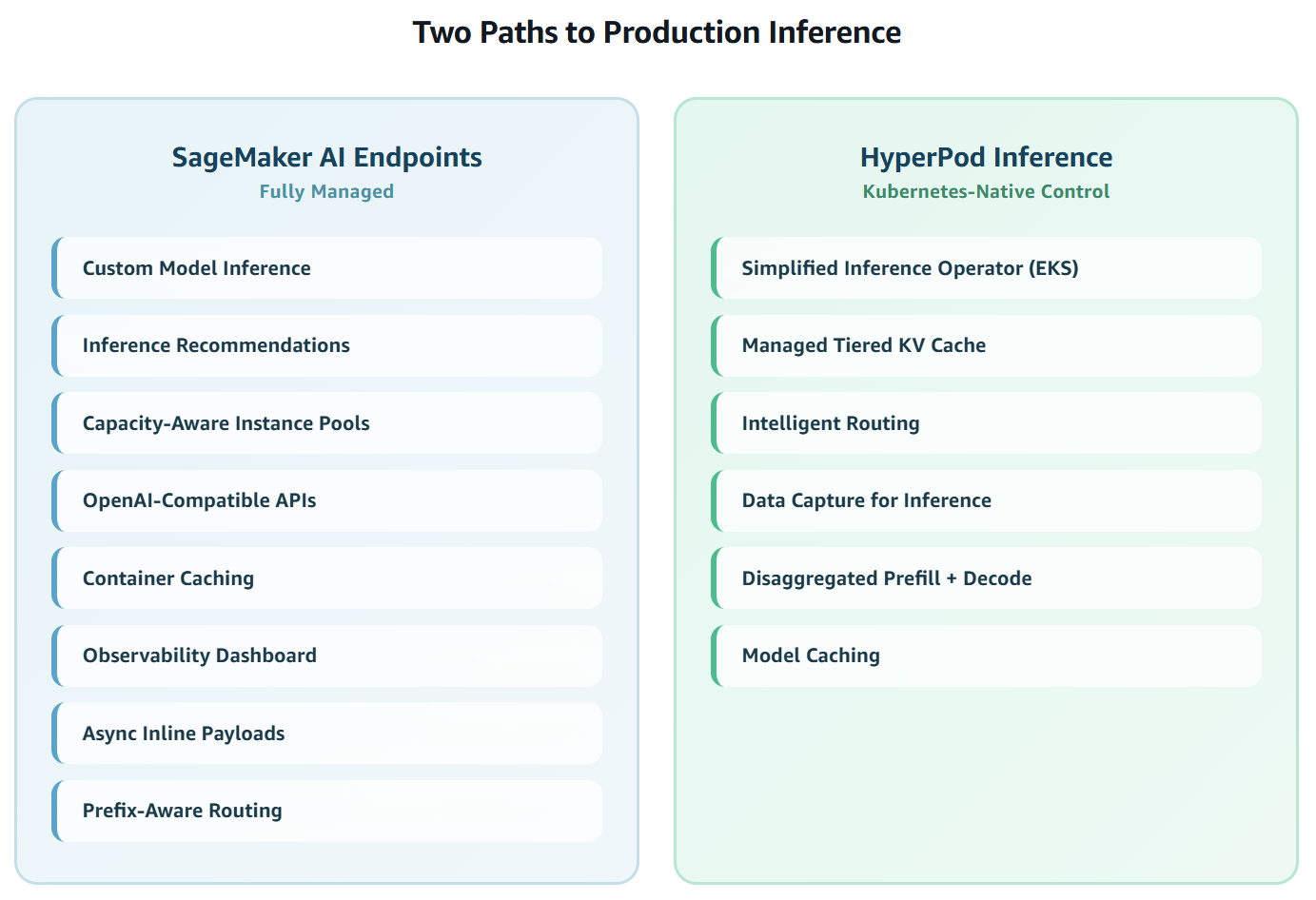
By mid-2026, AWS consolidated its inference strategy into two primary paths designed to cater to divergent operational philosophies. Managed SageMaker endpoints are engineered for speed and simplicity, offloading the heavy lifting of infrastructure management, auto-scaling, and health monitoring to AWS. Conversely, Amazon SageMaker HyperPod Inference addresses the needs of technical teams requiring Kubernetes-native control, allowing for deep customization of dedicated GPU clusters while maintaining the resilience expected from managed services.
This dual-track approach reflects a broader industry trend where companies must balance the need for "time-to-market" against the requirement for "deep-stack control." The following chronology tracks the systematic rollout of these capabilities, which began in the spring of 2026 and culminated in a robust ecosystem for generative AI deployment.
Chronology of Innovation: April to July 2026
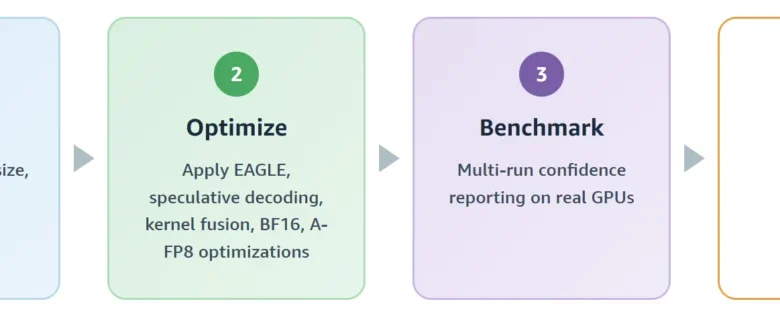
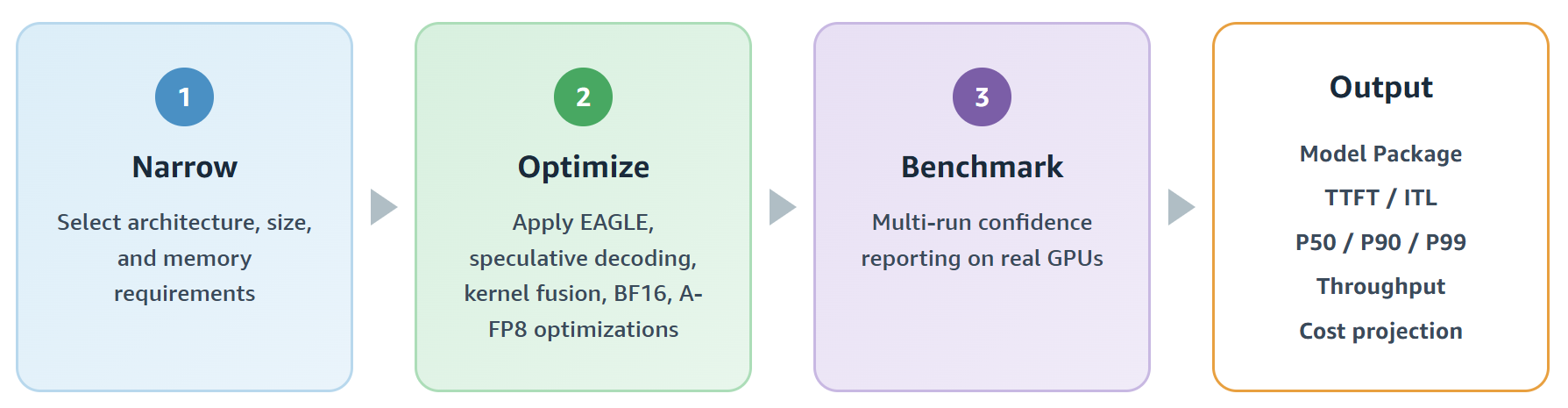
The 2026 deployment cycle was marked by a focus on removing "cold start" latency and optimizing resource utilization. In April 2026, AWS introduced Inference Recommendations and Benchmarking, an automated diagnostic suite that replaces weeks of manual experimentation. By testing over 1,000 combinations of instance types and model configurations, the service generates a tailored blueprint for cost and latency targets.
Following this, the May 2026 updates addressed the fragility of single-instance inference. The introduction of capacity-aware instance pools allowed endpoints to dynamically failover between five different instance types, effectively mitigating the risk of GPU shortages. Concurrently, the release of OpenAI-compatible API support removed the single greatest barrier to entry for developers: the need to rewrite proprietary client adapters. By exposing a standard /openai/v1 endpoint, SageMaker enabled seamless migration for applications built on LangChain or similar frameworks, using standard bearer token authentication.
As the summer progressed, June and July updates tackled the physical realities of data movement. Container Caching and Model Caching emerged as critical tools, pre-pulling container images and model weights onto local NVMe storage. This reduced cold-start times—previously measured in minutes—by over 50% in many production environments. The introduction of Disaggregated Prefill and Decode (DPD) for HyperPod in July marked a breakthrough in hardware efficiency, decoupling the compute-intensive prompt-processing phase from the token-generation phase, allowing for independent scaling of each process.
Analytical Deep Dive: The Economics of Inference
The implications of these 2026 advancements extend beyond mere convenience; they represent a fundamental change in the economics of LLM serving. Prior to these updates, organizations often over-provisioned their GPU clusters to account for the unpredictable latency spikes inherent in shared-resource environments.
The data suggests that the new routing and caching mechanisms are directly driving cost-efficiency:
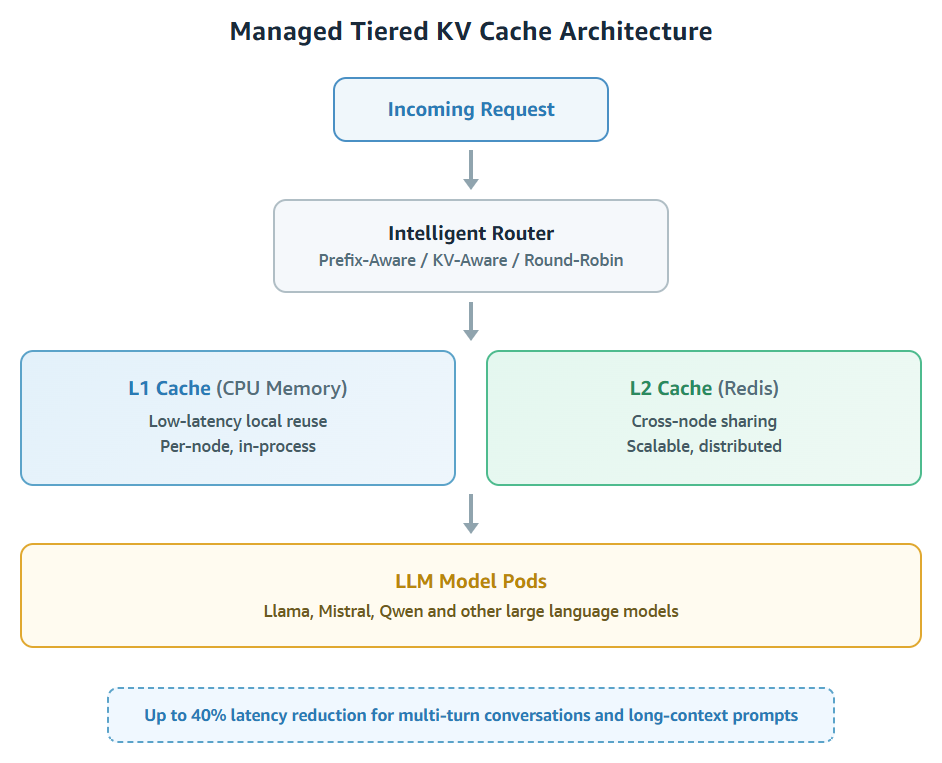
- Prefix-Aware Routing: By directing requests with shared prompt prefixes (such as long-context system instructions) to the same instance, organizations have seen KV cache hit rates jump from 25% to 82%, effectively reducing the compute burden for recurring prompts.
- Startup Latency: The combination of container caching and local NVMe loading has transformed scaling events. In testing with models like Qwen3-8B, startup latency dropped from 525 seconds to 258 seconds, a 51% improvement that allows for more aggressive auto-scaling without sacrificing user experience.
- Throughput Optimization: Benchmarks using the GPT-OSS-20B model demonstrated that, when configured via the new inference recommendations, users could achieve a 2x increase in tokens per second without increasing the request latency.
Official Perspectives and Market Context
While AWS has not issued a singular executive statement, the engineering focus throughout 2026 indicates a strategic pivot toward "experience-based acceleration." By automating the selection of hardware and software stacks, AWS is attempting to commoditize the "MLOps" layer. The sentiment among early adopters, particularly in the public sector and high-regulated industries, centers on the utility of the new Data Capture features within HyperPod. By providing tamper-evident logging across multiple request paths, AWS has made it significantly easier for enterprise compliance officers to approve the deployment of generative models that handle sensitive customer data.
Broader Implications for the Enterprise
The maturation of these tools suggests that the "Wild West" era of generative AI deployment is closing. In 2025, successful deployment often required a team of highly specialized infrastructure researchers. By 2026, the introduction of the Simplified Inference Operator on EKS (Amazon Elastic Kubernetes Service) and the standardization of APIs have shifted the burden from researchers to standard DevOps engineers.
This democratization is expected to accelerate the adoption of "agentic" workflows—AI systems that perform multi-step tasks autonomously. Because these systems rely on continuous inference cycles, the reliability improvements brought by the new CloudWatch Insights dashboards and the PromQL-compatible metrics are not merely "nice-to-have" features; they are foundational to building trust in autonomous systems.
Looking Ahead: The Future of the Stack
The roadmap for late 2026 and beyond suggests that the "Managed vs. Kubernetes" divide will continue to blur. AWS is expected to integrate the deep-stack observability found in HyperPod into the broader managed endpoint service. Furthermore, as model architectures evolve toward mixtures-of-experts (MoE) and other specialized formats, the ability to dynamically route and cache specific model layers will likely become the next frontier for inference optimization.
For organizations still grappling with the complexities of generative AI, the current state of SageMaker AI provides a clear path forward. The focus is no longer on simply running a model, but on running it with the same operational rigor as traditional microservices. As the ecosystem continues to evolve, the winners in the generative AI race will likely be those who leverage these automated infrastructure tools to minimize their "time-to-value," ensuring that their models remain performant, cost-effective, and compliant in an increasingly competitive digital marketplace.
Conclusion: A New Standard for Inference
The 13 capabilities launched in 2026 represent a cohesive effort to resolve the inherent friction of production-grade AI. By addressing the entire lifecycle—from initial benchmarking and infrastructure provisioning to long-term monitoring and compliance—AWS has established a new standard for what it means to host large-scale generative models. For startups and enterprises alike, the tools are now in place to move beyond the prototype phase and into a future where AI-driven capabilities are a seamless, reliable component of the modern software stack. The era of manual, ad-hoc inference management is effectively over, replaced by a sophisticated, automated architecture that enables true enterprise scalability.