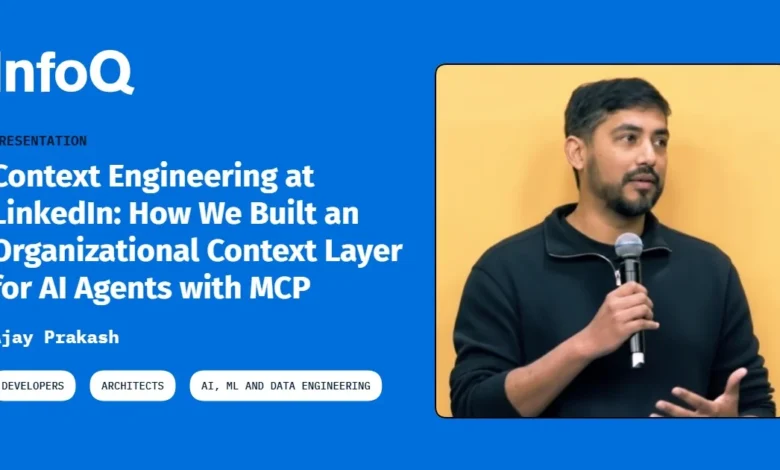
Context Engineering at LinkedIn: How We Built an Organizational Context Layer for AI Agents with MCP

LinkedIn has successfully deployed an internal organizational context layer designed to bridge the severe capability gap between generalized artificial intelligence coding assistants and the intricate demands of a massive enterprise infrastructure. Facing widespread adoption hurdles when engineering teams initially attempted to integrate generative AI tools into their daily workflows, the professional networking platform engineered a custom framework combining the open-source Model Context Protocol (MCP), procedural memory structures known as playbooks, and dynamic tool orchestration. This scalable architecture now serves over 8,000 daily active users across engineering, product management, and design, facilitating roughly 600 automated workflows that span automated debugging, incident mitigation, code refactoring, and environment configuration.
The Evolution of Enterprise AI Coding Assistants
The widespread industry enthusiasm surrounding AI-driven coding agents accelerated dramatically throughout late 2024 and early 2025. Following the popularization of interactive agent modes—where large language models (LLMs) gained autonomous execution capabilities such as terminal command line execution and multi-file editing within integrated development environments—industry observers coined terms like "vibe coding" to describe a paradigm where software engineers interact exclusively via high-level natural language prompts rather than writing manual syntax.
However, when LinkedIn initially provided early access to these advanced coding assistants across its engineering organization, the anticipated productivity gains failed to materialize. The primary bottleneck stemmed from the unique architectural maturity and proprietary scale of LinkedIn’s technical stack. Operating thousands of interconnected microservices, custom internal data frameworks, and specialized tracking, experimentation, and configuration management infrastructure, the company discovered that out-of-the-box LLMs severely lacked the domain-specific grounding required to navigate its repositories safely.
Instead of boosting velocity, engineers found themselves caught in an unproductive cycle of babysitting the models—constantly injecting manual context, correcting structural hallucinations, and supervising basic implementation steps. Consequently, many developers abandoned the automated tools in favor of traditional manual coding to meet strict engineering deadlines and reliability standards. This friction highlighted a fundamental disconnect: while foundational models possessed advanced code generation capabilities, they operated within an institutional vacuum, entirely blind to internal tribal knowledge, specialized deployment protocols, and custom system dependencies.
Leveraging the Model Context Protocol to Unlock Enterprise Integration
The technical turning point for LinkedIn arrived with Anthropic’s release and open-sourcing of the Model Context Protocol (MCP). Serving as an open standard for securely connecting external tools and data sources to LLM agents, MCP provided the foundational plumbing necessary to extend AI capabilities beyond pre-trained public data. LinkedIn capitalized on this standard by developing a localized MCP server architecture pre-installed and automatically updated hourly across all company laptops.
The first major deployment phase involved wrapping LinkedIn’s existing sophisticated code-search engine—capable of ingesting and indexing code across more than 1,000 internal repositories—into the MCP framework. This integration allowed coding agents to autonomously query codebases using natural language, dynamically retrieve relevant snippets, and read entire file contents without relying solely on public-domain training data. Furthermore, LinkedIn expanded this toolset to encompass internal documentation wikis, feature flag repositories, task management systems, and data platforms.
Despite unlocking direct tool access, however, early implementations revealed persistent architectural bottlenecks. As agents performed complex, multi-step queries, they routinely encountered the "context overload" phenomenon. Because tool outputs consumed valuable space within the model’s finite context window, recurring compaction cycles frequently triggered a loss of critical procedural state. Agents would periodically forget their current operational objective, fall into repetitive execution loops, and suffer from a distinct lack of durable long-term memory. Furthermore, crucial operational knowledge—such as dependency installation steps, compilation commands, and deployment nuances—remained scattered across disparate Slack threads, wikis, and senior engineers’ minds.
Procedural Memory and the Playbook Architecture
To resolve the challenges of context degradation, token inefficiency, and scattered tribal knowledge, LinkedIn introduced the concept of procedural memory implemented via "playbooks." Borrowing conceptually from early agent skill frameworks, playbooks encapsulate the exact step-by-step instructions, background context, and nuanced operational knowledge required to perform specific engineering tasks.
Stored within a centralized repository as well as localized directory structures tied to specific repositories, playbooks function as modular tools invoked directly by coding agents via MCP. Each playbook consists of a standardized name, description, and detailed instruction set. For instance, when a developer prompts an agent to establish a new Apache Airflow offline data pipeline, the agent recognizes its access to the relevant Airflow playbook through MCP, invokes it to ingest the required internal paradigms, and executes the end-to-end task with high fidelity.
LinkedIn enforces two core design philosophies to maintain the structural integrity of its playbook ecosystem:
- Self-Containment: Every playbook must address exactly one distinct operational objective to prevent scope creep and instruction degradation.
- Composability: Complex workflows are broken down into smaller, highly reusable sub-playbooks referenced by larger parent playbooks.
This hierarchical composition achieves "progressive disclosure of context." Rather than overwhelming the LLM’s context window by dumping all enterprise documentation simultaneously, the agent dynamically traverses a dependency graph of playbooks, loading granular instructions only when specifically required. This modular approach significantly reduces token consumption, minimizes latency, and prevents context compaction failures.
Moreover, LinkedIn addressed the inevitability of outdated documentation by designing an active feedback loop. When an agent encounters deprecated commands or infrastructural anomalies during playbook execution, it relies on its native tool access to improvise, query up-to-date systems, and prompt human operators for clarification. At the end of a successful session, the agent summarizes these learnings, updates the underlying playbook files, and submits a pull request, ensuring the organization’s procedural memory continuously adapts to ongoing infrastructure evolution.
Scalability, Security, and Governance Models
Managing thousands of distinct tools and playbooks introduces significant scaling challenges, particularly regarding LLM performance degradation. Industry benchmarks indicate that exposing more than thirty direct tools to an agent simultaneously causes context saturation, slows execution, and degrades reasoning quality.
To scale its internal ecosystem past thousands of registered utilities without sacrificing performance, LinkedIn implemented an intelligent search intermediary. Instead of exposing all tools and playbooks directly to the MCP server from initialization, the system reduces the active toolset to three primary meta-tools. When an agent requires an action, it queries the internal catalog using domain tags and keyword filters. The search utility surfaces relevant high-level descriptions, allowing the agent to fetch only the specific JSON schema required for execution.
Security and governance remain central to the platform’s operational model. Every custom tool integrated into the MCP server requires mandatory review by LinkedIn’s Information Security (InfoSec) team to mitigate potential vulnerabilities inherent in open protocol integrations. Authentication is handled seamlessly via an OAuth framework that securely caches and refreshes authorization tokens within a secure keychain, enabling frictionless execution during automated workflows.
Ownership is decentralized yet structured: while a core platform team maintains the central MCP infrastructure and foundational utilities, an open contribution model permits any internal team to author and maintain domain-specific tools and playbooks. To prevent system bloat, unmaintained or infrequently utilized playbooks are systematically deprecated based on telemetry metrics captured across the platform.
Operational Impact and Enterprise Workflows
Today, the MCP server and its associated automation layers support over 8,000 daily active users across diverse organizational roles, including software engineers, product managers, designers, and technical program managers. Telemetry data gathered over several months of operation indicates a measurable 20% increase in overall engineering productivity, with zero negative impact on system reliability or code quality metrics.
An analysis of LinkedIn’s roughly 600 active playbooks reveals five primary thematic use cases driving enterprise adoption:
- Debugging and Incident Investigation: Teams routinely convert static runbooks into dynamic playbooks. During latency spikes or critical production alerts, agents autonomously ingest metrics, logs, and deployment histories across upstream and downstream services, pinpointing root causes and drafting incident management reports within minutes.
- Boilerplate Code Generation: Leveraging internal frameworks and custom database schemas, agents rapidly spin up boilerplate code and execute local verification tests, allowing developers to bypass repetitive setup tasks.
- Large-Scale Code Refactoring and Migrations: Agents execute mandatory infrastructural migrations across dependent repositories, autonomously generating and submitting verified pull requests.
- Infrastructure and Pipeline Management: Long-running operational workflows, such as offline data processing pipelines and AI training jobs, are increasingly delegated to autonomous agent loops governed by strict instructional playbooks.
- Environment and Repository Setup: New engineering hires utilize onboarding playbooks to configure local development environments instantly, drastically reducing ramp-up times compared to traditional static README documentation.
Future Outlook and Strategic Implications
As generative AI development accelerates across the technology sector, LinkedIn’s successful implementation of an organizational context layer offers a blueprint for enterprise AI adoption. Future roadmap initiatives focus heavily on fully automating the creation and maintenance of playbooks. By deploying background oversight agents to analyze pull request histories, session telemetry, and execution logs, the platform aims to autonomously generate new playbooks and patch outdated instructions without requiring manual developer intervention.
The broader implications for the software industry are clear: raw model capability alone is insufficient to drive enterprise-grade productivity. Organizations must invest heavily in internal context engineering—building secure, discoverable infrastructure that bridges proprietary tribal knowledge with standardized protocol layers. Without such a framework, companies risk remaining trapped in a cycle of model supervision, unable to scale artificial intelligence safely across complex, mature software ecosystems.
Related posts: