Bridging the Execution Gap: Why Traditional Leadership Development Programs Fail to Change Workplace Behavior


In boardrooms and executive suites across the globe, a familiar ritual plays out annually: millions of dollars are funneled into elite leadership development programs designed to transform organizational culture, streamline communication, and empower mid-level and senior managers. These initiatives routinely boast stellar satisfaction metrics. Participants report high engagement, articulate newfound strategic frameworks, and leave training seminars armed with a shared corporate vocabulary. Yet, a persistent paradox continues to baffle corporate executives: despite overwhelmingly positive feedback, post-program workplace behavior frequently remains entirely unchanged.
This friction between educational acquisition and behavioral execution has long plagued human resources (HR) and learning and development (L&D) divisions. When initiatives fail to yield observable operational shifts, organizations historically default to a predictable remedy—prescribing additional training, supplementary coaching modules, or more complex theoretical models. However, an emerging body of organizational psychology and corporate governance analysis suggests that the root cause is rarely a deficit of knowledge. Instead, the failure lies in a fundamental disconnect between classroom theory, high-pressure operational reality, and conflicting institutional incentive structures.
The Anatomy of the Corporate Learning Paradox
The modern multi-billion-dollar leadership development industry operates largely on the assumption that behavioral transformation is a linear equation: input knowledge equals output action. However, corporate case studies reveal a starkly different trajectory. Several years ago, a prominent multinational enterprise initiated a comprehensive, year-long senior leadership intervention. The curriculum was meticulously designed, featuring immersive modules on strategic delegation, conflict resolution, active coaching, and collaborative decision-making.
At the conclusion of the program, participant evaluations soared. Leaders demonstrated an exceptional grasp of the material, successfully articulating complex management theories in simulated environments. However, upon returning to their respective business units, their day-to-day operations mirrored pre-program habits. When faced with impending client deadlines or operational crises, senior managers abandoned delegation methodologies, reverted to autocratic command-and-control styles, and absorbed tasks intended for their subordinates.
Confronted with this disconnect, the chief executive posed a foundational question that has since influenced modern corporate diagnostics: "We invested so much in this. Everyone loved the program. Why are we not seeing a change?"
This inquiry exposes a critical oversight in traditional corporate training architectures. When a leader understands a framework in a classroom setting but defaults to legacy habits under pressure, the issue transcends simple comprehension. Diagnosing this phenomenon requires a systemic evaluation of how organizations assess capability, structure practice, and align institutional incentives with desired behavioral outcomes.
Unpacking the Four Barriers to Behavioral Execution
To resolve the execution gap, organizational strategists urge L&D professionals to conduct rigorous pre-development diagnostics. Rather than treating every operational shortcoming as a training deficiency, leadership must systematically analyze four distinct operational barriers that impede behavioral change.
- The Knowledge Deficit vs. The Execution Reality
Sometimes, the issue is precisely what it appears to be: a lack of foundational skill. Newly promoted managers, for instance, frequently transition into leadership roles without formal instruction on conducting performance evaluations, delivering constructive criticism, or managing horizontal workflows. In these distinct scenarios, traditional learning and development interventions provide vital functional frameworks.
However, corporate audits indicate that executive leadership rarely suffers from a structural lack of awareness. A senior director attending a delegation seminar can readily outline the four pillars of effective delegation: defining clear outcomes, establishing mutual decision-making rights, setting appropriate operational checkpoints, and granting team autonomy. The breakdown occurs not when conditions are calm, but when external stressors—such as an unhappy client, shrinking profit margins, or failing project timelines—threaten the leader’s professional reputation. Under these conditions, the leader instinctively bypasses established delegation protocols to retain absolute control.
- The Impact of Hierarchy, Pressure, and Identity
The corporate environment is rarely a neutral laboratory. When psychological safety is low and the stakes are high, abstract theories collide with complex human dynamics, including hierarchy, peer pressure, and professional identity.
Research from organizational behavior specialists indicates that even when leaders possess advanced interpersonal skills, these capabilities frequently become inaccessible under stress. A manager may intellectually value radical candor, yet systematically soften critical feedback when interacting with a powerful stakeholder whose approval influences career trajectory. Similarly, an executive may champion cross-functional collaboration in theory, but retreat into departmental silos when resource allocation is threatened.
When these psychological and political friction points activate, the primary barrier is no longer competence; it is emotional and professional risk management. Re-teaching the theoretical framework in this context yields negligible returns. Instead, interventions must focus on navigating the precise psychological and environmental triggers that cause desired behaviors to dissolve.
- The Deficiency of Contextualized Practice
The corporate lexicon heavily features the term "practice," yet institutional definitions vary widely. Standard leadership programs rely heavily on theoretical case studies, peer role-playing, and digital simulations. While these exercises build baseline familiarity, they rarely replicate the high-stakes friction of actual day-to-day operations.
For professional development to drive tangible change, practice must incorporate the specific operational friction points that render the behavior difficult. If a management team struggles with upward accountability, simulation exercises must intentionally incorporate organizational hierarchy and executive pushback. If the corporate objective is to foster comfort with ambiguity, training models must introduce incomplete data sets and real-world consequences.
Furthermore, behavioral transformation requires an iterative feedback loop. Real-world application cannot be treated as an isolated event occurring after program completion. Sustainable integration demands a continuous cycle of trial, operational observation, peer feedback, and iterative refinement within the actual workplace.
- The Paradox of Conflicting Institutional Incentives
Perhaps the most complex barrier to behavioral modification is the misalignment between formal corporate messaging and lived organizational rewards. Organizations frequently encounter situations where corporate policies encourage one set of behaviors while institutional performance metrics reward entirely opposing actions.
For example, executive boards frequently mandate that leaders empower their teams and tolerate calculated risks. Yet, when a delegated project encounters failure, the immediate institutional response is often punitive: boards demand to know why the executive failed to maintain stringent oversight. Similarly, while companies verbally champion cross-functional collaboration, compensation models and key performance indicators (KPIs) remain strictly tethered to individual business-unit output.
Corporate behavioral studies show that employees quickly discern the delta between stated corporate values and operational reality. When a leadership program promotes empowerment, but corporate infrastructure demands error-free execution at all costs, the institutional system invariably prevails. Consequently, behavior change cannot remain the sole responsibility of the HR or L&D department; it requires active alignment from executive leadership, clear decision-rights frameworks, and supportive performance management systems.
Shifting the Paradigm: From Programmatic Satisfaction to Measurable Impact
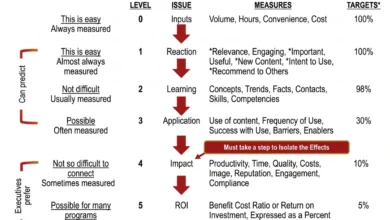
The realization that training satisfaction does not equal operational transformation is forcing a structural evolution across global enterprises. Modern talent development strategies are increasingly shifting away from traditional end-of-program smile-sheet metrics toward longitudinal, behavioral observation models.
Industry analysts emphasize that measuring the true return on investment (ROI) of a leadership program requires defining target behaviors before curriculum design begins. Rather than asking participants if they enjoyed a seminar, organizations are now deploying 360-degree observational diagnostics six months post-program. Key performance questions include whether managers are successfully escalating fewer operational bottlenecks, whether cross-functional teams are exhibiting greater autonomy, and whether senior executives are visibly reallocating time from tactical execution to strategic oversight.
By diagnosing organizational friction points prior to capital allocation, enterprises can avoid redundant training expenditures and direct resources toward systemic alignment. Ultimately, the success of a leadership intervention is no longer measured by a participant’s ability to articulate a management framework in a classroom. It is measured by the emergence of new operational capabilities within the workplace—transforming theoretical insight into sustainable, enterprise-wide behavioral change.