SaaS Isn’t Dead. Old SaaS Is Dead: Sierra Adds $150M ARR in One Quarter While ServiceNow Drops 27% in a Day

A seismic shift is underway across the enterprise software landscape, crystallizing in a dramatic 24-hour window that provided more insight into the future of business-to-business (B2B) technology than eighteen months of speculative punditry regarding the death of traditional Software-as-a-Service (SaaS). This transformation is not characterized by the complete obsolescence of legacy cloud infrastructure, but rather by a ruthless reallocation of corporate technology budgets. Incumbent software giants built on decades-old pricing models are facing unprecedented market skepticism, while hyper-growth agentic AI platforms capture monumental swaths of new recurring revenue by fundamentally redefining how software delivers value.
The dichotomy of this transition was laid bare on a Thursday in late October, when enterprise workflow titan ServiceNow suffered a staggering 26.9% plunge in its share price following its third-quarter earnings report. The historic drop occurred against a relatively stable broader market, as the S&P 500 slipped a mere 0.3%. The single-day wipeout represented ServiceNow’s most severe market valuation correction since its initial public offering in 2012, pushing its stock price more than 40% below its 52-week high.
Just hours later, on Friday morning, the contrasting narrative of the new technological era was underscored when Bret Taylor and Clay Bavor published the Q3 performance metrics for Sierra, an artificial intelligence agent platform. Founded just 30 months prior, Sierra reported adding more than $150 million in Annual Recurring Revenue (ARR) during the single quarter, vaulting its total ARR past the $400 million threshold. To contextualize the velocity of this expansion, Sierra’s third-quarter revenue acquisition alone surpassed its total ARR generated across the entirety of the previous fiscal year, effectively doubling its business from $200 million to $400 million in a span of just five months.
Financial Dissection: ServiceNow’s Solid Quarter Met With Market Hostility
To understand the severity of ServiceNow’s market reaction, one must first examine the fundamentals of its Q3 financial report. By traditional corporate standards, the quarter was robust. ServiceNow reported year-over-year subscription revenue growth of approximately 20%, pushing its total revenue to $4.11 billion—modestly eclipsing Wall Street consensus forecasts of $4.09 billion. Furthermore, the company maintained exceptional profitability metrics, boasting free cash flow margins of 36% and total remaining performance obligations (RPO) reaching $29.7 billion. At a revenue scale exceeding $16 billion, maintaining a 20% expansion rate is a feat most technology enterprises would welcome without reservation.
Yet, Wall Street’s verdict was swift and unforgiving. The primary catalyst for the sell-off was not a catastrophic revenue miss; adjusted earnings per share (EPS) came in at $1.00, trailing analyst expectations of $1.02 by a mere two cents. Instead, market analysts pointed to forward-looking indicators that signaled structural pressures. Most notably, ServiceNow’s critical Remaining Performance Obligation (RPO) growth guidance decelerated, and management adjusted expectations for future backlog expansion downward from 21% to 18.5%.
Compounding these growth concerns was visible margin compression. As ServiceNow aggressively accelerated its investments in artificial intelligence features and infrastructure, the cost of delivering these advanced capabilities began to outpace the immediate top-line revenue additions they generated. The market’s overarching conclusion was clear: ServiceNow has transitioned into a steady 20% compound grower, but the integration costs of generative AI are eroding its profitability profile faster than they are expanding its valuation multiples.
The Exponential Velocity of Sierra’s Agentic Scale
While ServiceNow navigated the complex challenges of protecting a massive legacy enterprise footprint, Sierra demonstrated the blistering speed achievable by companies built native to the agentic AI paradigm. Achieving a doubling of ARR within a five-month timeframe stands in stark contrast to legacy enterprise trajectories. For perspective, at its current growth rate of approximately 20.5%, ServiceNow requires roughly 3.7 years to double its top-line revenue scale.
A closer examination of net new recurring revenue highlights the magnitude of Sierra’s ascent. Over a trailing twelve-month period, ServiceNow’s subscription revenue rose by approximately $2.76 billion, translating to roughly $690 million in net new ARR per quarter. In comparison, Sierra—a company that did not exist commercially 30 months prior—added $150 million in ARR during a single quarter. This single-quarter intake represents nearly 22% of ServiceNow’s quarterly net new recurring revenue, achieved with a fraction of the headcount and infrastructure overhead.
ServiceNow’s own aggressive projections for artificial intelligence target between $1 billion and $1.7 billion in total AI Annual Contract Value (ACV) across the full 2026 calendar year, supported by an established base of roughly 680 enterprise customers each paying in excess of $5 million annually. By contrast, Sierra secured $150 million in net new ARR in a single three-month window, starting from a baseline of zero enterprise clients less than three years ago.
The Macroeconomic Reality: Re-Splitting a Finite B2B Budget
A fundamental misconception surrounding the rise of agentic AI is that it represents an influx of entirely new capital into the corporate technology ecosystem. In practice, startups like Sierra are not being funded out of exploratory innovation slush funds; they are drawing directly from the established, finite B2B budgets that enterprise organizations allocate annually toward customer experience (CX), customer service, IT operations, and administrative workflows.
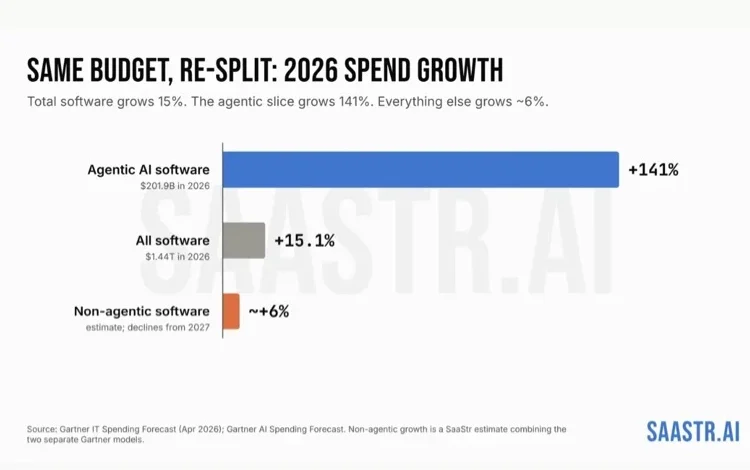
Chief Information Officers (CIOs) and Chief Customer Officers are not expanding their aggregate technology expenditure allocations at historical rates. Rather, the distribution of those checks is undergoing a radical realignment. Data compiled from leading technology research firms such as Gartner and IDC illustrates this macro-level reallocation. For the 2026 fiscal year, overall enterprise software spending is projected to grow at a modest rate of approximately 15%. Within that same period, expenditures dedicated specifically to agentic AI systems and autonomous workflows are forecast to surge by an astonishing 141%.
When accounting for these divergent growth trajectories, core legacy software spending is effectively stagnating, projected to grow by just 6% in 2026 before entering outright contraction phases by 2027. The total size of the enterprise software pie is remaining relatively flat; the underlying slices, however, are being carved up anew. While legacy incumbents retain the capacity to capture portions of this shifting spend—as evidenced by ServiceNow’s expanding AI deal pipeline—the central competitive battleground has shifted entirely toward market share acquisition.
The Ideological Divide: Seat-Based Pricing Versus Outcome-Based Models
At the heart of this budgetary migration lies a fundamental philosophical divergence in how software vendors monetize their value: the traditional seat-based model versus emerging outcome-based pricing architectures.
During the quarterly earnings call, ServiceNow executives doubled down on their hybrid monetization strategy. Chief Executive Officer Bill McDermott emphasized that enterprise buyers deeply value the budget predictability associated with seat-based pricing structures, supplemented by consumption-based metrics for advanced processing capabilities. Chief Financial Officer Gina Mastantuono reinforced this perspective, noting that enterprise clients remain satisfied with hybrid frameworks and are not actively agitating for wholesale transitions to outcome-based pricing. While ServiceNow has integrated alternative monetization methods—reporting that 50% of its net new business is now sourced via non-seat channels such as consumption tokens and connectors—these mechanisms remain fundamentally tethered to traditional software metering.
Conversely, Sierra operates on a radically different commercial premise: charging strictly for verified business outcomes rather than human software licenses or compute tokens. Under Sierra’s model, enterprise clients compensate the platform based on successful operational completions, such as a fully refinanced financial loan, an insurance claim successfully adjudicated, a complex customer service issue permanently resolved, or a verified sales conversion executed autonomously.
This structural pricing shift carries profound implications for the venture capital and startup ecosystems. Industry analysts increasingly argue that modern agentic B2B enterprises must demonstrate average initial contract values and deal sizes at least double those commanded by their pre-AI legacy competitors. In an environment of flat aggregate enterprise budgets, software solutions that match incumbent price points merely split existing expenditures rather than capturing new budgetary dominance. Sierra’s ability to scale to $400 million in ARR by displacing traditional operational overhead demonstrates the commercial potency of capturing enterprise value at the outcome level.
Debunking the Death of SaaS: Architecture Versus Application
Despite sensationalist declarations regarding the demise of SaaS, platforms like Sierra do not represent the annihilation of the Software-as-a-Service architecture. Structurally, Sierra is unmistakably SaaS: it relies on recurring revenue models, multi-tenant cloud infrastructure, and enterprise-grade deployment frameworks. Its comprehensive product suite—encompassing specialized modules such as Agent Studio, conversational analytics, and integration channels—mirrors the architectural maturity of traditional enterprise platforms. Furthermore, Sierra is actively constructing an expansive software ecosystem via open protocols like Poppy, forging design partnerships with global consumer and enterprise leaders including Meta, Shopify, Stripe, and Walmart.
The transformation is not architectural; it is functional. Legacy software was engineered fundamentally to assist human workers in executing tasks, organizing workflows, and recording data. Agentic software, by contrast, is engineered to independently execute the work itself.
Incumbent software platforms are acutely aware of this transition. ServiceNow positions itself as the overarching enterprise "execution layer," pointing to genuine adoption metrics: its AI-driven net new ACV surged 65% year-over-year, transactions exceeding $1 million expanded by 4.5 times, and agentic consumption grew 13-fold over the course of the year. However, incumbents face an inherent strategic dilemma: they must aggressively defend a legacy $16 billion seat-based revenue foundation while simultaneously engineering the disruptive technologies designed to cannibalize it. Native agentic platforms operate without legacy revenue bases to protect, allowing for unencumbered market penetration.
Strategic Imperatives for Enterprise Technology Founders
The parallel market events involving ServiceNow and Sierra offer critical lessons for early-stage technology founders, venture capitalists, and enterprise strategists navigating the current macroeconomic environment:
- Value Capture Over Feature Incrementalism: Building AI capabilities as an auxiliary feature to justify modest price increases is no longer sufficient. Enterprise software must absorb underlying operational workflows and replace manual labor budgets directly.
- The Imperative of Outcome-Based Economics: Transitioning away from legacy seat-based metrics toward monetization frameworks tied directly to measurable business outcomes aligns vendor incentives with enterprise buyers seeking tangible return on investment.
- Budget Displacement Strategy: Founders must target existing enterprise headcount and operational budgets rather than relying on the creation of new discretionary technology allocations.
- Velocity as a Competitive Moat: In the agentic era, time-to-scale metrics have been compressed. Building structural enterprise trust rapidly is essential to capturing market share before legacy incumbents successfully re-platform their offerings.
- Ecosystem Integration: Even hyper-growth autonomous platforms must seamlessly integrate with existing enterprise data systems and execution layers to achieve widespread institutional adoption.
Conclusion
The simultaneous valuation contraction of ServiceNow at a 20% growth rate and the hyper-growth trajectory of Sierra illustrate a decisive turning point in enterprise technology. The B2B budget that historically fueled the rise of traditional SaaS has not vanished; it is undergoing a profound, irreversible re-segmentation. Software designed to assist human workers, monetized on a per-seat basis, is encountering a market ceiling that values mature cash flows at steady, predictable multiples. Meanwhile, autonomous, outcome-based agentic platforms are capturing unprecedented amounts of recurring capital by fundamentally executing the underlying work. Software as a service is far from dead; however, the era of SaaS defined purely by human productivity augmentation has definitively drawn to a close.