A Call for Ethical AI and Sustained Community Amidst Personal Reflection and Pioneering Social Initiatives


Jeff Atwood, a foundational figure in the internet’s collaborative landscape, has issued a poignant and critical commentary spanning personal loss, pioneering social experiments, and the existential threat posed by artificial intelligence to the very communities that fuel its advancement. His recent reflections intertwine the deeply personal — the passing of his father following a significant milestone in a rural Guaranteed Minimum Income (GMI) study — with a forceful public plea for AI companies to respect and sustain the human communities, particularly Stack Overflow, upon which their generative capabilities fundamentally rely. This dual narrative underscores a critical juncture in both social welfare innovation and the ethical development of artificial intelligence, highlighting the intricate dependencies between human ingenuity, community effort, and technological progress.
The Personal and the Pioneering: A Father’s Legacy and the GMI Initiative
Atwood’s recent dispatch opens with a profoundly personal note, marking the end of "one of those months" — a lifetime’s worth of 663 months — culminating in the passing of his father. This personal loss is inextricably linked to a pivotal moment in social policy experimentation: the re-ordering of the Rural Guaranteed Minimum Income Initiative (RGMII) study counties, ensuring Mercer County, West Virginia, his father’s home county, commenced its study in October 2025. This strategic scheduling allowed Atwood a final, meaningful encounter with his father, underscoring the deeply human motivations behind his engagement with initiatives aimed at societal betterment.
The Rural Guaranteed Minimum Income Initiative (RGMII) represents a significant, privately funded endeavor, spearheaded by a $50 million plan designed to fund rural GMI studies across the United States. Its stated objectives are ambitious: to expand opportunity, strengthen democracy, and address the economic disparities prevalent in underserved rural communities. Guaranteed Minimum Income, often referred to interchangeably with Universal Basic Income (UBI), involves providing a regular, unconditional cash payment to individuals, regardless of their employment status or wealth. Proponents argue that GMI can reduce poverty, improve health outcomes, stimulate local economies, and offer a safety net in an increasingly volatile economic landscape, particularly in rural areas facing challenges such as declining industries, out-migration, and limited access to resources.
Mercer County, West Virginia, a region deeply rooted in Appalachian history and facing contemporary economic shifts, serves as a crucial pilot site for the RGMII study. The decision to prioritize Mercer County for the October 2025 launch holds both personal resonance for Atwood and broader significance for the GMI movement. Rural GMI studies are particularly vital as they assess the unique impacts of unconditional cash transfers in contexts distinct from urban trials, often characterized by different employment patterns, social structures, and economic needs. Data collected from such studies—examining outcomes related to health, employment, education, and community engagement—will be instrumental in shaping future policy discussions around poverty alleviation and economic security nationwide.
Atwood’s deep involvement, extending to his "third startup," Staygold.us, further illustrates his commitment to these principles. While specific details about Staygold.us remain somewhat nascent, the explicit connection to "winning capitalism, then [going] back to help improve it for everyone" suggests an venture focused on systemic economic improvement or community empowerment, likely leveraging technology or innovative social models. This aligns with a broader philosophical stance that economic success should ultimately serve to uplift society, not merely accumulate private wealth. The narrative here is one of continuity: from building foundational internet infrastructure to actively participating in social welfare innovation, Atwood’s career trajectory reflects a consistent drive to create value and foster community, whether digital or geographic.
The Digital Cornerstone: Stack Overflow’s Enduring Legacy and the Rise of LLMs
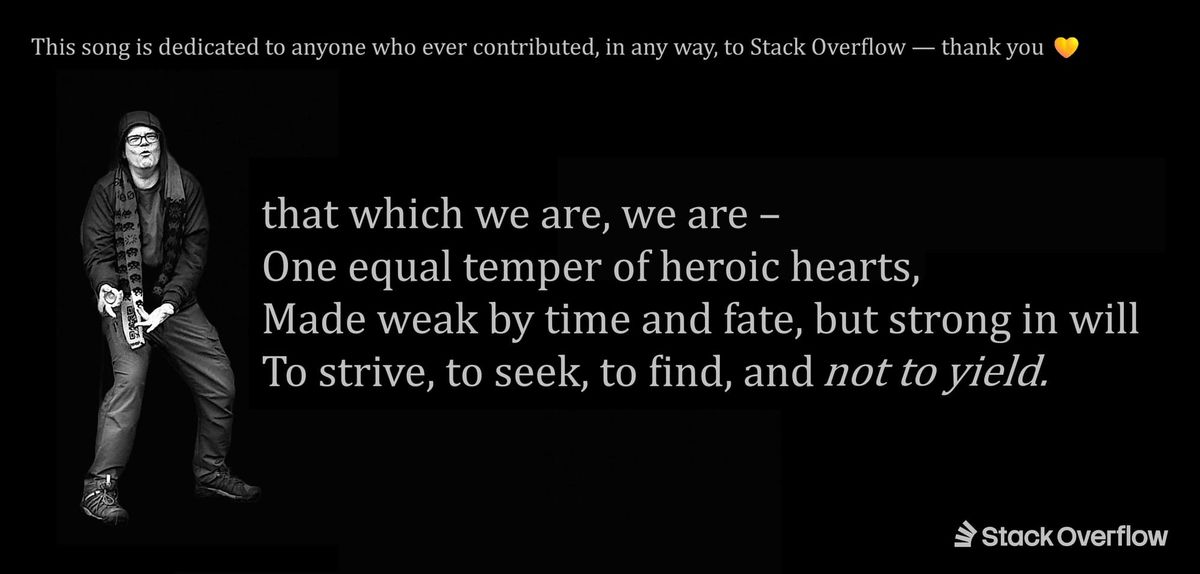
The second, equally powerful, thread of Atwood’s message pivots to the digital realm, specifically to Stack Overflow and the burgeoning world of Large Language Models (LLMs) and Generative AI (GAI). With profound gratitude, Atwood extends a "thank you to everyone — and I do mean everyone — who ever contributed to Stack Overflow in any way." This acknowledgement is not merely sentimental; it frames Stack Overflow as an indispensable, collectively built resource whose value, he argues, has been critically undervalued by the very AI systems now leveraging it.
Founded in 2008 by Jeff Atwood and Joel Spolsky, Stack Overflow rapidly became the internet’s most comprehensive and authoritative question-and-answer platform for professional and enthusiast programmers. Its success stemmed from a meticulously designed reputation system, robust moderation, and a commitment to high-quality, community-driven content under a Creative Commons license. Over its nearly two decades, millions of developers have contributed an astonishing volume of precise, peer-reviewed, and highly structured information, covering every conceivable programming language, framework, and problem. This collective effort transformed Stack Overflow into an unparalleled global knowledge base, effectively democratizing programming expertise and accelerating software development worldwide.
Atwood’s central contention, dramatically stated, is that "LLMs basically could not code at all without access to the extremely high quality creative commons programming Q&A dataset that all of us built together at Stack Overflow." This assertion, he challenges readers to verify directly with the LLMs themselves, highlights a critical, often obscured, dependency. Generative AI models, particularly those designed for code generation, explanation, and debugging, learn by identifying patterns and relationships within vast datasets of text and code. Stack Overflow’s content, characterized by its clear problem statements, detailed solutions, and community validation (through upvotes and accepted answers), provides an exceptionally clean, diverse, and contextually rich corpus for training these models. Without this meticulously curated, human-generated knowledge, the ability of LLMs to generate functional, contextually appropriate code would be severely hampered, if not entirely nonexistent. It is a foundational layer, built by millions of human intellects, that underpins much of the current AI revolution in software engineering.
Ethical Quandaries and the Future of Digital Communities in the AI Era

Atwood’s gratitude quickly morphs into a stark warning, resonating with a consistent philosophy he has championed throughout his career: the imperative to protect and nurture human communities that create valuable content. Drawing a direct parallel to his advice to Joel Spolsky when he left Stack Overflow to found Discourse — a platform dedicated to fostering healthy online communities — Atwood emphatically states, "do not, for any reason, under any circumstances, kill the goose that lays the golden eggs."
This "golden goose" is the human community: the users, contributors, and moderators who volunteer their time, expertise, and intellectual property to build platforms like Stack Overflow. The threat, as Atwood articulates, is that if LLMs "end up hollowing out the very communities that produce all their training data, they’re going to really, really regret that." This "hollowing out" could manifest in several ways:
- Reduced Contribution: If users find that AI tools can provide answers instantly, they may be less inclined to contribute new questions or detailed solutions to human-powered platforms, leading to a stagnation of fresh, cutting-edge content.
- Diminished Engagement: The vibrant, interactive nature of Q&A platforms, where developers learn from each other and build professional networks, could erode if human interaction is replaced by AI-generated responses.
- Quality Degradation: While LLMs can synthesize existing information, their capacity for novel problem-solving or truly original insights remains limited. The continuous influx of human-generated, peer-reviewed solutions is essential for maintaining the high quality and relevance of the dataset.
- Ethical Concerns over Attribution and Compensation: AI models often ingest vast amounts of Creative Commons licensed data, which typically requires attribution. While legal frameworks for AI training data are still evolving, the ethical argument for acknowledging and potentially compensating original creators is gaining traction. The lack of direct benefit or recognition for the community that built the "golden goose" could lead to widespread disillusionment.
The implications extend beyond Stack Overflow, touching on the broader ecosystem of open-source projects, Wikipedia, and other collaborative knowledge bases that form the bedrock of internet information. These platforms thrive on volunteer contributions and the goodwill of their communities. If AI models extract value without reciprocation, they risk destabilizing the very foundations of shared knowledge that have powered the internet’s growth.
Chronology of Influence and Innovation
Atwood’s career trajectory and the events he references paint a picture of continuous engagement with technology and community:
- 1970s (approx. based on 663 months): Jeff Atwood’s birth, marking the start of a journey through the nascent and evolving digital age.
- 2008: Co-founding of Stack Overflow, establishing a cornerstone for developer knowledge sharing.
- 2013: Founding of Discourse, a testament to his ongoing commitment to building sustainable and respectful online communities.
- Recent Years (leading up to 2026): The exponential rise of Large Language Models and Generative AI, creating new opportunities and ethical challenges.
- October 2025: Commencement of the RGMII rural GMI study in Mercer County, West Virginia, a significant step in social policy experimentation, coinciding with a profound personal moment for Atwood.
- Ongoing (2026 and beyond): The continued development of his "third startup," Staygold.us, and the broader RGMII $50 million plan, reflecting sustained efforts to improve economic systems and community welfare.
Reactions and Expert Perspectives (Inferred)

Atwood’s impassioned stance is likely to resonate deeply across several communities:
- Stack Overflow Contributors: Many long-time users and moderators would likely echo Atwood’s sentiment, feeling a sense of pride in their collective achievement and concern about the potential exploitation of their work. There is a growing movement among creators advocating for fair use, proper attribution, and even compensation for their data in the age of AI.
- AI Ethicists and Researchers: Experts in AI ethics would likely find Atwood’s warning compelling, aligning with their calls for responsible AI development that considers societal impacts, intellectual property rights, and the sustainability of human creative endeavors. The debate over "data provenance" and "ethical AI training" is intensifying, and Atwood’s statement adds significant weight from a practitioner’s perspective.
- Community Management Professionals: Professionals dedicated to fostering and maintaining online communities would undoubtedly support Atwood’s "golden goose" principle. They understand intimately the effort, trust, and delicate balance required to cultivate engaged communities and would caution against any practices that undermine these foundations.
- GMI Advocates and Rural Policy Makers: Advocates for Guaranteed Minimum Income programs would view the RGMII study, particularly its focus on rural areas like Mercer County, as a crucial step towards gathering empirical evidence for policy implementation. They would welcome Atwood’s involvement as a high-profile individual lending credibility and momentum to the initiative.
Broader Impact and Implications
Jeff Atwood’s dual message serves as a potent reminder of the interconnectedness of human endeavor, technological progress, and social responsibility. The GMI initiative in Mercer County represents a hopeful, proactive approach to addressing systemic economic challenges, investing in the fundamental well-being of individuals and communities. This contrasts sharply with the passive, often extractive, relationship that some AI companies currently maintain with the data-generating communities.
The warning to AI companies is not merely about protecting intellectual property; it’s about preserving the very engine of collective human knowledge creation. If AI companies fail to "treat the community with the respect they deserve," the long-term consequences could be dire: a decline in the quality and freshness of public datasets, a chilling effect on open collaboration, and a fundamental erosion of trust between technology developers and the global online citizenry. Respect, in this context, could involve various measures: direct financial contributions to platforms like Stack Overflow, robust attribution mechanisms, ethical data licensing agreements, or even revenue-sharing models that allow creators to benefit from the AI applications built upon their work.
Ultimately, Atwood’s reflections call for a balanced future where technological advancement, whether in AI or social policy, proceeds with a deep understanding and respect for the human element. The future of coding, knowledge sharing, and even economic stability may well depend on whether the lessons from his personal journey and professional warnings are heeded. His concluding "Thank you for being a friend" resonates as a profound acknowledgement of collective effort and the indispensable power of human connection, reminding us that no significant achievement, personal or technological, is truly made in isolation.