Building a Multi-Modal RAG Pipeline in Python to Unlock Complex Document Intelligence

The landscape of enterprise data is shifting rapidly from flat, text-based archives to complex, visually rich documents. Modern business reports, financial audits, technical manuals, and scientific research papers are rarely just strings of prose; they are dense tapestries of integrated data tables, analytical charts, architectural diagrams, and embedded infographics. While standard Retrieval-Augmented Generation (RAG) systems have revolutionized how organizations interact with text, these legacy pipelines often fail when confronted with visual data. When a document is parsed as a simple stream of characters, the semantic context of a table or the critical data point in a pie chart is lost, leading to incomplete or hallucinated responses. To bridge this gap, developers are increasingly turning to multi-modal RAG architectures that treat images and text as first-class, retrievable citizens.
The Evolution of Document Intelligence
For years, the industry relied on Optical Character Recognition (OCR) to convert document visuals into text, a process that frequently resulted in "data scrambling." Tables would lose their row-column relationships, and captions would become disconnected from the visual data they described. The emergence of vision-language models (VLMs) like OpenAI’s GPT-4o has fundamentally changed this paradigm. By enabling systems to "see" and interpret images alongside text, developers can now build pipelines that preserve the original document structure.
This shift is part of a broader evolution in AI, as detailed in recent industry guides on multi-modal systems. Unlike early AI implementations that required separate, siloed models for vision and text, current architectures utilize unified latent spaces. This allows for a holistic understanding of a document, where the reasoning engine can correlate a paragraph explaining a market trend with the corresponding visual evidence in a bar chart, providing a level of accuracy previously unattainable in automated document analysis.
Technical Foundations and System Architecture
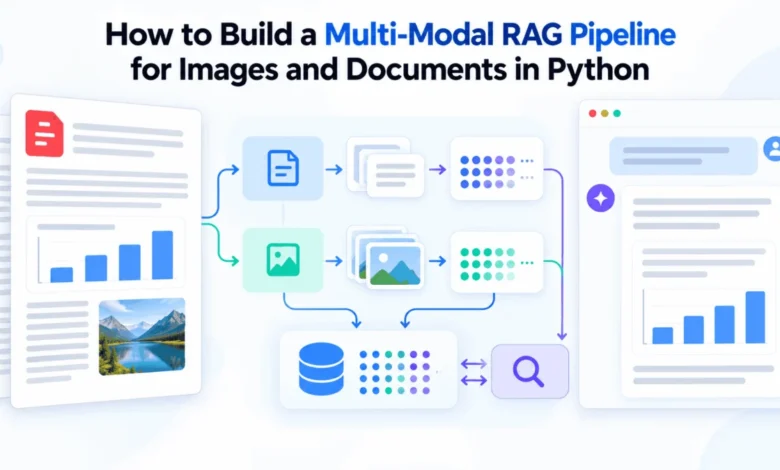
Building a robust, production-grade multi-modal RAG pipeline involves four distinct stages: parsing, summarization, multi-vector storage, and multimodal retrieval. This architecture is designed to run on standard, accessible hardware, making it a viable solution for mid-sized enterprises and research teams alike.
Phase 1: Intelligent Document Parsing
The primary challenge in document ingestion is segmentation. Traditional parsers treat a PDF as a flat layer. In contrast, libraries such as unstructured allow for high-fidelity extraction that classifies elements—paragraphs, headers, tables, and images—at the time of ingest. By using a partition_pdf function, the system generates separate data structures for textual prose and visual assets. This separation is critical; it ensures that the metadata associated with an image (such as its page position and surrounding text) is preserved, which is essential for grounding the AI’s later analysis.
Phase 2: Generating Searchable Semantic Proxies
Raw images lack the vector coordinates required for similarity searches in vector databases. To make an image "discoverable," the system must generate a textual proxy—a detailed, semantic summary. By passing each extracted image to a VLM like GPT-4o with a specialized prompt—such as "Describe this image in detail for use in a search system"—the pipeline creates a dense, descriptive summary. This summary serves as the searchable key, while the image itself remains in a secure document store. This approach effectively bridges the gap between natural language queries and visual content.
Phase 3: The Multi-Vector Storage Strategy
Standard RAG systems typically map one document chunk to one vector embedding. However, in a multi-modal environment, this is insufficient. A multi-vector retriever maintains a dual-storage system:
- The Vector Store: Houses the embeddings of text chunks and the generated image summaries, facilitating high-speed similarity searches.
- The Document Store: An
InMemoryStoreor persistent database that holds the raw content (the original text and the image file paths).
These two stores are linked by unique identifiers (UUIDs). When a query is executed, the vector store returns the most relevant summary, and the system uses the associated ID to fetch the original, unadulterated source material for the generative phase.
Phase 4: Retrieval and Generative Reasoning
The final stage is the retrieval loop. When a user asks a question, the retriever searches the vector space for the most relevant context. If the match is a text chunk, it is retrieved directly. If the match is an image summary, the system programmatically opens the raw image file, encodes it into a base64 string, and attaches it to the prompt. This "multimodal context window" is then fed to GPT-4o, which performs the final reasoning task. This enables the model to produce answers that reference specific data points within a chart while simultaneously explaining the trend using the document’s supporting text.
Implementation Prerequisites
Developing this pipeline requires a focused software stack. Developers must ensure the following environment is established:
- Core Libraries: LangChain, LangChain-OpenAI, Unstructured (with PDF extensions), ChromaDB, and Pillow for image processing.
- System Dependencies:
poppler-utilsis essential for handling PDF rendering and image extraction on Linux-based environments. - API Infrastructure: An active OpenAI API key with access to the GPT-4o model is required for both the summarization and the final inference steps.
Economic and Practical Implications
One of the most significant considerations for organizations is the cost-benefit analysis of such a system. Every image extraction and summarization process incurs an API cost. Consequently, developers should implement filtering mechanisms, such as discarding images below a certain pixel threshold or excluding icons and logos, to optimize performance and reduce expenditure.
From a broader impact perspective, this architecture solves a major bottleneck in financial, legal, and engineering sectors. In the financial industry, for example, analysts often spend hours manually cross-referencing earnings call transcripts with quarterly revenue reports. A multi-modal RAG pipeline can automate this, providing near-instant responses that cite both the executive’s spoken words and the corresponding visual data in the report. This improves not only efficiency but also the auditability of AI-generated insights.
Future Trajectories
The current state of multi-modal RAG is a stepping stone toward even more advanced document intelligence. Researchers are already looking at "Native Vision-Language" retrieval, exemplified by models like ColPali, which bypass the need for explicit text summaries by embedding document pages directly as visual patches. While these methods are computationally intensive, they represent the next generation of document retrieval.
For now, the four-stage architecture—parse, summarize, store, and query—provides the most stable, scalable, and effective solution for organizations looking to unlock the value hidden in their visual document archives. By treating images as data rather than static objects, developers are transforming the way information is processed, analyzed, and synthesized, ultimately creating a more informed and data-driven workspace. As the technology matures, we can expect to see these systems integrated directly into document management platforms, making multi-modal reasoning a standard feature of the digital office.