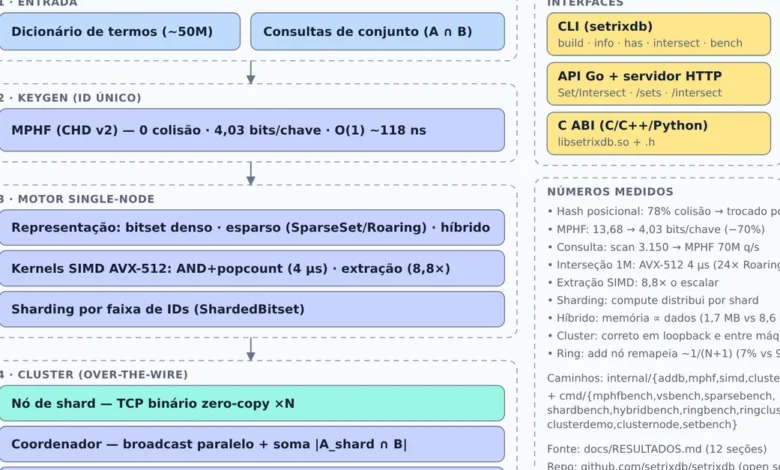
The modern digital landscape is increasingly defined by the ability to process massive datasets at near-instantaneous speeds. While traditional database management systems have long prioritized the storage and retrieval of complex payloads—such as user profiles, transaction logs, and multimedia files—a critical operational gap has emerged. Many high-performance applications spend a disproportionate amount of time performing set algebra, such as checking for the existence of specific identifiers or calculating intersections between massive lists. SetrixDB, a newly released open-source engine, aims to resolve these bottlenecks by treating identifiers as pure arithmetic values, moving away from the overhead-heavy structures typical of conventional database architectures.
The Problem of Scale and Set Algebra
In many contemporary software environments, the core workload is not the retrieval of descriptive data, but the comparison of vast lists of identifiers. Whether it is a faceted filter in an e-commerce catalog, a complex permission check in a multi-tenant cloud environment, or the pre-filtering of candidate documents for a Large Language Model (LLM), the task remains the same: determining whether a specific ID exists within a set or which IDs are shared between two disparate lists.
Traditionally, developers have relied on generic structures such as hash maps, SQL joins, or sorted list scans to manage these operations. While these methods are conceptually sound for textbook exercises, they suffer from significant performance degradation when scaled to millions or billions of elements. Generic structures often require pointers, memory indirections, and expensive comparison operations that become redundant when the data being processed is strictly a 64-bit integer (uint64). By contrast, SetrixDB operates on the premise that an identifier is not an object to be fetched, but a numeric value to be processed. In this framework, a set is simply a collection of uint64 integers, and an intersection is a high-speed logical AND operation.
Chronology of Development: Addressing the Collision Crisis
The development of SetrixDB was punctuated by a significant technical hurdle that highlights the risks of naive hash implementation. Early in the project’s lifecycle, the engineering team attempted to use a positional hash—a straightforward arithmetic formula—to generate dense, collision-free identifiers. The result was a failure rate of 78% on a test corpus of 200,000 alphanumeric tokens. For example, distinct inputs such as "Oa" and "0b" were mapped to the identical ID, rendering the set engine ineffective.
This realization prompted a shift toward the implementation of a Minimal Perfect Hash Function (MPHF), specifically based on the CHD v2 algorithm, built from the ground up. By measuring the collision rate against a real-world corpus rather than relying on synthetic data, the developers were able to refine the architecture. This shift underscores a broader industry truth: performance tuning is often rendered moot if the fundamental mapping of data is flawed. The move to a collision-free key generation process became the cornerstone of SetrixDB’s current architecture, allowing for O(1) lookup times with minimal memory footprint.
Benchmarking Performance in a Modern Context
To validate its efficacy, SetrixDB was subjected to rigorous testing on a standardized reference server: a dual-vCPU AMD EPYC (Zen4, AVX-512) machine with 3.8 GB of RAM, running Go 1.22. The benchmarks focused on two primary metrics: membership checks and set intersection speed.
In membership tests involving 1 million elements, SetrixDB demonstrated a significant advantage over standard Go map structures. While a map[uint64] required approximately 22.3 bytes per key, the SetrixDB structure achieved the same objective with only 0.5 bytes per key. Crucially, while a Bloom filter could achieve lower memory usage, it introduced a 1% false-positive rate, which is often unacceptable in applications requiring strict data integrity. SetrixDB maintained speed parity with hash maps at 118 nanoseconds per lookup, while remaining entirely exact.
The most dramatic results were observed in intersection operations. When comparing two sets of 1 million IDs, SetrixDB’s bitset implementation using AVX-512 instructions completed the intersection in just 6 microseconds. By comparison, standard hash joins took over 90 milliseconds, and traditional sorted merges required over 9 milliseconds. These findings demonstrate that when the universe of data is dense and fits within available memory, an optimized, vectorized bitset approach is vastly more efficient than conventional relational methods.
Real-World Data Validation
To ensure these metrics were not isolated to laboratory conditions, the developers tested the engine against three distinct, publicly available datasets.
- E-commerce Retail: Using the UCI Online Retail II dataset, which contains over 1 million sale lines, a query filtering for UK transactions in Q4 of 2011 with a price threshold of 5 units yielded 22,701 rows in 823 microseconds. This result was verified against external
sortandcommoperations, confirming 100% accuracy. - Textual Indexing: When applied to the Wikipedia titles dataset (approximately 19.3 million entries), the engine performed complex intersection queries—such as multi-word strings starting with specific letters—in under 10 milliseconds.
- MovieLens Scale: In a test involving 25 million user ratings, SetrixDB processed sets with over 12 million members, performing complex intersections between genre, decade, and rating scores in sub-millisecond timeframes.
The data confirms that for dense, memory-resident sets, the transition from list-based processing to bitset-based arithmetic results in a performance increase of roughly 350x and a memory reduction of 43x.
Strategic Implications and Limitations
The introduction of SetrixDB suggests a potential paradigm shift in how system architects approach high-frequency indexing. The engine is designed as a companion to, rather than a replacement for, existing database infrastructure. By serving as an "index-in-the-side," it allows primary databases like PostgreSQL, MongoDB, or specialized vector stores to handle persistence and payload management, while SetrixDB manages the high-velocity arithmetic required for filtering and permissioning.
However, the engine is not a panacea. Its design necessitates clear trade-offs. Because it relies on a Minimal Perfect Hash Function, it is not optimized for dynamic, high-frequency updates. Inserting or deleting elements from a set typically requires a rebuild of the hash structure, making it unsuitable for highly volatile data streams. Furthermore, it is not a relational or columnar database; it lacks SQL support and the ability to perform complex joins or similarity searches. For use cases where the data universe is sparse or too large to fit in memory, the developers explicitly recommend established solutions such as Roaring Bitmaps.
Industry Reception and Future Directions
Industry analysts note that the rise of specialized, embeddable primitives like SetrixDB reflects a broader trend in software engineering: the move toward "decoupled performance." As applications become more complex, the reliance on monolithic, "do-it-all" databases is being replaced by a modular ecosystem of specialized engines, each optimized for a narrow, high-impact operation.
The decision to release the project under the Apache-2.0 open-source license is intended to foster community contribution and broader testing across different hardware architectures. By inviting developers to run benchmarks and expose performance discrepancies, the project owners aim to solidify the role of vectorized arithmetic engines in the standard backend stack.
The implications for the future of AI and large-scale data retrieval are significant. As LLMs and recommendation engines move toward increasingly large candidate pools, the ability to perform pre-filtering—narrowing down millions of possibilities in microseconds—will be a decisive factor in latency-sensitive applications. If SetrixDB can maintain its performance profile as it evolves, it may well become a standard component for developers seeking to optimize the "decision-making" layer of their architecture.
As the industry moves toward 2026 and beyond, the competition to squeeze every last microsecond out of core system operations continues. With SetrixDB, the focus is squarely on the efficiency of the "arithmetic set," proving that even at the scale of millions of records, the most effective solution is often the one that simplifies, rather than adds, complexity. Developers interested in the underlying mechanics of this approach are encouraged to review the project’s documentation and reproducible benchmarks, which are currently available on its official repository. Through this, the developers hope to establish a new standard for what it means to perform set operations at speed.