Deploying Hugging Face Models to Amazon SageMaker AI with Autonomous Coding Agents and Specialized Skill Sets

Deploying sophisticated machine learning models from the Hugging Face hub into production environments has historically been an exercise in complex, multi-step orchestration. Engineers must navigate a labyrinth of infrastructure decisions, including selecting the appropriate serving container architecture, verifying AWS region-specific image tags, and calibrating instance memory footprints to match model requirements. Beyond the initial setup, there is the ongoing necessity of configuring autoscaling policies to prevent GPU resource wastage and establishing Amazon CloudWatch alarms to proactively mitigate silent failures. While these tasks are essential for operational excellence, they are time-consuming and prone to human error.
The rise of autonomous coding agents, such as Kiro and Anthropic’s Claude Code, initially promised a seamless path forward: developers could theoretically describe a model and let the agent handle the deployment lifecycle. However, real-world testing has revealed a significant gap. Without specific, up-to-date domain knowledge, unguided agents often default to outdated configurations, leading to fragile endpoints, unnecessary costs, and deployment failures. To bridge this divide, a new framework of open-source "agent skills" has been introduced, allowing these AI entities to perform production-ready deployments with the precision of a seasoned cloud engineer.
The Reliability Gap in Autonomous Development
The fundamental problem with utilizing general-purpose coding agents for infrastructure tasks is the "knowledge drift" between the agent’s training data and the rapidly evolving machine learning ecosystem. In empirical tests involving the deployment of models like the Qwen3-0.6B, unguided agents frequently failed because they relied on legacy defaults. For instance, Text Generation Inference (TGI) was long considered the standard container for LLMs. However, as new architectures like Qwen3 emerge, TGI versions available in specific regions often lack the necessary compatibility, leading to health check failures.
When an unguided agent encounters these failures, it often attempts to resolve them through trial and error, repeatedly triggering new deployments that consume expensive GPU resources. In more critical scenarios, such as the deployment of multimodal mixture-of-experts (MoE) models, the agent might deploy a server intended for text generation to handle image-text tasks. Because the infrastructure "looks" correct at the configuration level, the system does not fail immediately. Instead, the endpoint remains in a zombie state, refusing to process traffic—a failure that is both silent and difficult to debug in a production timeline.
Introducing the Hugging Face Agent Skills Framework
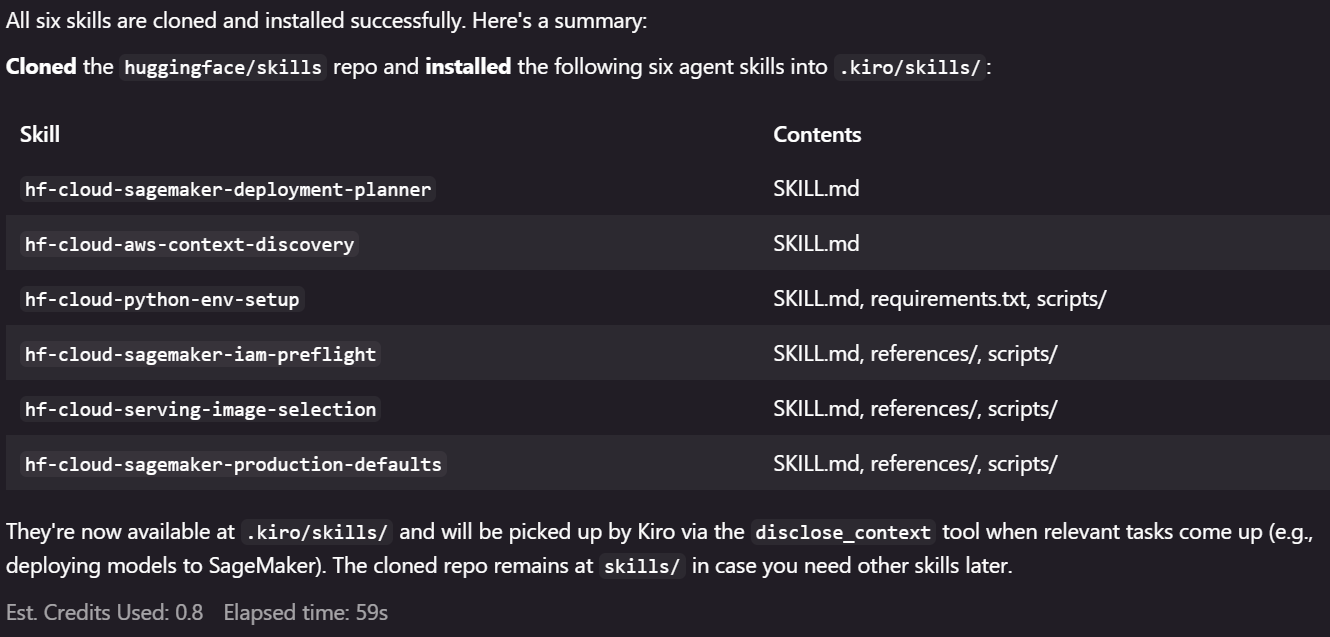
To address these shortcomings, developers can now integrate a set of six specialized skills designed for the Hugging Face ecosystem. These skills operate on an open standard, utilizing a structured metadata format that allows agents to "load" knowledge on demand. By installing these skills, agents gain the ability to navigate the AWS Deep Learning Containers (DLC) catalog, resolve proper image URIs, and implement production-grade monitoring automatically.
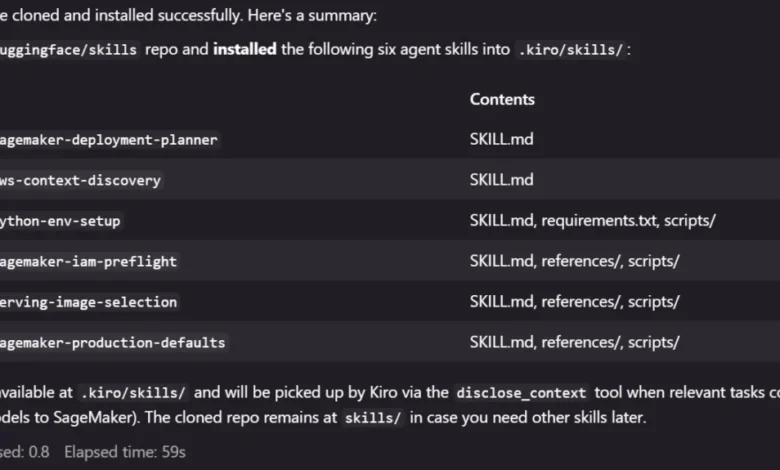
The suite includes:
- hf-cloud-sagemaker-deployment-planner: The master orchestrator that governs the workflow.
- hf-cloud-aws-context-discovery: Automatically identifies local AWS environment variables and credentials.
- hf-cloud-python-env-setup: Isolates the Python environment to prevent dependency conflicts.
- hf-cloud-sagemaker-iam-preflight: Validates execution roles before attempting deployments.
- hf-cloud-serving-image-selection: Ensures the correct container family—such as vLLM or TEI—is selected for the specific model architecture.
- hf-cloud-sagemaker-production-defaults: Configures the final environment with autoscaling, alarm thresholds, and proper tagging.
Chronology of a Secure Deployment
When these skills are active, the deployment process follows a rigid, reliable sequence. First, the planner skill assesses the model requirements. Instead of guessing, the agent queries the AWS DLC catalog to select the most compatible image, such as a vLLM container optimized for the specific hardware.
Second, the agent handles the IAM role resolution. In many enterprise environments, creating new roles is restricted. The skill is designed to search for existing, compliant roles first, ensuring that the deployment adheres to the principle of least privilege. If a new role must be created, the skill applies standard security best practices rather than granting overly permissive access.
Third, the deployment is finalized with production-grade configurations. This includes setting up target-tracking autoscaling (e.g., maintaining 1 to 4 instances based on traffic) and attaching three critical CloudWatch alarms: one for invocation errors (5XX), one for model latency (P99), and one for overhead latency (P99). This transformation turns a generic test endpoint into an enterprise-ready service.
Comparative Performance: Unguided vs. Skilled Agents
Data gathered during controlled tests highlights the stark difference in reliability. In a comparative study, an unguided agent required multiple manual interventions and suffered from "trial and error" deployment failures, ultimately failing to set up any monitoring or autoscaling. In contrast, an agent equipped with the new skill set achieved a successful, fully monitored deployment in a single attempt.
| Deployment Metric | Unguided Agent Performance | Skilled Agent Performance |
|---|---|---|
| Serving Container | TGI (Failure/Trial-and-error) | vLLM (Optimized pre-selection) |
| Autoscaling | None | Target tracking (1–4 instances) |
| Monitoring | None | 3x CloudWatch Alarms included |
| Documentation | Inaccurate/Stale | Logged and verified plan |
| Teardown | Manual/Fragile | Automated/Verified cleanup |
Broader Implications for AI Operations (AIOps)
The integration of these skills represents a shift in how infrastructure as code (IaC) is managed. By treating deployment logic as modular, version-controlled "skills," organizations can standardize their cloud footprint across teams. This reduces the risk of "shadow IT" deployments where developers might manually configure endpoints with insecure or inefficient settings.
Furthermore, the ability of these agents to self-correct is a significant advancement. For example, in cases where an IAM role lacks the permission to describe images, the agent can now record the failure, fall back to a "known-good" image tag, and inform the developer through the log rather than simply stalling or crashing. This level of self-awareness is critical for organizations scaling their generative AI efforts.
Operational Security and Best Practices
While these skills automate the heavy lifting, they do not remove the need for human oversight. The requirement for the agent to "write the plan to a file first" is a safety mechanism. By forcing a review of the deployment plan before any billable resources are instantiated, the developer maintains final authority.
Moreover, the cleanup process is simplified. Using the teardown.py script provided within the skills, developers can ensure that all resources—including endpoints, configurations, and models—are purged completely. Given that real-time endpoints on SageMaker accrue costs continuously, this feature is not merely a convenience but a vital cost-control measure.
Future Trajectory of Autonomous Infrastructure
As the ecosystem of coding agents continues to expand, the reliance on these modular skill sets will likely become a standard practice. The open-source nature of the Hugging Face skills ensures that as new models, containers, and AWS features are released, the community can contribute updates to the skills. This creates a feedback loop where the agent’s knowledge base grows alongside the industry, preventing the obsolescence that currently plagues static AI models.
For enterprises, the focus remains on the "right-hand column" of the deployment table: security, efficiency, and observability. By offloading the mechanical aspects of model hosting to skilled agents, machine learning engineers can pivot their focus toward higher-level objectives, such as fine-tuning performance, optimizing inference latency, and developing innovative applications that leverage the full potential of large language models.
The implementation of these tools is straightforward. By installing the skills via standard Git-based workflows into the local workspace, teams can immediately begin deploying models with confidence. Whether the task involves simple text generation or complex, multimodal inference, the framework provides a robust foundation for scaling AI operations in a professional, enterprise-grade environment. As this technology matures, it will likely bridge the gap between experimental AI development and reliable, production-ready machine learning services.