The modern corporate landscape is defined by an enduring paradox: while employees universally report that excessive meetings are the primary barrier to completing their daily tasks, corporate calendars continue to swell with back-to-back video conferences and in-person gatherings. This friction between individual productivity and institutional collaboration has persisted despite decades of management interventions. Organizations across the globe have experimented with a variety of palliatives, including no-meeting Fridays, mandatory reductions in meeting durations, and strict caps on participant headcounts. Yet, despite these well-intentioned policy implementations, actual deep work frequently grinds to a halt while schedules remain perpetually congested.
This systemic failure has forced executive leadership teams to re-examine the fundamental architecture of corporate communication. The root cause of calendar bloat, according to organizational researchers, rarely stems from an explicit desire to micromanage. Instead, it is anchored in decades of inherited corporate habits rather than deliberate, intentional design. As businesses navigate an increasingly complex operational environment marked by hybrid work models and accelerated technological disruption, the necessity of reforming meeting culture has transformed from a minor operational nuisance into a critical driver of organizational performance, employee retention, and overall corporate wellness.
The Anatomy of Modern Meeting Fatigue and Calendar Bloat
To understand the current state of workplace productivity, one must examine the quantitative reality of contemporary schedules. According to various workplace analytics reports compiled over the past several years, the average professional now spends upwards of 20 hours per week in meetings—a figure that has doubled, and in some cases tripled, since the widespread adoption of remote and hybrid work environments. This dramatic escalation has given rise to new economic and psychological phenomena, most notably the concept of meeting debt. Similar to financial debt, meeting debt accumulates when organizations continuously schedule synchronous discussions without accounting for the long-term maintenance costs and the displacement of essential individual tasks.
The consequences of this accumulation extend far beyond simple schedule fatigue. Organizational psychologists have identified direct correlations between high meeting volume and elevated rates of burnout, emotional exhaustion, and diminished employee engagement. When professionals are forced to fragment their days into thirty-minute increments to accommodate a succession of briefings, updates, and impromptu brainstorming sessions, the cognitive switching costs accumulate exponentially. Human brains require sustained periods of uninterrupted focus to solve complex problems, write code, draft strategic plans, or analyze financial data. When these windows are systematically eroded by the constant ping of meeting notifications, the quality of institutional output inevitably declines.
Furthermore, leaders frequently find themselves caught in a self-perpetuating cycle. Fearing a loss of alignment or visibility in distributed teams, executives default to synchronous communication as a primary management tool. This reflex creates a vicious circle: poor asynchronous communication practices necessitate more meetings, which in turn leaves employees with no time during regular working hours to actually execute the decisions made during those very meetings. Consequently, staff are forced to work during evenings and weekends to complete their core deliverables, accelerating physical and mental exhaustion.
The Evolution of Workplace Collaboration: A Chronological Overview
The trajectory of workplace collaboration has undergone profound structural shifts over the past century, transitioning from rigid, highly localized hierarchies to fluid, technology-enabled ecosystems. A historical review of how organizations manage time and communication reveals distinct eras of evolution.
During the mid-to-late 20th century, corporate collaboration was predominantly physical, synchronous, and constrained by geography. Meetings required physical presence in a boardroom, which naturally limited their frequency due to logistical friction. Agendas were formalized, documentation was laboriously typed and distributed via internal mail, and spontaneous gatherings were relatively rare. The introduction of email in the late 1980s and 1990s promised to liberate communication from the constraints of time and space, yet it ultimately served as a precursor to the hyper-connectivity era.
The turn of the millennium witnessed the rapid proliferation of enterprise software, including early collaboration platforms and widespread adoption of conference calling. While these tools improved connectivity among global teams, they also lowered the barrier to entry for convening groups. By 2010, the emergence of cloud-based project management tools and advanced video conferencing began to fundamentally alter daily workflows. However, the most acute disruption to the traditional meeting paradigm occurred in 2020.
The global shift toward remote work necessitated by public health protocols acted as a massive catalyst for digital collaboration tools. Overnight, physical boardrooms were replaced by virtual grid interfaces. Without the natural boundaries of the physical workday—such as commuting times or the physical capacity of meeting rooms—virtual calendars quickly expanded to fill every available hour. By 2021 and 2022, organizations realized that digital platforms had exacerbated meeting bloat rather than alleviated it. This realization sparked a wave of experimental countermeasures, ranging from company-wide bans on internal meetings on specific days of the week to the implementation of automated scheduling software designed to audit and restrict calendar density.
Expert Insights on Organizational Behavior and Future Trends
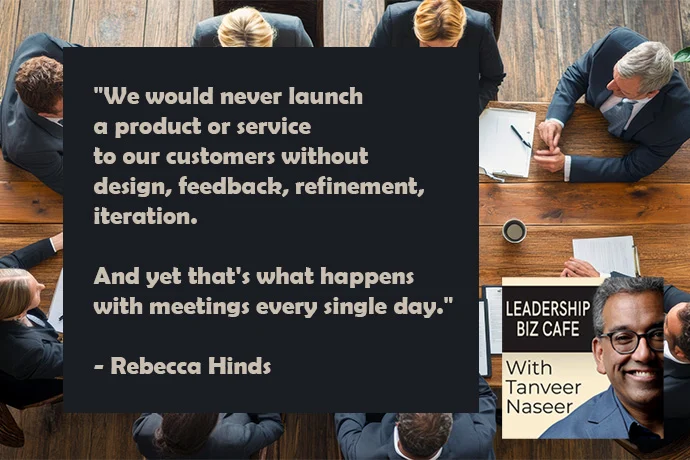
Addressing the modern meeting crisis requires rigorous, evidence-based methodologies rather than superficial policy adjustments. Leading voices in the field of organizational behavior have increasingly turned their attention to dismantling inherited workplace habits. Among the foremost experts studying this intersection of future work dynamics, artificial intelligence, and corporate culture is Dr. Rebecca Hinds. Her extensive research into how contemporary teams collaborate has been featured in premier academic and business publications, including the Harvard Business Review, The New York Times, Forbes, TIME, and Fast Company.
Dr. Hinds’ empirical work investigates the hidden frictions within modern knowledge work, particularly the ways in which digital tools and emerging technologies can either compound or alleviate organizational inefficiencies. In her widely acclaimed book, Your Best Meeting Ever: 7 Principles to Designing Meetings That Get Things Done, she provides a comprehensive, research-backed framework designed to transform broken meeting cultures into purposeful engines of corporate productivity.
According to Dr. Hinds and supporting organizational research, the fundamental flaw in corporate meetings is that they are treated as default settings rather than specialized interventions. When meetings lack intentional design, they frequently degenerate into status updates that could have easily been communicated via asynchronous text, or brainstorming sessions that lack clear facilitation structures. Furthermore, her research highlights the existence of subtle, pernicious behaviors within group dynamics that she categorizes as energy-sucking bugs. These behavioral patterns—such as dominating personalities, unstructured tangents, lack of pre-meeting preparation, and indefinite action items—quietly drain the momentum and psychological safety from professional conversations.
To counteract these dynamics, organizational experts advocate for a complete re-evaluation of how meetings are conceptualized, scheduled, and executed. This involves treating time as a finite, highly valuable corporate asset that must be budgeted with the same rigor applied to financial capital.
Data-Driven Perspectives and the True Cost of Meetings
Analyzing the efficacy of corporate meetings requires looking past subjective employee complaints and examining hard economic and operational data. Numerous workplace studies conducted by management consulting firms and academic institutions have attempted to quantify the financial drag of poorly designed meetings.
Calculated on an aggregate scale, the financial cost of unnecessary meetings runs into the billions of dollars annually for large enterprises. This figure is derived by multiplying the hourly compensation of all participants by the duration of the meeting, factoring in preparation time and the cognitive recovery period required to return to deep work. When an executive team of ten high-level professionals spends one hour in a meeting that lacks a clear agenda, actionable purpose, or decision-making framework, the organization is not merely spending one hour of collective time; it is squandering ten hours of specialized labor alongside the opportunity cost of what those professionals could have achieved during that window.
Moreover, quantitative surveys consistently demonstrate a profound disconnect between how leaders and employees perceive meeting efficacy. While executive leadership frequently views meetings as vital forums for alignment, culture-building, and strategic oversight, frontline managers and individual contributors often experience them as obstacles to execution. Data indicates that upwards of 70% of employees feel that meetings are unproductive and prevent them from completing their core responsibilities. This perceptual gap explains why surface-level solutions—such as simply shortening meetings from 60 minutes to 50 minutes—often fail to yield meaningful improvements in employee satisfaction or organizational output. Without addressing the underlying purpose and structural integrity of the gathering, minor adjustments merely compress the same chaotic dynamic into a tighter timeframe.
Corporate Responses and Strategic Interventions
In response to mounting empirical evidence and employee feedback, progressive organizations are deploying sophisticated strategies to reclaim institutional time and restore operational momentum. Rather than relying on blunt instruments like blanket meeting bans, modern leadership teams are implementing structured, multi-phase interventions.
One foundational strategy gaining traction is the execution of a comprehensive calendar cleanse to eliminate accumulated meeting debt. This process involves a systematic audit of all recurring meetings on an organization’s master schedule. Teams are required to justify the continued existence of each recurring appointment by demonstrating its direct link to key performance indicators, strategic decisions, or critical project milestones. If a recurring meeting cannot pass this rigorous test, it is immediately canceled or transitioned into an asynchronous communication channel.
Complementing the calendar cleanse is the deliberate adoption of asynchronous-first working norms. Organizations are increasingly investing in advanced project management software, collaborative documentation tools, and artificial intelligence-driven summarization platforms. These technologies allow team members to contribute updates, review project statuses, and debate strategic proposals across different time zones and work schedules without requiring real-time, synchronous presence. By shifting status updates and informational briefings to asynchronous formats, meetings are reserved exclusively for complex problem-solving, high-stakes decision-making, and collaborative innovation.
Furthermore, forward-thinking enterprises are establishing rigorous design principles for the meetings that do remain on the calendar. These guidelines include mandatory pre-read materials distributed at least 24 hours in advance to eliminate the need for lengthy informational presentations during the actual call; strict adherence to targeted attendee lists based strictly on contribution rather than hierarchy or visibility; and the mandatory inclusion of clearly defined, actionable outcomes and designated owners for every decision made before the meeting concludes.
Broader Organizational Implications and Future Outlook
The imperative to reform meeting culture extends far beyond the immediate goal of increasing daily task completion; it touches upon the core viability of modern organizational models. As businesses compete globally for top-tier talent, workplace culture and respect for employee time have become paramount differentiators in recruitment and retention. Professionals, particularly younger generations entering the workforce, increasingly evaluate potential employers based on their operational efficiency and commitment to work-life integration. Organizations that cling to archaic, meeting-heavy management styles frequently experience higher turnover rates, lower morale, and diminished capacity for innovation.
Conversely, enterprises that successfully transition to an intentional, design-driven approach to collaboration unlock significant competitive advantages. By freeing employees from the relentless cycle of calendar congestion, organizations cultivate an environment conducive to deep focus, creative problem-solving, and agile execution. When time is treated as a strategic asset, teams are empowered to move with greater speed and clarity, aligning their daily activities directly with overarching corporate purpose.
Ultimately, resolving the modern meeting crisis requires a cultural shift driven from the top down. Leaders must model disciplined calendar management, champion asynchronous communication standards, and continuously evaluate the utility of their collaborative practices. As artificial intelligence and advanced collaboration tools continue to reshape the contours of knowledge work, the organizations that thrive will be those that recognize a fundamental truth: the goal of corporate communication is not to keep everyone perpetually connected, but to empower individuals to think, decide, and execute exceptional work together.