Beyond the Boardroom Burnout: Why Leadership Mental Health Requires a Paradigm Shift

In the modern corporate landscape, navigating perpetual economic uncertainty, rapid technological disruption, and shifting workforce expectations has pushed the conversation around workplace well-being to the forefront. While organizations increasingly recognize the necessity of supporting employee mental health, a critical blind spot persists at the highest levels of corporate hierarchy: the psychological well-being of those in leadership positions. Executives, managers, and directors are frequently expected to function as resilient pillars of stability, absorbing organizational stress while projecting unwavering confidence. Consequently, leadership mental health is frequently overlooked, neglected, or dismissed as an occupational hazard of reaching the top.
When leadership mental health does enter corporate discourse, the proposed remedy almost invariably defaults to "self-care." From spa weekends and luxury purchases to mandated mindfulness apps and digital detoxes, the prevailing narrative suggests that leaders can inoculate themselves against burnout through isolated consumption and personal indulgence. However, a growing chorus of leading psychologists, neuroscientists, and organizational behaviorists is calling out this approach. Far from being a solution, traditional self-care is frequently misunderstood, fundamentally misdirected, and, in many cases, potentially more harmful than good.
The Flaws of Contemporary Self-Care Paradigms
To understand why conventional self-care fails leaders, one must examine the psychological mechanisms underlying human fulfillment. Dr. Jamil Zaki, director of Stanford University’s Social Neuroscience Laboratory, has extensively researched the science of human connection and empathy. In his scholarly writings and public lectures, Dr. Zaki has observed a fundamental predictive error common in modern society: individuals consistently miscalculate what brings them lasting psychological sustenance.
According to Dr. Zaki, people wrongly predict that spending time, money, and energy exclusively on themselves will make them more fulfilled than allocating those same resources toward others. In a corporate context, this translates to the familiar executive trap of trying to recover from a grueling 70-hour work week through consumerist splurges, luxury vacations, or solitary escapism. While binge-watching television series or purchasing high-end goods may provide a fleeting dopamine hit, these activities fail to address the systemic, existential stressors driving modern workplace burnout. They treat the symptoms of isolation while exacerbating the root cause: a disconnection from meaning, purpose, and community.
Reimagining the Oxygen Mask Metaphor
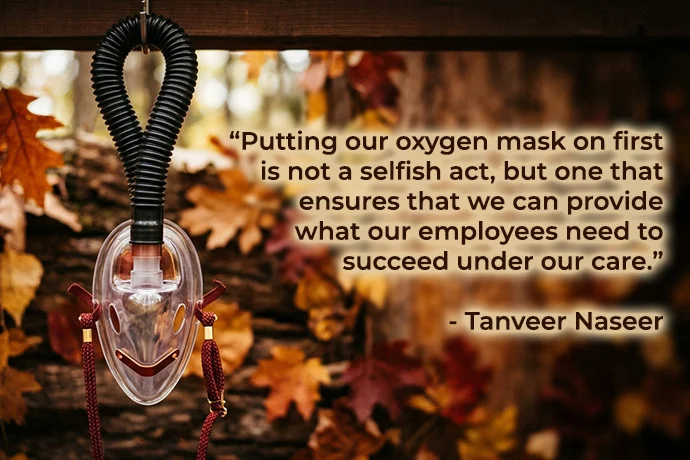
The classic airline safety instruction dictates that passengers must secure their own oxygen masks before assisting others. In popular culture, this metaphor is frequently hijacked to justify hyper-individualistic self-care—the idea that one must look inward and prioritize personal gratification above all else before engaging with the demands of leadership. Yet, when re-examined through the lens of social neuroscience, the oxygen mask metaphor takes on an entirely different meaning.
Dr. Zaki’s research demonstrates that humans are psychologically intertwined. We are fundamentally prosocial creatures whose neurological wiring rewards altruism and communal support. When leaders feel a deep sense of connection to their organizational purpose and genuinely engage in supporting the people under their care, it triggers a profound sense of psychological fulfillment. Helping others is, neurologically and emotionally, a kindness extended to oneself.
Therefore, prioritizing one’s own well-being is not an act of selfish withdrawal; rather, it is a strategic necessity. By maintaining their mental and emotional health, leaders ensure they possess the cognitive bandwidth, emotional resilience, and strategic clarity required to cultivate a thriving organizational culture where employees can succeed.
The Broader Context of Workplace Burnout and Executive Stress
The urgency surrounding leadership mental health is amplified by a volatile global economic climate. Over the past decade, leaders have navigated the unprecedented disruptions of the COVID-19 pandemic, subsequent supply chain crises, inflationary pressures, geopolitical instability, and the rapid democratization of generative artificial intelligence. According to various global workforce studies, executive burnout rates have surged, with a significant percentage of senior leaders reporting symptoms of chronic exhaustion, depersonalization, and a diminished sense of professional accomplishment.
Historically, corporate culture has celebrated the "hustle culture" archetype—the tireless executive who sleeps five hours a night, works eighty hours a week, and answers emails at midnight. However, organizational psychologists note that this model is not only unsustainable but dangerous. High-profile executives who publicly champion sleep deprivation and round-the-clock availability inadvertently establish toxic organizational norms that trickle down through the ranks, normalizing chronic stress and driving attrition.
Drawing parallels to elite sports psychology reveals the fallacy of the hustle-culture mindset. Professional athletes at the pinnacle of their respective disciplines do not achieve victory through continuous, unmitigated exertion. Instead, elite performance is universally recognized as the byproduct of a rigorous balance between high-intensity output and intentional rest, recovery, and tactical reflection. Leadership must adopt a similar paradigm.
Three Practical Strategies for Protecting Leadership Mental Health
For leaders seeking to transition away from superficial self-care and toward sustainable mental health practices, experts recommend three practical, evidence-based approaches. These strategies integrate seamlessly into daily operations, bridging the gap between personal well-being and effective leadership execution.
- Leverage Influence as an Authentic Role Model
Actions consistently resonate louder than corporate policy manuals. Leaders cannot effectively champion well-being through empty rhetoric while maintaining punishing, unsustainable schedules. To foster a healthy organizational culture, leaders must model the behaviors they wish to see.
This involves actively demonstrating boundaries around work hours, prioritizing physical and mental recovery, and openly acknowledging the importance of rest. By consciously rejecting the badge of honor associated with chronic overwork, leaders signal to their teams that well-being is a core organizational value rather than a superficial HR compliance metric. When employees see leadership respecting recovery time, they feel psychologically safe to do the same.
- Cultivate Emotional Self-Awareness
Well-being encompasses far more than physical health; it is deeply rooted in emotional regulation and self-awareness. Leaders must regularly check in with their internal states, recognizing how emotional stress manifests physically—such as through muscle tension, fatigue, or irritability.
Furthermore, leaders must recognize that their emotional states are rarely hidden. In workshops on leadership communication and emotional intelligence, experts frequently emphasize that even when a leader attempts to maintain a calm verbal demeanor, non-verbal cues—micro-expressions, vocal tone, and body language—are continuously observed and interpreted by employees. These subtle cues heavily influence team morale and psychological safety. Cultivating emotional self-awareness allows leaders to manage their internal states proactively, preventing stress from inadvertently poisoning the organizational atmosphere.
- Remove, Rather Than Add, Barriers to Well-Being
Organizational wellness is often mistakenly approached through an additive lens: adding wellness apps, mandatory mindfulness seminars, or periodic team-building exercises on top of an already bloated workload. True leadership well-being, however, often requires a subtractive approach.
A stark example of this dynamic can be observed in the systemic implementation of emerging technologies, such as artificial intelligence. A prominent study by the MIT Media Lab revealed that an alarming 95 percent of enterprise artificial intelligence adoption efforts fail to meet their intended objectives. While much of the post-mortem analysis focuses on technical architecture and algorithmic limitations, the human cost is frequently ignored. Employees are routinely forced to alter complex workflows to integrate new AI tools, only to discover the systems are inadequate, requiring them to revert to legacy processes while still shouldering the burden of meeting aggressive productivity targets.
This churn creates profound friction and anxiety for both employees and the leaders charged with guiding them. Failures in major technological transformations inevitably erode trust in executive decision-making, compounding leadership stress. To protect mental health and preserve organizational trust, leaders must adopt an open-door posture of inquiry. By proactively asking employees which processes, administrative burdens, and technological tools act as impediments rather than enablers, leaders can systematically remove these barriers. This collaborative problem-solving alleviates operational friction and restores a shared sense of accomplishment by the end of the fiscal year.
The Macroeconomic and Organizational Implications
Neglecting leadership mental health carries severe economic and operational consequences. When executives and managers experience chronic burnout, decision-making capabilities degrade, strategic vision narrows, and organizational agility plummets. Furthermore, burned-out leaders often resort to micromanagement or reactive communication styles, which in turn drive up employee turnover, increase absenteeism, and depress overall productivity.
Conversely, organizations that invest in holistic leadership well-being—moving beyond consumerist self-care toward purpose-driven connection and operational efficiency—demonstrate superior resilience during times of crisis. When leaders feel mentally fortified and supported, they are better equipped to model empathy, navigate ambiguity, and maintain the psychological safety of their teams.
Conclusion: Taking Care of Self to Care for the Team
Ultimately, the paradigm of putting on one’s oxygen mask first must be reframed as a collective, rather than purely individual, responsibility. Taking care of one’s mental health as a leader is not an act of self-indulgence or separation from the team; it is an intentional, foundational commitment to creating an organizational culture where sustainable performance is possible. By rejecting hollow self-care trends, modeling authentic recovery, monitoring emotional intelligence, and aggressively removing operational barriers, leaders can safeguard their own well-being while empowering their workforce to thrive in an increasingly complex world.