Mastering the Conversion Map: A Strategic Framework for Scaling Digital Marketing Growth


In the current digital marketing landscape, organizations are inundated with a surplus of channels and tactics. From social media advertising and search engine optimization to influencer partnerships and email automation, the sheer volume of choices often leads to tactical fragmentation. Many marketing teams attempt to manage dozens of disparate initiatives simultaneously, which frequently results in a loss of strategic clarity and a failure to drive measurable business outcomes. At its core, however, marketing remains a straightforward equation: traffic multiplied by conversion rate equals total growth. By shifting focus from a broad, scattered approach to a disciplined, data-driven framework, companies can systematically improve their performance and optimize their acquisition costs.
The Mathematics of Growth: Deconstructing the Conversion Formula
The fundamental objective of any digital marketing strategy is to attract an audience and guide them toward a specific action, such as a product signup or a purchase. This process is governed by the formula: New Signups = Traffic x Conversion Rate. While traffic represents the raw volume of potential customers visiting a digital property, the conversion rate measures the efficacy of the user experience in persuading those visitors to take action.
Data from industry benchmarks suggests that the average conversion rate for e-commerce sites hovers around 2% to 3%, while high-performing SaaS (Software as a Service) platforms often aim for 5% to 10% on dedicated landing pages. When a marketing team attempts to juggle too many variables, they often lose sight of these two primary levers. By analyzing every marketing channel, landing page, and piece of content through this binary lens, businesses can effectively categorize their assets into a "Conversion Map." This framework allows teams to prioritize resources based on the specific stage of growth and the potential for optimization.

Chronology and the Evolution of Marketing Optimization
Historically, the evolution of digital marketing has moved from a "spray and pray" methodology—where brands purchased broad reach regardless of intent—to highly targeted, data-backed optimization. In the early 2000s, digital advertising was dominated by impression-based models. As tracking technologies matured in the 2010s, the focus shifted toward conversion rate optimization (CRO) and the rigorous testing of landing pages.
The implementation of the Conversion Map framework typically follows a chronological order of operations designed to maximize efficiency. First, marketers must identify which assets are already producing results. By isolating high-traffic, high-conversion channels, teams can establish a baseline of "maintenance mode" assets. These serve as the company’s "cash cows," providing the financial stability and data intelligence required to fund more speculative growth experiments.

Categorizing the Quadrants: A Strategic Analysis
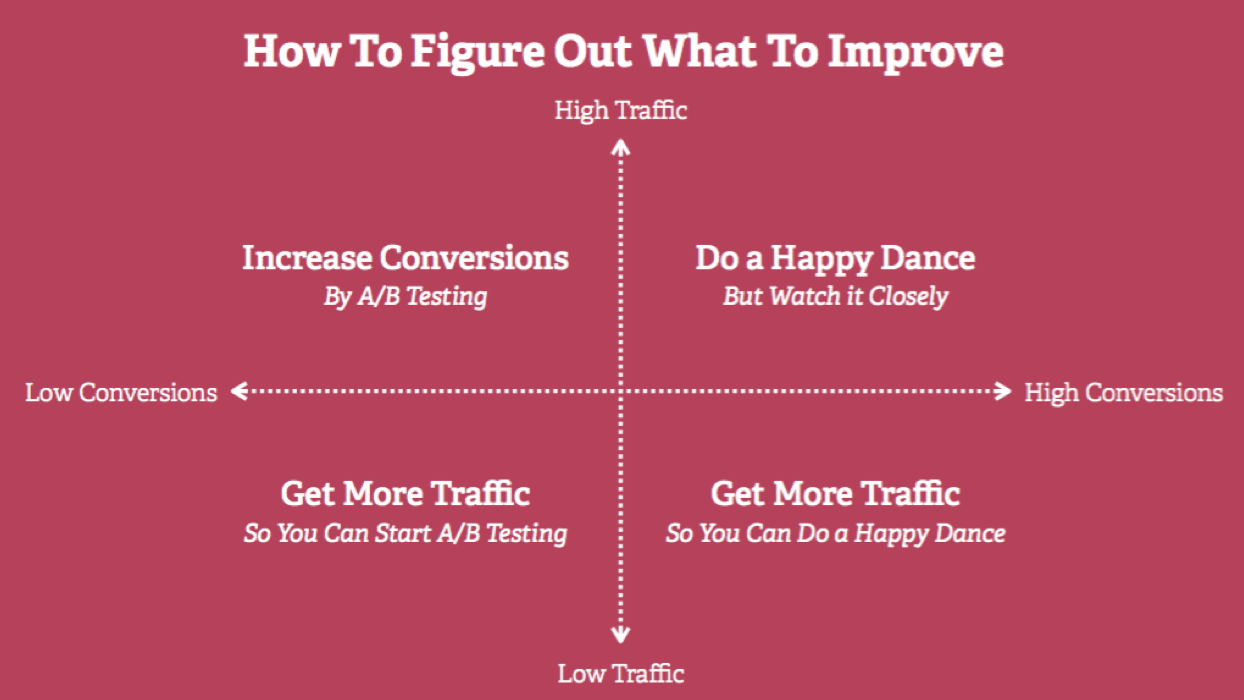
To execute this strategy, marketing assets are plotted on a two-dimensional grid:
- High Traffic, Low Conversion: This quadrant represents the most immediate opportunity for growth. Because the volume of visitors is already substantial, the sample size for A/B testing is large enough to achieve statistical significance quickly. Marketers should focus on user interface (UI) adjustments, copy refinement, and simplified sign-up flows. By increasing the conversion rate of these pages even by a fractional percentage, companies can see an exponential increase in total signups without needing to acquire a single additional visitor.
- Low Traffic, High Conversion: These assets often reside deep within a sales funnel, such as specific case studies or highly technical documentation. While they do not reach a massive audience, they represent a strong product-market fit. The strategic objective here is to scale traffic. By repurposing the successful elements of this content—the tone, the specific pain points addressed, or the value proposition—marketers can create broader-appeal assets that drive more traffic while maintaining high conversion standards.
- Low Traffic, Low Conversion: This is the "testing ground." It is the most common state for early-stage startups and new campaigns. The priority here is not optimization, but experimentation. Marketers must deploy content marketing, paid acquisition, or SEO strategies to build a baseline of traffic. Once a steady stream of visitors is established, the asset can be moved into the high-traffic, low-conversion quadrant for further refinement.
- High Traffic, High Conversion: These are the pillars of a successful marketing organization. These assets should be carefully monitored to prevent performance decay but do not require the constant, labor-intensive overhauling that the other quadrants demand.
Data-Driven Insights and Cost-Effectiveness
One of the most compelling arguments for this structured approach is the significant reduction in Customer Acquisition Cost (CAC). For instance, established firms like KISSmetrics have demonstrated that a disciplined, long-term content strategy can drive trial signups at a fraction of the cost associated with competitive keyword bidding on platforms like Google Adwords. By prioritizing organic conversion optimization over paid traffic spikes, firms can achieve a more sustainable growth trajectory.

Industry analysts note that companies utilizing structured frameworks for their marketing efforts often outperform their competitors in long-term retention. When a brand focuses on the quality of the interaction rather than just the volume of clicks, they build an audience that is more deeply invested in the product. This creates a "flywheel effect," where satisfied users contribute to further traffic growth through word-of-mouth and organic sharing.
The Role of Experimentation and User Feedback
An essential component of the Conversion Map is the integration of direct user feedback. Tools that allow for on-site surveys and behavior tracking are critical in the "High Traffic, Low Conversion" quadrant. Understanding why a user chooses not to convert is often more valuable than knowing that they didn’t.

According to product management experts, there is a clear distinction between understanding a customer and understanding an audience. A high-conversion, low-traffic piece of content often speaks to the core customer’s specific needs. To scale that into a high-traffic asset, the marketing team must learn to translate that deep, technical knowledge into a message that resonates with a wider, top-of-funnel audience. This transition is delicate; as traffic increases, the intent of the average visitor inevitably shifts from "high-intent researcher" to "casual browser." Therefore, the conversion strategy must adapt in tandem with the traffic growth.
Broader Implications for Scaling SaaS
The implications of this framework extend beyond simple website optimization; they reflect a broader shift in how modern businesses view the "long game." In the software sector, the race to scale can often lead to burnout and the pursuit of unsustainable growth tactics. The Conversion Map forces a return to fundamentals, reminding stakeholders that sustainable growth is built on the deliberate, iterative improvement of existing assets rather than the constant pursuit of new, unproven channels.

As the industry continues to mature, the reliance on high-quality, targeted content will likely increase. The "continents of content" metaphor—where small islands of information eventually connect to form a robust, authoritative domain—illustrates the long-term investment required to dominate a market niche. This is not a strategy for those looking for immediate, short-term gains, but for organizations aiming to build a defensible competitive advantage.
Conclusion: A Disciplined Path Forward
The pursuit of growth is rarely linear. It is a process of constant evaluation, testing, and refinement. By utilizing the Conversion Map, marketers can strip away the noise of the digital landscape and focus on what truly drives the bottom line. Whether a company is in its infancy, struggling to find its first 100 visitors, or a mature enterprise looking to optimize its cash-cow assets, the principles remain the same: identify what works, document the process, and scale through intentional, data-backed decisions. In an environment where every marketing dollar is scrutinized, the ability to prioritize and execute with precision is the ultimate competitive advantage.