Mastering the Post-Interview Q&A: Essential Questions to Ask Employers and Elevate Your Job Search

The modern employment interview is rarely a simple one-way interrogation where an employer evaluates a candidate’s fitness for a role. Instead, recruitment specialists increasingly emphasize that the interview process functions as a critical two-way dialogue. Yet, despite extensive preparation regarding company research and practiced answers to common behavioral questions, many job seekers experience a moment of intense anxiety when the interviewer finally prompts, "Do you have any questions for me?" This pivotal transition frequently catches candidates off guard, resulting in missed opportunities to leave a lasting, positive impression or gather vital information about a prospective workplace.
Failing to ask thoughtful questions can inadvertently signal a lack of genuine interest or critical engagement with the role. Conversely, entering an interview equipped with targeted, strategic inquiries allows candidates to showcase their analytical thinking, industry knowledge, and long-term commitment. As the labor market continues to evolve—particularly with the widespread adoption of remote and hybrid work models—navigating this final phase of the interview has become more critical than ever for career success.
The Evolution of the Modern Interview and the Two-Way Dialogue
Historically, the employment interview was heavily skewed in favor of the hiring organization. Candidates were expected to answer inquiries passively, accepting whatever terms were offered should they receive a job offer. Over the past two decades, however, workplace dynamics have shifted dramatically. Labor shortages in specialized sectors, the rise of remote and distributed teams, and an increased cultural emphasis on workplace well-being and mental health have transformed the hiring landscape.
Modern recruitment experts note that interviews now serve as an initial cultural exchange. Employers are not merely looking for someone who possesses the technical skills to execute a task; they are searching for cultural alignment, emotional intelligence, and problem-solving capabilities. For the job seeker, this reciprocal environment means the interview is an evaluation tool to determine whether the company’s values, management style, and operational framework align with their professional goals and personal needs.
When a candidate hesitates or declines to ask questions, it can inadvertently introduce friction into the evaluation process. Interviewers often interpret silence or a lack of questions as indifference, poor preparation, or a passive work ethic. By viewing the Q&A segment as an equal partnership, candidates can shift the narrative, transforming from passive applicants into active participants shaping their future career trajectories.
Chronology and Preparation: Navigating the Interview Lifecycle
Preparation for a successful interview demands a structured timeline that begins long before the candidate enters the room or logs onto a video conferencing platform. Understanding this lifecycle helps mitigate the panic often associated with the final moments of an interview.
Phase One: Pre-Interview Research (Weeks to Days Prior)
The foundation of effective questioning is laid during the initial research phase. Candidates should analyze the company’s recent press releases, quarterly earnings reports (if publicly traded), product launches, and media coverage. Furthermore, reviewing the organization’s social media channels and employee review platforms provides a baseline understanding of its public-facing identity versus its internal culture.
Phase Two: The Core Interview (Duration of the Meeting)
During the primary question-and-answer period, candidates should actively listen rather than simply wait for their turn to speak. Effective interviewees take mental or physical notes regarding topics raised by the hiring manager—such as recent departmental restructuring, technological upgrades, or expansion goals. These real-time details can be referenced during the closing Q&A session to formulate highly customized questions.
Phase Three: The Closing Q&A (The Final 10 to 15 Minutes)
When the interviewer opens the floor, the candidate should pivot smoothly from answering inquiries to posing them. Candidates should aim to have three to five well-formulated questions prepared in advance, prioritized by importance, allowing them to adapt based on how much time remains in the meeting.
Phase Four: Post-Interview Follow-Up (1 to 3 Days After)
The questions asked during the interview often inform the subsequent follow-up communication. For instance, inquiring about the hiring timeline during the interview establishes clear expectations for when a thank-you note or check-in email should be sent, reducing the anxiety of waiting for a response.
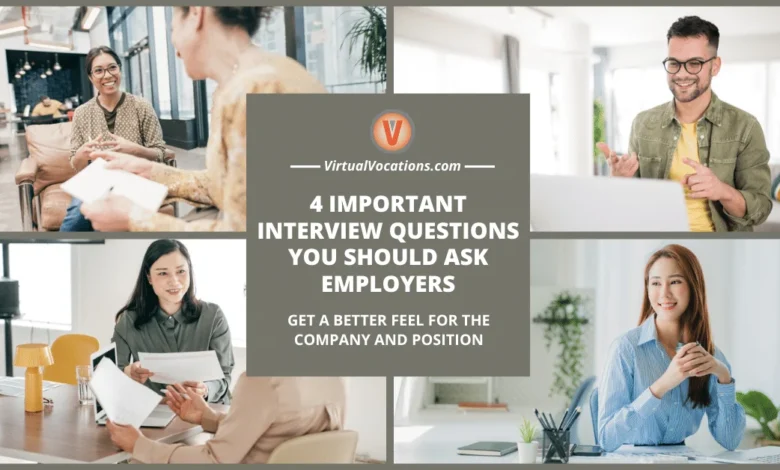
Four Essential Questions to Ask Employers
To maximize the impact of the closing segment, career advisors recommend focusing on specific categories of inquiry that reveal operational realities, support structures, and competitive advantages.
-
What is the job like on a day-to-day basis?
Job descriptions often present an idealized, high-level overview of responsibilities. Asking about the daily routine pierces through corporate boilerplate to reveal the practical execution of the role. For remote workers, this question holds even greater weight. It allows candidates to clarify expectations regarding asynchronous communication, core working hours, daily deliverables, and collaboration tools. Understanding these operational rhythms helps candidates assess whether their working style matches the daily realities of the position.
-
How long does your hiring process typically take?
Navigating the timeline of a corporate recruitment pipeline can be notoriously stressful. Inquiring about the next steps and the overall hiring timeline demonstrates proactive interest without projecting impatience or presuming a job offer. From a practical standpoint, this data allows candidates currently managing multiple applications or pending offers to coordinate their professional timelines effectively. It also establishes a clear benchmark for when it is appropriate to follow up. -
What does your onboarding process look like?
The transition into a new organization is a vulnerable period for any employee, but it presents unique challenges within remote or hybrid environments. A comprehensive onboarding program ensures that new hires receive adequate training, technical setup, and opportunities to integrate with their teams. Asking about onboarding signals to the employer that the candidate values structured growth and immediate productivity. Conversely, a vague or nonexistent onboarding plan can serve as a red flag, indicating that the organization may lack the internal support systems necessary for long-term employee retention and success. -
What distinguishes your company from its competitors?
This inquiry prompts the interviewer to articulate the organization’s unique value proposition, market positioning, and internal strengths. The resulting answer frequently sheds light on company culture, leadership philosophy, and employee retention strategies. Whether the differentiator is an innovative product line, an exceptional professional development budget, or a collaborative team ethos, understanding what sets the firm apart helps the candidate evaluate whether the organization represents a sustainable environment for long-term career development.
Data and Industry Insights on Remote Work and Interview Dynamics
The rapid expansion of remote and hybrid work models over the past several years has fundamentally altered what candidates look for during interviews. According to labor market studies and employment trends tracked by career platforms, flexibility and structural support rank among the highest priorities for modern job seekers.
Data compiled across human resources sectors indicates that more than 60 percent of professionals working in remote or hybrid capacities consider clear communication policies and structured onboarding to be the primary indicators of a healthy company culture. Furthermore, surveys of hiring managers consistently reveal that candidates who ask insightful, role-specific questions are 30 percent more likely to advance to subsequent rounds or receive formal job offers compared to those who decline to ask questions or limit their inquiries to salary and benefits.
This statistical advantage underscores the psychological impact of the Q&A segment. Interviewers view questioning as a proxy for engagement, critical thinking, and intellectual curiosity. When a candidate asks about team dynamics or workflow challenges, they project an image of a problem-solver who is already visualizing how they can contribute to organizational objectives.
Official Responses and Employer Perspectives
From the perspective of human resources professionals and talent acquisition executives, the closing phase of an interview is often the most revealing part of the evaluation process.
Industry recruiters frequently report that the quality of a candidate’s questions serves as a direct indicator of their professional maturity. Junior candidates often focus narrowly on compensation, vacation time, and basic perks, while seasoned professionals tend to inquire about strategic alignment, performance metrics, and team structures. While compensation is undeniably important, leading with structural and cultural inquiries demonstrates a holistic understanding of professional integration.
Moreover, hiring managers appreciate candidates who use the Q&A session to address potential gaps in their application. If a candidate realizes during the interview that a specific skill mentioned in the job description was not adequately covered in their resume, they can frame a closing question to highlight their capacity to learn or their relevant background in that specific area. This tactical deployment of the Q&A segment turns a potential vulnerability into a closing argument.
Broader Impact and Implications for the Labor Market
The shift toward treating the interview as a reciprocal dialogue carries significant implications for the broader labor market. As transparency becomes a dominant expectation among the workforce—driven largely by younger generations entering management and professional roles—organizations are under increasing pressure to refine their recruitment practices.
Companies that maintain opaque hiring processes, fail to define clear onboarding procedures, or struggle to articulate their competitive advantages are increasingly finding themselves at a disadvantage in attracting top-tier talent. Conversely, organizations that embrace the two-way interview dynamic use the opportunity to pitch themselves to the candidate, recognizing that hiring is increasingly mutual.
For job seekers, mastering the post-interview Q&A is more than a tactical maneuver to impress a hiring manager; it is an exercise in professional self-determination. By systematically preparing relevant inquiries regarding daily operations, timelines, support systems, and market differentiation, candidates protect themselves from unsuitable work environments while positioning themselves as confident, engaged professionals ready to excel in the modern economy.