ChartMogul Launches MRRaudit to Solve the Age-Old Mystery of Discrepancies Between Billing Systems and Subscription Analytics

For as long as subscription-based software-as-a-service (SaaS) businesses have relied on specialized metrics platforms, founders, finance leaders, and sales teams have grappled with a persistent, nagging question: “Why is my Monthly Recurring Revenue in ChartMogul different from what I see in my billing system?” It is an inquiry that has echoed across countless weekly sales calls, onboarding sessions, and customer support queues since the dawn of modern subscription analytics.
At the heart of this discrepancy lies a fundamental nuance in how data is interpreted. When a customer misses a payment, when should they officially be categorized as churned? If a client temporarily pauses their subscription for a two-month hiatus, should their MRR drop immediately to zero? Does a one-time promotional discount impact recurring revenue calculations? Calculating accurate SaaS metrics requires making definitive decisions about these scenarios. Platforms like ChartMogul apply consistent, standardized logic to raw billing data, while offering customizable settings to reflect individual business models. However, because these standardized algorithmic rules do not always mirror the native accounting logic of various billing systems, the final reported figures frequently diverge.
Addressing the Discrepancies: A Historical Perspective
Historically, bridging this gap required painstaking manual labor. For years, customer support and sales representatives at subscription analytics firms have walked clients through these discrepancies line by line. Teams routinely compared systems side by side, traced financial gaps back to individual customer accounts, and manually parsed the intricate web of invoices, credit notes, and subscription lifecycle events behind each computation.
While this meticulous investigative work ultimately helped clients understand the underlying analytical framework and build trust in the metrics driving their businesses, it was inherently inefficient. Finance teams spent hours reconciling reports rather than focusing on strategic growth. Recognizing the friction this caused for growing enterprises, ChartMogul decided to automate the investigative process, shifting the power of reconciliation directly to the end-user with the launch of MRRaudit.
How MRRaudit Works: Tracing Every Discrepancy to the Source
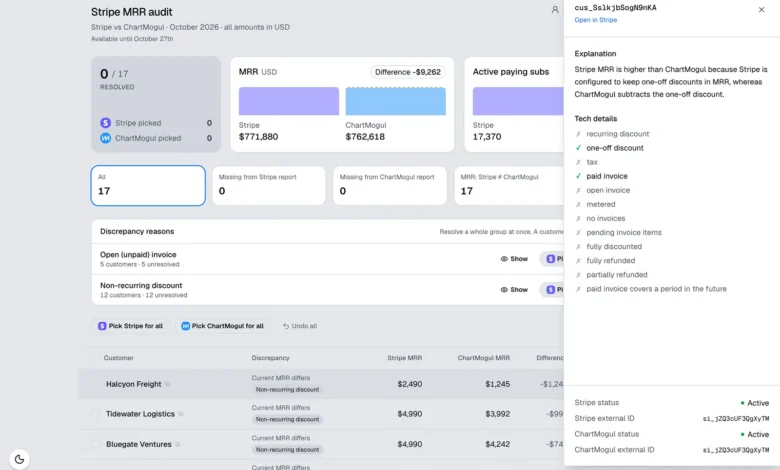
Announced by Jordan van Everdingen, Director of Sales, the newly introduced tool—accessible at mrraudit.com—fundamentally transforms how businesses audit their revenue data. MRRaudit is designed to systematically compare Monthly Recurring Revenue figures reported in platforms like Stripe against those calculated in ChartMogul. Crucially, the tool does not merely highlight that a discrepancy exists; it groups these variances by root cause and articulates them in clear, plain language.
Every single calculated difference is directly linked back to the specific customer, the exact invoices involved, and the precise subscription events that triggered the variance, allowing financial stakeholders to inspect the underlying logic independently.
To understand the value of this transparency, consider a common real-world edge case: a customer agrees to upgrade to a $4,800 annual plan. In the course of processing this transaction, internal operations teams void the system-generated recurring invoice, replacing it with a custom one-off invoice that the client subsequently pays. In this scenario, Stripe may continue reporting $400 in MRR based on the underlying active subscription framework, while ChartMogul—detecting no corresponding recurring invoice—registers $0 in recurring revenue for that specific cycle. The customer has paid in full, yet the mechanical recording of the payment creates an analytical divergence.

Prior to the rollout of MRRaudit, uncovering this level of transactional granularity required hours of manual auditing. The new platform consolidates these insights into a single, unified dashboard, seamlessly illuminating discrepancies driven by complex variables such as refunds, promotional discounts, failed payment retries, usage-based revenue fluctuations, and ambiguous subscription statuses.
The Broader Challenge: Untangling Years of Billing History
As companies scale, their billing infrastructure naturally evolves. Over several years of operation, businesses frequently alter their pricing tiers, negotiate bespoke contract terms for enterprise clients, and migrate legacy customers across disparate billing schemas. Consequently, determining why two separate systems produce conflicting MRR figures often requires unearthing years of archived transaction history. Analysts must sift through legacy data to isolate timing differences, invoice errors, or nuanced events that Stripe, Chargebee, and ChartMogul interpret through different operational lenses.
The compounding nature of these historical billing complexities can paralyze executive decision-making. Elliott Fisher, Chief Operating Officer at Lavender, experienced this firsthand when attempting to answer a seemingly straightforward executive query.
“Our CEO asked a simple question: ‘What’s our ARR?’” Fisher recounted. “None of us could answer with confidence. We had to rebuild four years of Stripe invoice history from scratch. With MRRaudit, we could have found the differences ourselves in a fraction of the time and shown exactly what was behind the number.”
This sentiment resonates deeply across the broader SaaS landscape, where reliable financial reporting forms the bedrock of investor relations, board meetings, and operational planning. When executive teams lack confidence in core metrics like Monthly Recurring Revenue and Annual Recurring Revenue, strategic execution stalls.
Market Implications and Future Outlook
The launch of MRRaudit signals a strategic shift in the SaaS tooling ecosystem. By democratizing the audit trail, analytics providers are acknowledging that transparency is just as critical as calculation accuracy. When financial operators can independently trace a metric anomaly all the way down to a specific customer invoice without requiring deep engineering support or direct vendor intervention, friction dissipates and trust multiplies.
Furthermore, the deployment model of MRRaudit reflects modern software accessibility. Organizations can begin utilizing the audit framework without needing pristine, pre-cleaned data repositories or even an active subscription to ChartMogul. By lowering the barrier to entry for revenue reconciliation, the platform enables emerging and mid-market companies to establish financial hygiene early in their corporate lifecycles.
As the subscription economy matures, the demand for deterministic financial reconciliation will only intensify. Tools that bridge the gap between native billing infrastructure and sophisticated analytical engines will transition from nice-to-have utilities to essential components of the modern finance stack. By transforming a historically opaque administrative burden into an automated, transparent, and self-service workflow, MRRaudit establishes a new standard for data accountability in the SaaS sector.