The Ideal Length for Instagram Reels in 2026: New Data From 2.7 Million Posts Reveals Surprising Algorithm Trends

The debate surrounding the ideal length for short-form video content on social media has reached a critical juncture, particularly as platform algorithms evolve to balance user acquisition with community retention. For creators, marketers, and brands operating within the Instagram ecosystem, determining how long a Reel should be has long been a combination of trial, error, and anecdotal evidence. However, a comprehensive new empirical study released in late 2026 provides much-needed clarity, offering quantitative insights derived from an extensive analysis of millions of published posts.
Conducted with the assistance of data science teams, a recent large-scale investigation evaluated over 2.7 million Instagram Reels published through the social media management platform Buffer between January 1 and August 15, 2026. The findings challenge several long-held assumptions regarding short-form video performance, demonstrating that while ultra-short clips have dominated creator strategies for years, a specific sweet spot exists for maximizing distribution. Furthermore, the data reveals a distinct trade-off between expanding overall reach to new audiences and driving deeper engagement with existing followers.
Understanding Platform Limits and the Three-Minute Threshold
To contextualize the data, it is necessary to examine the technical boundaries currently established by Instagram. Over the course of recent platform updates, Instagram expanded its native video recording and upload limits, allowing users to publish Reels that run up to 20 minutes in length. This capability applies whether creators record directly within the in-app camera interface or upload pre-edited footage from external camera rolls.
Despite this expansive technical ceiling, a critical algorithmic caveat governs content distribution. Instagram officially restricts recommendation eligibility for longer videos: only Reels spanning three minutes (180 seconds) or less are eligible to be pushed to new audiences via recommendation channels such as the Reels tab, the Explore page, and the home feeds of non-followers. When creators upload a video exceeding the 180-second mark, the application issues a formal notification stating that the content will not be recommended to new users. While existing followers can still view, like, and comment on these extended videos, their organic discovery potential outside the creator’s immediate follower base is severely constrained.
This policy aligns with statements from leadership at Meta and Instagram, including Head of Instagram Adam Mosseri, who have consistently emphasized that Instagram does not intend to replicate the long-form video architecture of platforms like YouTube. Consequently, while the platform technically accommodates extended content, anything surpassing the three-minute threshold introduces significant distribution implications.
The Data: Which Reel Lengths Deliver the Most Reach?
In evaluating the dataset of 2.7 million posts, researchers sought to isolate the variable of video length from external distortions, such as the massive baseline followings held by celebrity accounts or major publishers. To achieve this, the methodology compared each individual account’s performance against its own historical baseline, measuring how specific duration buckets performed relative to the creator’s typical output.
The analysis categorized the content into six distinct duration tiers: under 15 seconds, 15 to 29 seconds, 30 to 59 seconds, 60 to 89 seconds, 90 to 179 seconds, and 180 seconds or longer.
The results indicated that Reels falling into the 90-second to 3-minute tier (specifically 90 to 179 seconds) achieved the highest overall reach, outperforming an account’s baseline by an average of 7.4%. Conversely, videos extending beyond the three-minute mark experienced a severe decline in distribution, registering a 49.3% drop in reach and a 45.9% reduction in overall views compared to the baseline.
Interestingly, the data demonstrated that for content under 90 seconds, duration played a relatively minor role in determining performance. Duration buckets ranging from under 15 seconds up to 89 seconds all landed within a narrow margin of approximately three percent of baseline performance in either direction. For instance, clips under 15 seconds performed 1.5% below baseline reach, while videos lasting 30 to 59 seconds performed 2.7% above baseline. Statistically, these minor variances suggest that micro-durations below the 90-second threshold matter far less to the algorithm than core creative variables such as hook strength, topical relevance, visual pacing, and overall production value.
The Reach Versus Engagement Trade-Off
While the data firmly establishes that mid-length videos (90 seconds to 3 minutes) excel at maximizing reach and discovery among non-followers, a contrasting trend emerges when analyzing audience engagement rates.
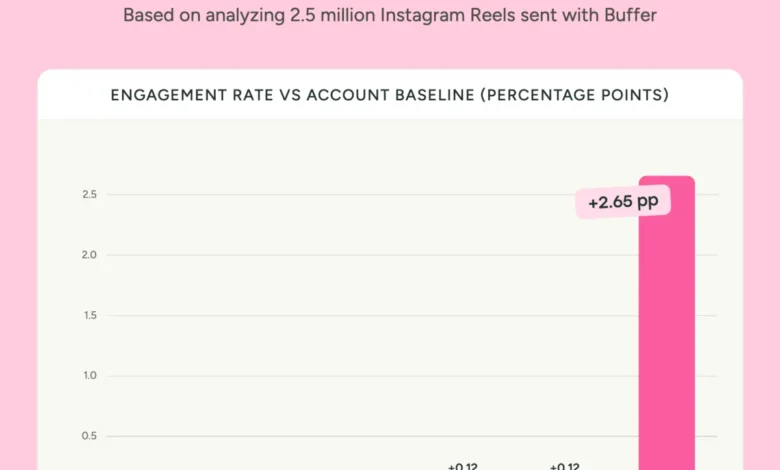
When evaluating interactions such as likes, comments, shares, and saves relative to audience size, videos exceeding the three-minute threshold demonstrated superior performance. Reels lasting 180 seconds or longer recorded an engagement rate 2.65 percentage points above their respective account baselines, representing the highest engagement return of any duration category analyzed.
This creates a clear strategic dichotomy for content creators:
- Maximizing Reach: Creators prioritizing top-of-funnel growth and audience acquisition should target a duration between 90 seconds and 3 minutes. This timeframe maximizes algorithmic distribution to non-followers while remaining compliant with recommendation guidelines.
- Maximizing Engagement: Creators focusing on community nurturing, educational tutorials, or in-depth storytelling tailored to an established following can successfully utilize longer formats (exceeding three minutes). While the total number of unique viewers decreases, the audience members who choose to watch the entirety of the video exhibit significantly higher intent and interaction rates.
This dynamic closely mirrors parallel studies conducted on other content formats, such as Instagram carousels, where broader distribution formats often yield lower per-user engagement compared to niche, high-intent formats.
Comparative Analysis Across Major Platforms

As cross-platform content distribution becomes standard practice for digital marketers, understanding how Instagram Reels compare to competing short-form video ecosystems is essential for workflow efficiency.
TikTok currently permits in-app recordings of up to 10 minutes and uploaded videos of up to 60 minutes, providing the most permissive timeline for long-form vertical video. YouTube Shorts maintains a strict three-minute maximum duration cap, automatically categorizing any uploaded video exceeding three minutes as a standard long-form YouTube video rather than a Short.
Instagram’s current structure bridges these approaches: it allows long-form uploads up to 20 minutes for internal community building, but mirrors YouTube Shorts by enforcing a strict three-minute ceiling for algorithmic recommendation to new users. For multi-platform creators, adhering to a sub-three-minute standard remains the most frictionless approach for multi-posting without requiring platform-specific edits.
Methodological Rigor and Statistical Safeguards
To ensure the integrity of these conclusions, the Buffer data science team applied rigorous statistical filters to the initial pool of over 3.7 million successfully published Reels. To eliminate skewing caused by viral outliers—where a single monster post might artificially inflate averages—both reach and view metrics were log-transformed prior to comparative analysis. Furthermore, engagement rates were capped at the 99th percentile (approximately 54.8%) to neutralize mathematical anomalies caused by posts with extremely small denominator counts.
Accounts were required to have published a minimum threshold of posts across multiple duration categories to qualify for comparative evaluation. This methodological framework ensures that the observed trends reflect genuine algorithmic weighting rather than random statistical noise or the influence of mega-influencers.
Strategic Implications for Content Creators and Marketers
As social media algorithms continue to mature in 2026, the data underscores the necessity of aligning content length with specific marketing and communication objectives. Creators can no longer rely on arbitrary duration choices or assume that shorter is universally better.
For brands seeking broad market visibility, structuring narratives to fit comfortably within the 90-second to three-minute window offers a statistically supported advantage. Meanwhile, complex educational content or narrative-driven brand storytelling retains a vital place in the content mix, provided expectations regarding top-of-funnel reach are adjusted in favor of deeper community engagement. Ultimately, while duration serves as a vital structural variable, empirical evidence confirms that substance, pacing, and audience alignment remain the definitive drivers of digital media success.